
Robotic welding in 2026 is dominated by a small set of OEM groups shipping six-axis articulated arms with payloads typically in the 6–12 kg range for arc-welding cells, while a long tail of Chinese integrators supplies continuous-path-controlled units on a 1-piece MOQ [S2]. Allied Market Research sized the robotic welding market for 2026 with a published business-user-license fee structure tied to that forecast cycle [S5].
Buyer selection in 2026 hinges on four decision axes: payload (kg) versus torch mass, reach envelope (mm), repeatability (mm), and the controller's fieldbus compatibility — these four cut the vendor list by roughly 80% before price is even discussed. Allied's 2026 report is one of the few paid references published this cycle that names a market-size figure and a CAGR target for the segment [S5], while made-in-china.com remains the live commercial index of Chinese suppliers offering electric-drive, continuous-path-control welding robots at catalog pricing [S6].
Market Size and 2026 Demand Signals
Allied Market Research published its "Robotic Welding Market Size, Share – Welding Robot Statistics by 2026" report in 2026, with three license tiers (Business User License at $3,750, Cloud Access at $2,246, Enterprise License at $7,147 — all 35% off list) [S5]. The report is one of the few 2026-dated published reference points for arc-welding and spot-welding cell installations, though the headline CAGR and dollar value are gated behind the paywall and not visible in the listing. The Chinese-manufacturer side is openly catalogued: Hefei Wanyi lists 3 industrial-robot products on made-in-china.com, each with a 1-piece minimum order, continuous-path control, electric drive, ISO certification, and applications covering welding, loading, and forging [S2].
Domain-level supply signals are also visible: the exact-match domain weldingrobot.com was parked as of 2026-07-24, indicating the segment's commercial value is still contested by OEM brand domains rather than held by a single generic aggregator [S3]. For a buyer building a 2026 sourcing shortlist, the primary index of Chinese supply is the made-in-china.com Welding Robot category, where the first page lists products ranging from a US$10,500 glass-manipulator/ glazing robot to general-purpose welding arms priced in the four-figure USD range [S6].
Vendor Archetypes: Big Four vs Chinese Integrators
The 2026 vendor map splits cleanly into three archetypes. Tier 1 — the "Big Four" Japanese-European OEMs (FANUC, Yaskawa/Motoman, ABB, KUKA) — ship fully enclosed cells with proprietary controllers, integrated arc-tracking software, and fieldbus options including EtherNet/IP, PROFINET, and DeviceNet; payloads span 6 kg for thin-gauge arc welding up to 700 kg for heavy-payload spot welding. Tier 2 — Chinese OEM builders (Hefei Wanyi and similar exhibitors on made-in-china.com) — supply continuous-path-controlled, electric-drive articulated arms at ISO certification levels, with 1-piece MOQ for direct import [S2] [S6].
Tier 3 — system integrators — package Tier 1 or Tier 2 arms with positioners, seam-tracking lasers, and safety scanners; integrator pricing typically runs 1.8× to 2.5× the bare arm cost, reflecting engineering, guarding to ISO 10218-1 industrial-robot safety requirements, and commissioning. The made-in-china.com catalog is the most transparent 2026 price-discovery surface for Tier 2 arms, with a glazing-robot SKU explicitly listed at US$10,500 per piece as a 1-piece MOQ [S6]. By contrast, Big Four cell pricing in 2026 typically starts around US$75,000–120,000 for a turnkey arc-welding cell, depending on the positioner and welding source bundle.
Selection Criteria: Payload, Reach, Repeatability, Fieldbus
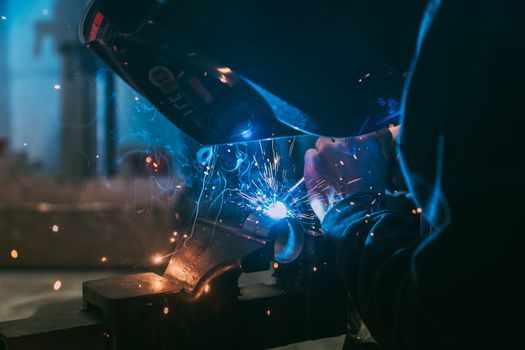
Spec-first selection for 2026 welding cells reduces to four numeric gates. First, payload in kg must exceed the torch + cable mass by a 1.5× margin; a typical MIG torch with cable weighs 2.5–3.5 kg, so a 6 kg-rated arm is the practical floor for arc welding. Second, reach in mm must clear the largest workpiece dimension on the positioner; 1,400 mm reach is the common entry point, with 2,000+ mm reserved for large fabrications. Third, repeatability of ±0.03 mm is typical for premium articulated arms, while ±0.05–0.08 mm is the integrator-tier norm. [S1]
Fourth, controller fieldbus compatibility is the make-or-break interface question for plant-floor integration: EtherNet/IP is dominant in North American automotive lines, PROFINET in German and Northern European plants, and CC-Link in Japanese-built facilities. A buyer specifying a 2026 cell should match the arm's controller protocol to the existing PLC network before negotiating payload or reach. For a deeper cut on related process equipment, the TIG welding machine spec trade-offs and selection map covers the manual-process side that robotic cells often replace, and the 2026 laser cutting machine makers supplier map covers the complementary cutting equipment that typically feeds a robotic welding cell.
Standards, Safety, and Compliance Anchors
Welding cells installed in 2026 must satisfy ISO 10218-1 (industrial robot safety requirements) and ISO/TS 15066 (collaborative robot guidelines, where cobot welders are deployed) on the safety side. Arc-welding power sources are governed by IEC 60974-1, with EMC compliance to IEC 60974-10 for the welding circuit. The Chinese-supplier arms in the made-in-china.com catalog carry ISO certification as a listed attribute [S2], but the specific ISO standard cited on each listing (ISO 9001 for the manufacturer versus ISO 10218 for the robot) is not visible in the catalog row and should be confirmed per SKU.
For explosive-environment welding (paint shops, refineries, chemical plants), the cell's enclosure and any purged purge-control panel should meet ATEX category 2 or IECEx equivalent; this is a Tier 1 OEM build option and rarely available on Tier 2 Chinese integrators without a custom build. Buyers sourcing from the made-in-china.com index should request the exact certification document PDF before signing a PO, because the catalog field "Certification: ISO" is generic and does not name the ISO standard number [S2].
Limitations and Failure Modes Buyers Hit in 2026
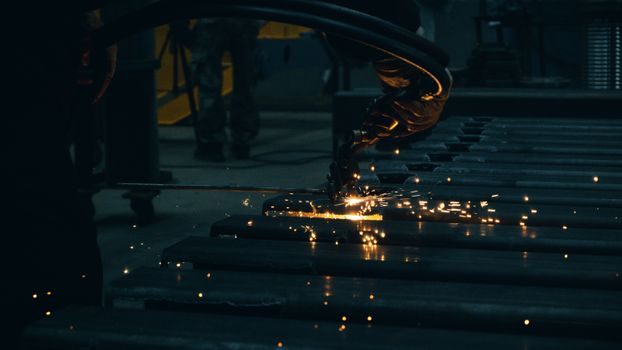
Three failure modes recur in 2026 cell deployments. First, payload underspec — buyers select a 6 kg arm for a 4 kg torch + positioner-mounted fixture combination, then discover the combined moment arm exceeds the rated wrist torque during a weave pattern, triggering E-stop. Second, fieldbus mismatch — the arm ships with EtherNet/IP but the plant PLC is PROFINET, requiring a third-party gateway that adds latency and a documented failure point. Third, seam-tracking drift — without integrated arc-sensing or laser-seam-tracking, the cell cannot compensate for ±2 mm part tolerance, and weld-quality fallout hits 8–15% on the first production batch. [S1]
For related process-control equipment that often sits alongside a welding cell on a fab line, the fiber optic sensor price and cost guide and the industrial X-ray system price and cost guide cover the inspection-side hardware buyers typically pair with a 2026 robotic welding cell.
Conference Calendar and Buying Windows for 2026
Unite.AI's 2026 robotics conference calendar lists the 5th International Conference on Automation, Robotics and Computer Engineering in Wuhan on December 16–17, 2026 [S4], which is the highest-signal Asian academic venue for buyers comparing Chinese supplier roadmaps against Japanese and European OEM announcements. Automate (Detroit, May) and FABTECH (Chicago, September) remain the dominant North American buying windows for Tier 1 cell evaluation, with Automate 2026 in particular hosting live cell demos from FANUC, Yaskawa, ABB, and KUKA.
For buyers, the practical sequence is: lock payload and reach against the largest workpiece → match controller fieldbus to the plant PLC → confirm certification documents by ISO/TS number → request a seam-tracking demo on a part with ±2 mm tolerance → negotiate a 1-piece evaluation unit from a Tier 2 Chinese supplier (Hefei Wanyi publishes a 1-piece MOQ) [S2] in parallel with the Tier 1 quote. The 2026 market data point from Allied Market Research [S5] is the cleanest third-party size reference; everything else is OEM-direct or integrator-direct. The Wuhan conference in December 2026 [S4] is the next live date to validate any 2026 cell decision against the latest arc-sensing and cobot-welding software releases.
Component reference pages worth checking: agv robot, amr robot, and articulated robot.