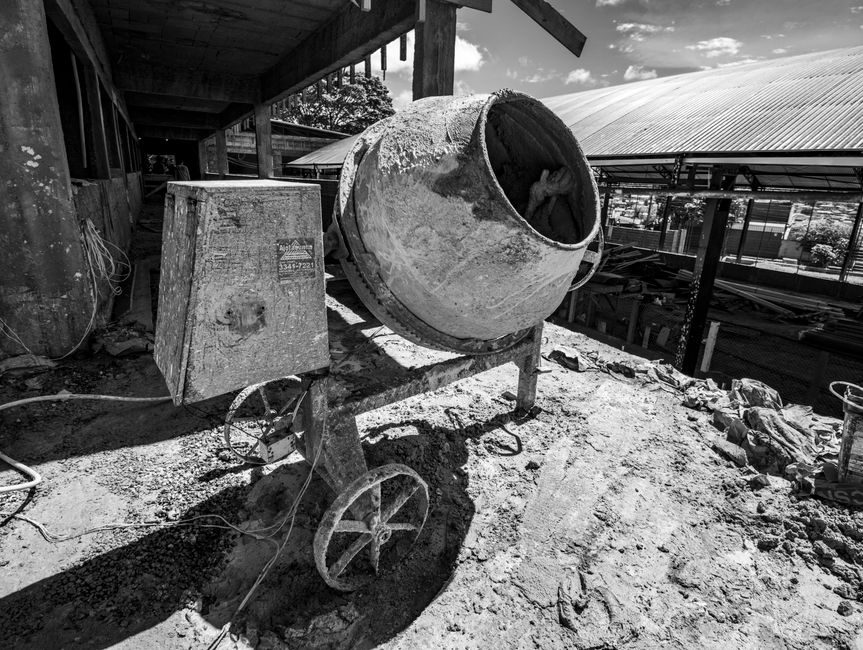
A concrete batching plant is a stationary or mobile dosing-and-mixing installation with measured outputs commonly quoted in the 25–240 m³/h band, while a concrete mixer truck is a revolving-drum carrier with practical drum capacities in the 4–14 m³ range — the two machines sit on opposite ends of the concrete supply chain and are almost never substituted for one another [S1][S7].
Chinese OEMs including Semix, Haomei, HAMAC, Minrui and Henan NF continue to ship both product lines from the same factory footprint, with 6 m³ / 8 m³ / 9 m³ / 10 m³ / 12 m³ / 14 m³ truck-mixer variants and parallel stationary / mobile batching-plant catalogues listed on their June 2026 product pages [S1][S2][S6][S7].
Functional Boundary: Plant Mixes, Truck Hauls
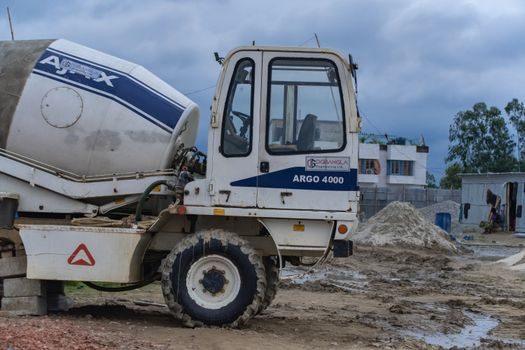
The batching plant is the metering and mixing node: it weighs aggregates, cement, water and admixtures against a recipe and discharges fresh concrete into a truck chute or a site bucket. The truck-mounted concrete mixer does not dose — it keeps already-mixed concrete homogeneous by slow drum rotation (typically 2–6 rpm mixing, 6–15 rpm agitating) and delivers it within a working window usually bounded by 90 minutes of drum time before slump loss and setting risk become unacceptable. [S1]
A concrete batching plant configured for ready-mix output is sized in cubic metres per hour (m³/h), not cubic metres of payload. Semix ships truck-mounted drum mixers in 7 m³ to 12 m³ nominal capacity and the same brand publishes batching plants that scale into much higher hourly throughput, which is the first tell that "capacity" means different things on each side of the chain [S1].
Capacity Numbers: m³/h vs m³ of Drum
Concrete mixer truck capacity is drum volume. Semix publishes a 7 m³ minimum and 12 m³ maximum for its SM9 truck-mounted hydraulic lightweight drum line, with the "lightweight" claim coming from hydraulic drive rather than gear drive [S1]. Minrui's June 2026 product table lists 4, 6, 8, 9, 10, 12 and 14 m³ truck mixers as in-line catalogue options, with 14 m³ and 12 m³ positioned as the heavy-end flagship drums [S7].
Batching plant capacity is hourly output. Haomei and Henan New Ways list mobile and stationary batching plants with theoretical outputs running from small 25 m³/h trailer units up to 120 m³/h and beyond, paired with twin-shaft compulsory mixers whose per-batch volume is normally 0.5–4.0 m³ [S2][S3][S8]. Because a single 12 m³ truck needs only a few minutes to load, plant output rarely bottlenecks on the truck — it bottlenecks on the mixer, aggregate bin geometry and the truck fleet size waiting under the discharge hood.
Mobility: Stationary, Mobile, Trailer-Mounted
Batching plants split into three mobility classes that the truck line does not have. Stationary plants are skip-hoist or belt-conveyor fed and intended for permanent foundations at a ready-mix yard; mobile plants are containerised or skid-mounted with their own chassis so they can be relocated between job sites; trailer-mounted plants are the smallest tier, sized for short civil works such as bridges, canals and small dam pours [S2][S8][S9]. Haomei explicitly markets the mobile class for "constructions like bridges, dams, concrete roads, canals & other civil works" where a permanent plant cannot be justified [S8].
Mixer trucks are all mobile by definition, but the truck-mounted concrete pump is a separate machine class that bolts a boom-and-piston pump onto the same chassis family. HAMAC's June 2026 catalogue lists concrete batching plant, stone crushers, concrete mixers, concrete pumps and pump trucks as five distinct product lines on a shared supply base, which is the cleanest cross-reference for buyers trying to keep terminology straight [S6].
Selection Criteria: Throughput vs Haul Distance
Pick the plant first, then size the truck fleet to it. An HZS60-class 60 m³/h plant paired with 8 m³ mixer trucks (as listed among available truck sizes) requires roughly eight truckloads per hour of continuous output to keep the drum fed, while an HZS120-class 120 m³/h plant paired with 12 m³ trucks needs about ten truckloads per hour, and because the 12 m³ truck carries 50% more concrete than the 8 m³ truck (12 ÷ 8 = 1.5), the binding constraint shifts toward axle load, route geometry, and road-class permits. Haomei's mobile-batch-plant catalogue positions the 25–120 m³/h band for "civil works" while warning buyers to match the truck fleet to the plant's discharge cycle, not the other way around [S9].
Buyers running a single project with a fixed pour rate should read the plant's m³/h figure as a hard ceiling and the truck's m³ as a divisor; the resulting integer is the standing truck count. Buyers running distributed pours — a road, a high-rise, a precast yard — should read the concrete pump truck reach and the truck's agitating-time window as the real binding limits, because slump loss on a 45-minute haul in 30 °C ambient is what kills the pour, not the plant's rated output [S6][S7].
Power and Drive: Electric Plant, Diesel/Hydraulic Truck

Stationary and most mobile batching plants run on mains three-phase electric for the mixer motors, screw conveyors and aggregate weigh hoppers, with a diesel generator as the optional standby. Mixer trucks are different: the drum is almost always hydraulically driven from a power take-off (PTO) on the truck engine, which is why Semix markets its SM9 line as "hydraulic / lightweight" rather than electric [S1]. HAMAC, Minrui and Haomei all list CE / CCC / ISO certifications on the same 2026 product pages, and the certification that matters for the truck is chassis-level (vehicle type approval) while the certification that matters for the plant is machinery safety and EMC [S6][S7][S8].
The power mixer class — heavy twin-shaft compulsory mixers in the 1–4 m³ per-batch band — is the energy hot spot inside the plant, not the truck. Henan New Ways lists twin-shaft mixers as a standalone product line alongside the batching plant, which is a useful tell that the mixer and the plant are bought (and serviced) as separate items even when shipped together [S3].
Standards, Certification and Quality Systems
ISO 9001 is the floor for the Chinese OEM segment: Haomei, Henan NF and HAMAC all publish ISO 9001 status on their June 2026 corporate pages, and Minrui goes further by stacking CE, CCC and ISO on the same certification block [S2][S4][S6][S7]. CE is the mandatory conformity mark for export to the European Economic Area; CCC is the China Compulsory Certification for the domestic market and for chassis-equipped vehicles; ISO 9001 is the quality-management system, not a product safety mark.
Buyers writing a 2026 spec should not treat ISO 9001 as a product-performance guarantee — it is a process guarantee. The product-level performance figures (m³/h, m³, slump retention, weighing tolerance) belong on the OEM's type-test report, not on the certificate wall. For a deeper look at the plant-side selection gates, the Concrete Batching Plant Selection: Six Spec Gates That Decide the 2026 Build reference works through the same plant numbers buyers need to validate before sign-off, and the Concrete Batching Plant Buying Guide 2026 pairs output, mixer and mobility into the same decision tree.
Failure Modes and Constraints Buyers Underestimate
The most common batching-plant failure is aggregate moisture: a plant rated at 60 m³/h with sand at 6% surface moisture can drop effective output by 8–12% if there is no inline moisture probe correcting the water set-point. The most common mixer-truck failure is slump loss on a long haul, which is a time-and-temperature problem, not a machine problem. Henan NF and Minrui both publish three-year warranty and "lifetime spares" language on their June 2026 corporate pages, but the warranty does not cover aggregate or ambient-condition damage — buyers need to read the exclusion list, not the headline [S4][S7].
The sand mixer and dry-mortar mixer class is a third product line that shares the plant's weighing and conveying hardware but is configured for sand-cement pre-blends, not structural concrete. Elitemortar's June 2026 product page lists single-shaft paddle and double-shaft non-gravity dry-mortar mixers as the mainstream configurations in this adjacent class, which is useful context for buyers who need a mortar line alongside the structural-concrete plant [S5].
Decision Map: Which One, and How Many
Use this four-criterion cut to keep the plant and the truck on the right side of the budget: [S2]
Criterion 1 — Output unit. Plant = m³/h, truck = m³ of drum. If the user's problem is "how many cubic metres per hour can I deliver," the plant is the answer. If the problem is "how many cubic metres can I move in one load," the truck is the answer.
Criterion 2 — Job duration. Plant fits a pour rate measured in months; truck fits a haul measured in minutes. Long-life fixed yards buy stationary plants; short civil works buy mobile or trailer-mounted plants, and the truck fleet is sized to the plant's hourly output.
Criterion 3 — Power source. Plants are electric (with optional diesel standby); trucks are diesel-hydraulic with a PTO drum drive. Spec the electrical infrastructure for the plant and the chassis spec for the truck — they do not overlap.
Criterion 4 — Certification. Plant certifications are machinery-safety + EMC; truck certifications are vehicle type approval + chassis homologation. A CE-marked plant is not a CE-marked truck, and a CCC chassis is not a CCC plant.
Buyers who hold the line on those four criteria will not confuse a m³/h figure for a m³ figure, will not spec electric drives for a truck drum, and will not assume a single ISO 9001 certificate covers both machines. Verify the type-test report, the chassis homologation, the slump-retention curve and the aggregate moisture-correction method before sign-off; treat the 2026 OEM product page as a starting point, not a closing argument.