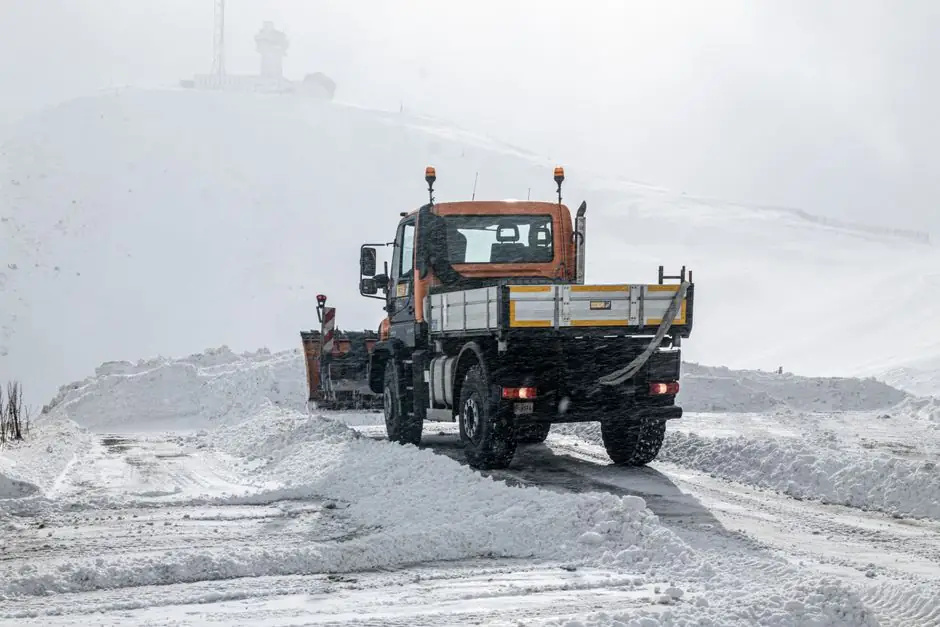
A concrete pump truck brings three attributes that snow contractors need: a heavy-duty multi-axle chassis (typically 26,000–63,000 lb GVWR), a powerful on-board diesel for hydraulic-driven accessories, and a four- to six-axle footprint with strong front-axle weight ratings for pushing a plow.
The mismatch is reach, not traction. A boom-folded pump truck runs roughly 38–45 ft long, so lane-width residential routes, cul-de-sacs, and tight parking decks are non-starters; the same chassis excels on arterials, industrial lots, and airport perimeter service roads [S3][S4].
Chassis Class and GVWR Threshold
Snow-plow OEMs and fleet guides converge on a minimum chassis rating: a 1-ton (Class 4, ~14,000 lb GVWR) is the entry point for routine residential/commercial plowing, and Class 7–8 chassis (26,000–63,000 lb GVWR) are standard for municipal and contractor plows pushing 10–14 ft blades [S4][S7]. A truck-mounted concrete pump typically sits on a Class 8 (33,000+ lb GVWR) tractor or a Class 7 (26,001–33,000 lb) straight chassis, which already exceeds the minimum plow-rated threshold.
Front axle weight is the second number that matters. Hiniker and other truck-plow makers publish fitment data keyed to front GAWR because the plow's downforce and impact loads transfer through the front axle; a typical Class 7 concrete pump chassis carries a 12,000–16,000 lb front GAWR, which accepts 8.5–11 ft straight or V-plow installations [S4].
Attachment Interface: Plow, Blower, and Spreader
Three snow-removal subsystems are commonly combined on a heavy chassis, mapped by the 2026 Keeyak selection matrix: front-mounted snowplow (continuous side-displacement on open pavement), powered snow blower (deep or compacted drift relocation), and metered de-icing material spreader (ice prevention rather than physical removal) [S3]. On a pump-truck chassis the front-mount push frame and hydraulic pack are the easiest retrofit, while a rear pintle-hitch spreader or a belly-mount blower pairs with the existing hydraulic PTO circuit.
Commercial snow pushers start at 8 ft and extend past 20 ft for box-style containment blades, sized to the carrier's hydraulic flow and weight class [S5]. For a Class 7–8 concrete pump chassis, a 10–14 ft front straight plow or 12 ft V-plow is the common commercial fit, paired with a 1.5–3.0 kW electric or hydraulic rear spreader rated for rock salt, calcium chloride, or pre-wetted brine [S3][S4].
Route Fit: Where a Pump Truck Works, Where It Does Not

Use case fit: airport perimeter service roads, industrial parks with 24 ft+ lanes, port container yards, and arterial state routes with 12 ft+ shoulders, where the boom-folded length is acceptable and the chassis weight improves plow bite [S3]. The same heavy chassis is also useful for hauling de-icing aggregate between yard and route, a logistics task a pickup-based plow truck cannot perform [S5].
Not a fit: cul-de-sacs under 50 ft radius, parking decks with posted weight limits (typically 4,000–6,000 lb per axle for residential structures), and dense residential streets where the 38–45 ft envelope blocks intersections. In these scenarios a pickup-based 1-ton plow truck is the correct tool, not a concrete pump chassis [S4][S7]. For a comparison of how carrier selection changes the snow-removal calculus across machine types, see wheel loader selection for snow removal: size, attachment, and traction spec map.
Decision Comparison: Concrete Pump Truck vs Other Snow Carriers
Four decision criteria line up the main snow-removal carrier options against the concrete pump truck: route length/radius, attachment hydraulic demand, payload for de-icing material, and off-season utilization [S3][S5][S6].
Criteria 1, route geometry: pickup (1-ton, 19–22 ft) wins on residential cul-de-sacs; wheel loader (compact, 12–18 ft envelope) wins on mid-size lots; dump truck (Class 7–8, 28–35 ft) wins on arterials; concrete pump truck (38–45 ft boom-folded) wins on industrial yards and airport perimeters [S3][S4][S6]. Criteria 2, hydraulic demand: a snow blower needs 25–50 gpm at 3,000+ psi, which a pump truck's hydraulic reservoir already supplies; a pickup needs an auxiliary pump and 15–25 gpm. Criteria 3, payload: a concrete mixer or dump body carries 8–14 cu yd of salt/sand versus 1.5–3 cu yd on a pickup spreader, so the heavy chassis wins on aggregate haul between yard and route [S5]. Criteria 4, off-season utilization: a concrete pump truck earns its keep nine months of the year on pour work, then converts to a seasonal snow asset, which solves the equipment-utilization problem contractors cite when justifying off-season snow work [S5].
Standards, Hydraulics, and Safety Constraints
Heavy chassis plow work sits at the intersection of two compliance regimes: on-road vehicle weight and dimension rules (state-specific, often mapped to FHWA bridge-formula limits) and OSHA 1910.132 PPE plus ANSI/ASAE S276.x loader attachment guidance for hydraulic-driven snow implements. Hydraulic plows and spreaders are matched to chassis specs published by the plow maker's "Match My Truck" database, which is the practical engineering gate before any front-mount installation [S4].
Operators should confirm three items before converting a pump truck for snow: (a) front GAWR vs plow-downforce + ballast, (b) hydraulic reservoir capacity vs combined plow/blower/spreader flow demand, and (c) visibility and mirror coverage with the plow mounted and boom folded for road travel. The boom must be fully stowed and pinned before any road transit, and most fleet SOPs require a second worker as a spotter for any reverse motion in a lot [S3][S4].
Limitations and Failure Modes
The two most common failure modes on a re-tasked pump truck are front-axle overload from undersized ballast and hydraulic overheating during continuous blower duty. A Class 7 chassis with a 14,000 lb front GAWR carrying an 11 ft steel plow needs at least 2,000–3,000 lb of rear ballast to stay within the manufacturer's published front-rear weight distribution, and the engine should be run at 1,200+ rpm PTO speed to keep the hydraulic fluid below 180 deg F under continuous load [S3][S4]. A third constraint is tire chain clearance: pump-truck steer tires are often low-profile highway tread and need dedicated winter tire or chain programs before sustained icy operation [S6].
A fourth, less obvious limit is municipal permitting. Some jurisdictions require a snow-vehicle license plate or commercial route permit for any chassis over 26,000 lb GVWR operating on residential streets; re-tasking a pump truck for snow routes should be cleared with the local DPW before the first storm [S3][S4]. For mixed-fleet buyers comparing a concrete pump truck to other heavy carriers on the same jobs, the concrete mixer truck selection for demolition projects: spec map and magnetic drive pump vs concrete pump truck: a 2026 spec map articles document how chassis spec shifts between roles.
Trackable signals to watch: OEM fitment database updates from Hiniker, Fisher, and BOSS for 2026–2027 Class 7–8 plow SKUs [S4], municipal RFPs combining pump-truck-hauled de-icing routes with concrete pour contracts [S1][S5], and SAE J1739 frame-rail stress guidance for combined plow/boom loading, which has been a recurring engineering review topic for heavy chassis retrofits.
The underlying component specifications are covered under concrete mixer truck.