
An aerial work platform (AWP) is OSHA-defined under 29 CFR 1910.67 as a vehicle-mounted elevating and rotating device for personnel, with extensible boom, articulating boom, aerial ladder, and vertical tower configurations each subject to design conformance with ANSI A92.2-1969 for units acquired on or after July 1, 1975 [S1]. Field commissioning therefore starts with model identification, then outrigger pad verification, pre-use inspection, and clearance from overhead power, in that order.
Selection comes first, before any unit touches the ground: required work height, total platform load (workers plus tools plus materials), ground bearing capacity, indoor versus outdoor rating, and access geometry all cut the equipment list before installation begins [S4]. A scissor lift rated 18-63 ft platform height suits level indoor slab work, while an articulating boom in the 38-136 ft class or a telescopic boom in the 52-138 ft class handles outdoor reach over obstacles [S2].
Standards That Govern AWP Installation
OSHA 29 CFR 1910.67(b)(1) requires that aerial lifts acquired on or after July 1, 1975 be designed and constructed in conformance with ANSI A92.2-1969, with pre-1975 units barred from service after July 1, 1976 unless retrofitted to that standard [S1]. For construction sites the companion rule is 29 CFR 1926.453 (Aerial Lifts), and the Oklahoma State University EHS program additionally references ANSI/SIA A92.3, A92.5, and A92.6 for manually propelled, boom-supported, and self-propelled elevated work platforms respectively [S3].
Field modifications are permitted only when certified in writing by the manufacturer or a nationally recognized testing laboratory as conforming to ANSI A92.2-1969 and at least as safe as the original configuration [S1]. The term "aerial device" under 1910.67(a)(1) covers any vehicle-mounted telescoping or articulating (or both) personnel-positioning machine, while a "platform" is the basket or bucket that actually carries the occupant, so any retro-fit must keep that platform-rated envelope intact [S1].
Outrigger Pad and Ground Preparation
OSHA 1910.67(c)(2)(iv) requires brakes set, outriggers positioned on pads or a solid surface, and wheel chocks installed before the aerial lift is used [S1]. A practical acceptance target is a bearing pressure below the manufacturer-stamped outrigger pad rating, typically expressed in kPa or psi on the data plate, with cribbing added when asphalt, soft soil, or turf would otherwise exceed that limit.
Ground assessment must verify levelness within the manufacturer's slope envelope (commonly 0-5 degrees for self-propelled units), absence of drop-offs closer than the chassis footprint, and clearance from excavations, manholes, and curb edges that could shear an outrigger foot [S5]. A scissor lift on a finished slab can usually be set with chocks only, but a boom lift above 80 ft working height almost always demands full outrigger deployment on rated pads, and operators must read the model-specific manual before transport or repositioning [S2].
Pre-Use Inspection Sequence
Each shift requires a documented pre-use inspection covering hydraulic and fuel systems for leaks, guardrails, gates, and chains for integrity, tires for inflation and damage, control panels for smooth labelled response, emergency stop and manual lowering, warning label legibility, and visible cracks or rust in welds [S4]. Oklahoma State University's EHS program formalizes this as Section D of the Aerial Lift Manual, requiring the inspection checklist to be filed so EHS can monitor program effectiveness [S3].
Function tests follow the static inspection: emergency stop must arrest all motion within the OEM time, the manual lowering valve must bleed the platform to ground at controlled rate, and the tilt or level sensor must inhibit elevation when the chassis exceeds its rated slope [S5]. A unit with any failed check is removed from service until the defect is corrected and re-tested, and the inspection record travels with the machine across shifts.
Type Comparison: Scissor, Articulating Boom, Telescopic Boom
Scissor lifts move purely vertically with a guardrail system, travel with platform lowered unless the manufacturer explicitly permits elevated travel, and are the lightest, most indoor-friendly option but cannot reach over obstacles [S5]. Articulating booms (38-136 ft platform height per Haulotte) add a knuckle joint to swing up and over, with horizontal outreach typically 20-40 ft depending on model, and they are the default for facility maintenance and tree work [S2].
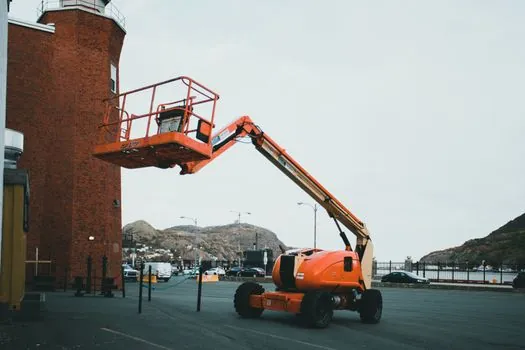
Telescopic booms (52-138 ft) trade the up-and-over articulation for straight-line horizontal reach up to 80 ft or more, suited to shipyards, steel erection, and large facades where the operator needs maximum envelope without re-swinging [S2]. Boom-supported lifts in either class create ejection, crushing, and snag hazards that scissor lifts do not, so fall-arrest attachment to the manufacturer's designated anchorage is mandatory on booms, while scissor fall protection is governed by the equipment design and company procedure [S5]. For deeper selection context on adjacent access equipment, the ZLP suspended platform spec map covers a different access family, while the industrial surveillance camera selection for work at height piece pairs with boom work where ground-level spotters need visual coverage. For site logistics, see road roller installation and pre-run commissioning for slope-protocol comparisons that share the same levelness acceptance logic.
Clearance From Energized Lines and Overhead Hazards
OSHA 1910.67(b)(4) routes operators to 1910.333(c)(3) for minimum approach distances to energized overhead lines, which for 50-345 kV typically requires 10 ft plus 0.4 inch per kV above 50 kV of clearance, scaled by the specific voltage present [S1][S5]. Insulated aerial devices (1910.67(a)(5)) are designed for live-line work but only when rated and configured for the line class, and they do not waive the approach distance for adjacent uninsulated booms or non-electrical personnel.
Aerial ladders must be secured in the lower traveling position by the locking device above the truck cab, plus the manually operated device at the base of the ladder or equally effective means, before any highway travel [S1]. On the work pad, the operator walks the boom path before elevation to confirm no overhead structure, awning, tree, or conductor can trap or crush the platform against an immovable surface, since boom geometry can swing the basket laterally by tens of feet during a single reposition.
Operator Training and Documentation
OSHA and ANSI/SIA require formal training before any worker operates an AWP, with hands-on practice that covers model-specific operating procedures, inspection technique, emergency rescue, and personal protective equipment including harness and lanyard use [S4]. Oklahoma State University codifies this as Section G of its Aerial Lift Manual, which specifies retraining on program revisions and tracks the inspection forms that EHS uses to monitor program effectiveness [S3].
Records should include the operator's training date, the specific AWP categories authorized, the most recent pre-use inspection checklist, and any field-modification certificates issued under 1910.67(b)(2)(ii) [S1][S3]. When a unit is sold, rented, or transferred, these records move with it, and the receiving party should re-verify outrigger pad rating, slope envelope, and ANSI A92.2 conformance before the first elevation on a new site.
When To Stop and Escalate
Escalate to a qualified mechanic (not a field fix) when hydraulic fittings show weeping that returns after torque, when the tilt sensor fails to inhibit elevation on a known-sloped surface, when the manual lowering valve will not bleed the platform smoothly, or when any structural weld shows a visible crack [S3][S4]. Replace, do not repair, any guardrail section, anchor point, or outrigger pad that has been permanently deformed, and tag the unit out of service until OEM parts are fitted.
For higher-elevation commissioning, field-modification certification must be in writing from the manufacturer or a nationally recognized testing laboratory before the modified configuration is used, and the certification must explicitly state conformance to ANSI A92.2-1969 [S1]. Acceptance signals to track going forward: revised ANSI A92 series updates (the A92.22 / A92.24 suite covering training and integrated systems), tighter 1910.67 enforcement citations, and OEM-published data-plate harmonization across scissor, articulating, and telescopic families.
The underlying component specifications are covered under aerial work platform, aerial work truck, and linear guide.