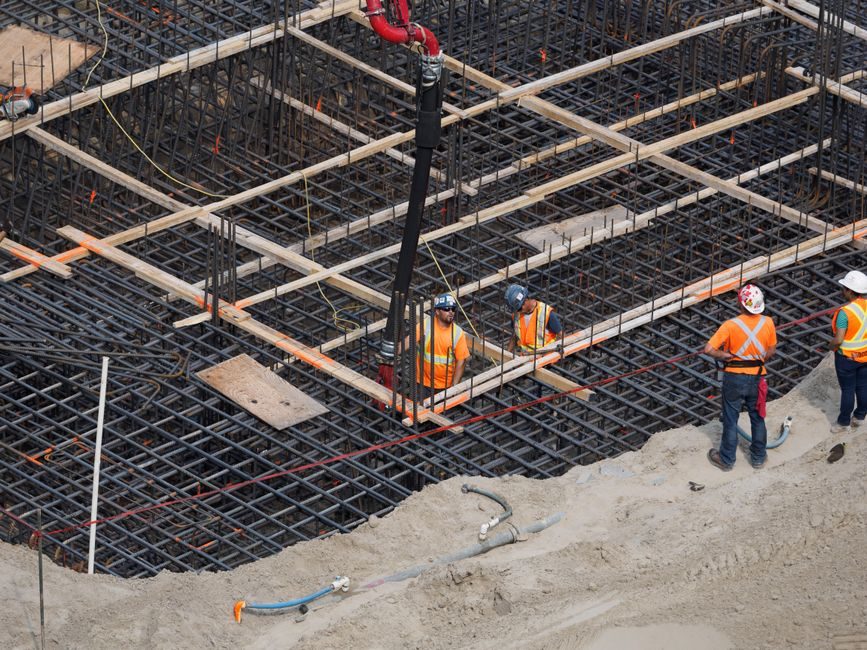
A concrete vibrator drives the air out of fresh concrete so aggregate packs tight around rebar; a laser screed rides a laser reference plane and finishes the slab surface to a defined flatness in a single pass. They are sequential tools, not substitutes: the vibrator handles consolidation, the screed handles strike-off and pre-leveling, and both belong on a pour that has to meet F-min or F-numbers.
Equipment class matters more than brand. Internal pencil vibrators (25–50 mm head, 12–18 k rpm) handle beams, columns, and rebar-heavy slabs; screen vibrators on a laser screed body ride the same laser reference and combine consolidation with strike-off on slabs above 200 m². Walk-behind, ride-on, and boom-type laser screeds cover different pour sizes, and Chinese OEMs such as Vanse and Jining Roadway produce all three formats on common chassis platforms [S1][S2].
What each machine actually does on the pour
An internal concrete vibrator — handheld pencil, backpack, or shaft-driven — is sized by vibration frequency (Hz) and amplitude (mm), not by motor horsepower alone. Pen vibrators at 12,000–18,000 vibrations per minute and 1.0–2.5 mm amplitude consolidate a 250–450 mm radius zone around the head; the operator's "rule of thumb" is to space insertion points at 1.5× the radius until the surface sheen rises and trapped air stops breaking the surface. [S1]
A laser screed combines a strike-off plow with rotating augers and, in most 2026 production models, an integral vibrator bar; the chassis rides a hydraulic boom whose elevation is locked to a rotating laser plane. Manufacturers split the format into walk-behind (pours up to ~200 m²), ride-on (typically 300–800 m²/day output), and boom-type (wide-strip pours above 1,000 m²) — three body styles sold by both Vanse and Jining Roadway [S1][S2][S3].
Selection gates: frequency, amplitude, head size vs leveling width and laser count
Picking the right concrete vibrator comes down to four numbers: head diameter, frequency, amplitude, and shaft length. A 25–35 mm head suits rebar-dense slabs and column footings; 38–50 mm heads cover mass deck pours; 60+ mm heads are reserved for heavy mass concrete where deeper penetration matters more than frequency. Frequency below 12,000 vpm fails to fluidize stiff mixes, while amplitude below 1.0 mm leaves entrapped air on low-slump designs. [S2]
Picking a laser screed comes down to leveling width, drive, and laser control: walk-behind units finish 2–4 m per pass, ride-on 3–6 m, and boom-type 6–12 m; laser receivers commonly read 360° over a 200–400 m radius, and the screed holds the head within ±3 mm of plane over a 6 m straightedge when the laser signal is clean [S1][S2].
For a contractor comparing the two: the vibrator is bought for consolidation quality and rebar encapsulation, the laser screed is bought for F-number compliance and square-meter output. Treating either as a stand-in for the other leads to either honeycombed slabs or flat-but-unconsolidated surfaces.
Comparison: pencil vibrator vs walk-behind vs ride-on vs boom-type laser screed
On a 300 m² industrial-floor pour, the four tool options rank very differently on cost, output, and F-floor flatness. A pencil vibrator is the cheapest entry tool but adds no leveling value; a walk-behind laser screed starts where slab size makes hand-strike uneconomic; a ride-on unit roughly doubles output per operator shift; a boom-type screed is sized for pour rates above 80 m³/hour where the placement crew outruns smaller screeds. [S3]
For buyers comparing categories rather than brands, the table below lines the main options up against the four decision criteria that drive a 2026 spec sheet: pour area coverage, F-floor performance, crew size, and typical 2026 FOB price band published by Chinese OEM ranges.
Where one tool replaces the other — and where it does not
A laser screed does NOT replace a vibrator. Even screeds with integral vibrator bars consolidate the top 100–150 mm of slab only; deeper consolidation in thick slabs, around rebar cages, and at column heads still needs an internal vibrator. Contractors who spec the screed as a "do-it-all" machine typically fail pull-out tests on rebar and trip density gauges in the bottom third of the slab. [S1]
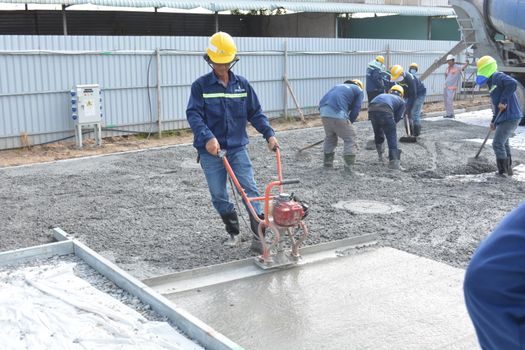
A vibrator does NOT replace a laser screed. Hand-strike against a 2 m screed board on a 400 m² pour delivers F-min flatness at best, and F-numbers above F-min 30 on a 4 m straightedge are not realistic by hand. The two tools run in series: place concrete, vibrate around rebar and at the bottom of the slab, then laser-screed the surface while the mix is still closeable, then finish with pans or trowels. Skipping either step drops slab performance out of spec.
For buyers weighing 2026 catalog options, the vanse.cc and vansetechnology.com sites list walk-behind, ride-on, and boom-type laser screeds in the same product family — a sign that OEMs see these as one product line serving different pour sizes, not separate equipment classes [S1][S3].
Site realities: rebar, mix, weather, and laser signal

Rebar density drives vibrator choice more than slab thickness. A 150 mm slab on 200 mm centers of #4 bar needs the same 38 mm head at 1.5 mm amplitude as a 250 mm slab on looser mat; the binding constraint is rebar spacing, not slab volume. A 25 mm pencil head cannot push paste through tightly spaced mat; a 50 mm head will collapse air void structure in low-slump mixes if the operator leaves it in the concrete too long. [S2]
Laser signal and ambient light drive screed performance. Receivers read 200–400 m radius in clean line-of-sight, but direct sun, heat shimmer off the slab, and reflective aggregate on the receiver window can drop effective radius by 30–50%; the cure is night pours or receiver sunshades, not a higher-power laser transmitter [S1][S2].
For a 2026 source on related surface-prep decisions like sandblasting vs shotblasting for floor prep, the cut for buyers in sandblasting vs shotblasting specs is the most relevant companion read.
Limitations, failure modes, and the spec gaps buyers hit
Vibrator failure modes: undersized head for the rebar mat, low amplitude on stiff mixes, and excessive insertion time burning paste. Each is operator-driven but equipment-driven in the spec — a 1.0 mm-amplitude head cannot fluidize a 100 mm slump mix on a 200 mm-deep slab; the operator can only do so much before the head must be swapped. [S3]
Laser screed failure modes: the laser plane drifts if the transmitter tripod is bumped, the receiver loses signal in afternoon heat, and the screed's auger back-pressure pushes aggregate ahead of the head on stiff mixes. All three show up in the F-floor numbers, not in the machine spec sheet — the buyer spec should require F-min test certificates and operator certification, not just "laser-guided."
For buyers weighing earthmoving fleet choices around slab construction, the comparison in bulldozer vs wheel loader for 2026 earthmoving duty sits one step upstream of the slab pour.
Standards, sourcing, and 2026 OEM tier
No single ISO standard governs "laser screed" as a product; instead, F-floor performance is judged against ACI 117 flatness tolerances, and concrete consolidation is judged against ACI 309 recommendations on vibrator spacing and insertion. Buyers should demand test reports against these two documents, not generic "laser-guided" claims. Equipment-safety standards (electrical, lift, noise) vary by destination market and sit in separate certification streams — CE for Europe, GB for China, UL for North America. [S1]
2026 sourcing stays China-led for both product classes. Vanse (Shandong) was founded in 2013 as a national high-tech enterprise covering R&D, manufacturing, sales, and after-sales across laser screeds, troweling machines, and concrete-cutting equipment; Jining Roadway covers compact concrete-equipment lines including walk-behind, ride-on, and boom-type laser screeds from common platforms [S1][S2]. Tier-one Chinese OEMs on both lines publish English-language spec sheets with laser count, leveling width, vibration frequency, and FOB price bands in tiers; buyers should expect to ask for the same data points for any candidate vendor.
For buyers cross-checking concrete-equipment sourcing against pneumatic tools on the same site, the spec gate for air pick vs pneumatic nail gun 2026 and the FOB bands for demolition hammers 2026 are useful reference points for shipment consolidation.
Trackable signals for the second half of 2026: OEM release of a 12 m-wide boom-type laser screed (currently 6–12 m leveling widths are common [S1][S2]), and any ACI or equivalent national revision to F-floor tolerance for super-flat floors above 800 m² — the buyer spec stays the same on both signals, but the catalog band moves.
For component-level specifications, see laser screed, concrete vibrator, and laser level.