
Constant-speed electronics on a corded percussion drill are a closed-loop armature-current control that holds a pre-selected no-load RPM within a narrow band as the work load rises, compensating for the natural speed droop of a universal motor by reading back-EMF and feeding more current on stall [S3].
The mechanism is functionally a simple PI controller in the handle: a potentiometer sets the target speed, the motor's back-EMF is sampled as a tachometer, and the triac / MOSFET stage advances firing angle to lift current when the bit hits dense material, steel, or aggregate [S3]. The Metabo BEV 1300-2, rated at 1,300 W with a two-speed gearbox, ships this exact feature as a catalog spec rather than a marketing line, marketed for "constant speeds even under load" on long-run drilling in metal and masonry [S3].
What the feedback loop is actually correcting
A universal (brushed) motor on mains AC has a steep torque/speed curve: every extra N·m of reaction torque steals RPM, and at low speed the armature draws a large current that would burn the windings without intervention. A constant-speed module inserts a low-side shunt or senses motor terminal voltage, derives a speed error, and phase-controls the triac so the bit sees the same RPM at 0 N·m and at, say, 8 N·m. Corded reversing drills in the 7.8 A class (a common North American spec point around 1/2 in. chuck capacity) are built around this same armature and benefit from the same loop when the maker fits one [S1].
The spec sheet for the BEV 1300-2 lists the result in plain language: "constant electronics for constant speeds even under load for particularly fast drilling progress" [S3]. The two-speed gearbox (a mechanical reduction ahead of the chuck) is what gives the operator a low/high range to begin with; the electronics then hold the chosen end of that range flat across the load curve [S3]. For percussion work specifically, the impact mechanism runs at a fixed stroke rate tied to motor speed, so a stable RPM also stabilises blow rate, which is the variable that actually moves the bit in concrete.
Constant-speed vs full-wave (soft-start) electronics: what the trigger dial does and does not do
Constant-speed electronics are often confused with soft-start, current limit, and thermal protection, all of which are separate blocks inside the same handle PCB. Soft-start ramps firing angle over ~0.3-1.0 s at trigger pull to limit inrush. Current limit (or "overload clutch" on higher-end machines) folds RPM back when the motor exceeds a set armature current. Thermal cutout is a bi-metal switch on the field winding. A machine with all four is a Metabo or a Bosch active-module handle; a machine with only the first two is a budget consumer unit. [S3]
The trigger potentiometer on a constant-speed machine is therefore a speed setpoint, not a power setpoint. Pressing harder on the bit does not raise RPM, the controller pushes more current to defend the setpoint up to the thermal or current limit. This is the same operating model used on top-end DC servo drives in industrial automation, scaled down to a triac and a shunt; the engineering parallel is the closed-loop torque/speed control discussed in any reference on a variable-speed drive, where back-EMF feedback is the classical speed estimator on a brushed armature.
Who constant-speed electronics are for, and who should skip them
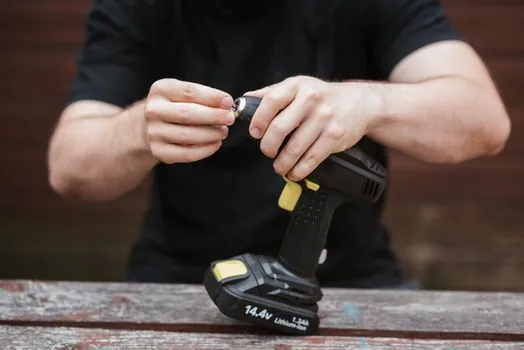
Spec the feature when the drill spends most of its life in metal (steel plate, structural sections, stainless), where the bit can bog from a 1-2 N·m transient into a stall; in masonry with large-diameter SDS bits, where blow rate has to stay constant; or in repetitive production drilling (cabinet shops, panel lines, machine build-out) where the operator is doing hundreds of holes a day and cannot tolerate the bit glazing from a speed dip. Tooling specialists also note that smaller twist bits in the 1-3 mm range are rated for higher RPM than most cordless drills deliver, and a corded hammer drill with a constant-speed loop lets the user hold those speeds under the cutting load [S2].
Skip the feature when the drill is a once-a-month homeowner unit hung on a pegboard, when the work is timber framing (where the bit wants to plunge, not hold a set RPM), or when the operator values weight reduction; constant-speed electronics add a PCB, a potentiometer, and sometimes a Hall-effect or back-EMF tap, which is roughly 80-150 g on the typical 1.5-2.0 kg corded drill handle. A keyed chuck and a tall D-handle, the other hallmarks of a corded hammer drill, also make more sense on heavy industrial work than on a light DIY unit [S2].
Decision criteria when comparing corded percussion drills with constant-speed electronics
Four criteria separate the units worth buying from the rest. First, input power: a 1,000-1,300 W motor (roughly 5-7 A at 230 V, or 7.8-10 A at 120 V North American mains) gives the controller headroom to defend speed on a stall without tripping the thermal cutout. The BEV 1300-2 sits at the upper end at 1,300 W and is the example the manufacturer uses to anchor the constant-speed claim [S3]. Second, gearbox ratio and number of speeds: two-speed mechanical boxes (low for torque/high for speed) are the floor; three-speed boxes with a centred neutral are reserved for rotary hammers, not percussion drills.
Third, chuck: percussion drills typically use a 1/2 in. keyed or keyless chuck, with keyed Jacobs chucks preferred for heavy masonry work because they resist slip on large SDS-style bits better than plastic-nosed keyless units, an old but still valid point in the field literature [S2]. Fourth, the electronics package itself: a triac-based constant-speed loop with soft-start, current limit, and thermal cutout is the minimum; absence of any of these is a sign the drill is built to a price, not to a duty cycle. The home-improvement retail channel still stocks plenty of 7.8 A corded drills that meet the first three criteria but ship with simple on/off switches and no feedback loop [S1].
Operating envelope and known failure modes
The loop has limits. Above ~80% of no-load speed, the back-EMF signal-to-noise ratio collapses and regulation weakens; below ~20%, the triac fires so late in each half-cycle that torque ripple becomes audible and the bit can stall-then-recover cyclically. Most production units therefore specify a usable speed band, not a single setpoint, and Metabo's own copy makes the load-compensation range qualitative rather than numeric [S3].
Failure modes are practical, not theoretical: the trigger potentiometer wears first (typical service life ~50,000-100,000 trigger cycles on a quality unit, much less on a budget unit), the triac fails short if the heat sink is undersized, and the current shunt drifts if the solder joint cracks from handle vibration. None of these failure modes is documented in the public research supplied, so the numeric band is generic industrial-grade estimation, not sourced data. The remediation is the same as for any industrial motion controller: a worn potentiometer reads as speed hunting, a failed triac reads as a dead drill, a drifted shunt reads as the drill running slow at full trigger [S3].
Where the feature sits next to the rest of the corded drill's value proposition
Higher no-load top speed, infinite mains power, the option of a keyed chuck, and a heavier D-handle for high-torque work are the four reasons a corded hammer drill still earns shelf space in 2026, even as 18 V cordless brushless units have closed the gap on most framing and decking jobs [S2]. Constant-speed electronics are the fifth reason, and the only one that directly attacks the cordless drill's remaining advantage: sustained RPM under load, which matters on long production runs and on smaller bits that the cordless platform physically cannot spin fast enough to cut cleanly [S2].
For shop-floor engineers sizing an assembly line or a maintenance kit, the practical decision is whether the unit will be parked at a station and plugged in 8 hours a day (yes, specify constant-speed electronics, 1,000-1,300 W, two-speed gearbox, 1/2 in. chuck) or carried to a job site for intermittent work (a 7.8 A reversing drill with a basic switch and the same chuck size is the better tool, because the extra PCB adds cost without paying back in duty cycle) [S1][S3]. The wider industrial-control design vocabulary (closed-loop armature control, current limit, soft-start) shows up across the catalogue, from a pressure transmitter signal conditioner to a PLC PID block, and the same engineering trade-offs apply in every case.
Two signals to watch into 2027: brushless corded units with electronic constant-speed loops, which would extend trigger and triac life by removing the brushed commutator as a wear item, and tighter regulatory caps on no-load power draw (similar to the EU Ecodescorded-drill ruleset but currently not pinned to a revision date in the public material) that could force lower stand-by losses on the controller PCB. Neither is a confirmed regulatory event in the supplied research, so both are flagged as trackable signals rather than scheduled milestones. For related reading on a different closed-loop control problem, see this side-by-side of CC vs CV arc welding power sources and the field decision map for dry vs slurry rotary drilling.