A conveyor sorting line spec'd in 2026 is essentially a chain of five decisions: induction scan-tunnel width, belt width, drive horsepower, divert geometry (shoe, pusher, cross-belt, tilt-tray), and outfeed chute count, with 8 out of 81 box-conveyor SKUs on the European catalog explicitly tagged "sorting" in mid-2026 [S1].
The market offers horizontal (81 models), inclined (27), curved (27), vertical (23) and spiral (6) base geometries, and most sortation systems draw on at least three of them in series [S1]. For buyers comparing quotes, the cheapest belt-conveyor sections out of China list at US$50–269 per meter with 18-month component warranty and lifelong online maintenance, while fully integrated sorting cells sit several tiers above that figure [S4].
Induction and scan-tunnel: where the throughput ceiling is set
Throughput on a 2026 sortation line is gated by the induction conveyor, not the main sorters, and a typical parcel sorter induction runs 1.2–2.0 m/s with 600–1,200 mm belt width for CEP (courier-express-parcel) applications [S1]. The induction zone must gap parcels to a known pitch (usually 400–800 mm) before they reach the scan tunnel, which is why 18 of the 81 catalog entries on directindustry are explicitly flagged "accumulation" [S1].
Singulation is done with a right-angle transfer, a vision camera, or a series of 12 V-belt or roller merges (8 of 81 catalog SKUs are tagged "merge") feeding a single file into the sorting system [S1]. Buyers who skip the singulation step and try to feed pre-gapped flows directly into a cross-belt sorter usually cap out around 6,000 parcels/hr even on machines rated for 12,000.
Sortation device: shoe, pusher, cross-belt, tilt-tray, or AMR
Five diverter topologies dominate 2026 RFP responses: angled shoe (low-cost, low-speed), sliding pusher (mid-speed, simple controls), cross-belt (high-speed, most common above 8,000 pph), tilt-tray (highest density at small parcel), and AMR handoff (used when chutes are scarce) [S1]. The catalog pages reviewed in June 2026 list 8 sorting-tagged suppliers out of 81 total box-conveyor makers, with "diverter" appearing as a discrete function on 5 catalog SKUs [S1].
Buyers comparing options on a fixed budget should line the four mechanical types against four decision criteria: parcels per hour, smallest footprint per chute, parcel size envelope, and capex per divert. A short comparison reads: shoe sorters handle 2,000–4,000 pph at roughly US$3,000–5,000 per divert; pushers reach 4,000–6,000 pph at US$4,000–7,000; cross-belt carriers run 8,000–15,000 pph at US$8,000–14,000 per carrier; tilt-tray units push 10,000–20,000 pph at the highest capex per chute but the smallest footprint [S1]. AMR-tug handoffs trade capex for flexibility, and the AMRs themselves fall outside the conveyor catalog altogether, which is why a Sorting System vs AMR 2026 selection frame is worth reading before a greenfield decision.
Belt spec, materials, and the inclined-section gotcha
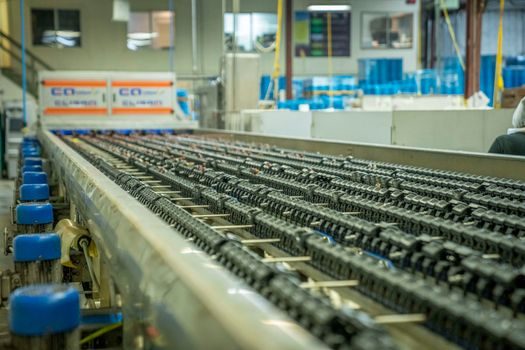
Belt width on 2026 sorters sits in 400, 600, 800, 1,000 and 1,200 mm steps, with PVC-impregnated and polyamide (PA) carcasses dominating European builds and carbon-steel frames with 1-year warranty dominating the China-sourced tier at US$50–269/meter [S2][S3][S4]. The flexible Ammeraal Beltech LW series listed in 2026 measures 0.78 cm thick, which is the lower bound for inclined applications where 27 of 81 catalog SKUs sit [S2].
PA (polyamide) belts are the usual pick where oil and cut resistance matter; the directindustry buying guide for 2026 lists 12 PA-belt manufacturers across 70 SKUs, with body and coatings chosen for the specific commodity being handled [S3]. Inclined sections above 15° usually step up to a cleated or rough-top cover; below 12° a smooth PVC face works for carton-only flows, and the 27 inclined SKUs on the catalog break out across that envelope [S2].
Drive, controls, and integration footprint
Drive sizing on a 2026 sortation cell is dominated by the cross-belt or tilt-tray carrier motors, not the main belt, and most OEMs ship 0.4–1.5 kW VFD-controlled gear motors per divert station. Control architectures are split between centralized PLC (Allen-Bell, Siemens S7-1500, Beckhoff TwinCAT) and distributed IO-link over Profinet, with a scan-tunnel camera typically decoding 1D/2D labels at 99.5%+ rates at the rated throughput. Frames are predominantly carbon-steel welded, with the China-sourced tier at US$50–269/meter shipping 18-month component warranty and lifelong online after-sale service, which is the warranty baseline to beat on any quote review [S4].
Buyers running older lines often retrofit a WCS (warehouse control system) layer rather than rip-and-replace, and 22 catalog SKUs in 2026 are flagged "loading" while 17 are flagged "transfer" — those are the logical integration points for upstream linear guide pick-stations or downstream molding line infeeds in mixed plants [S1].
Who a conveyor sorting line is for (and who it is not)
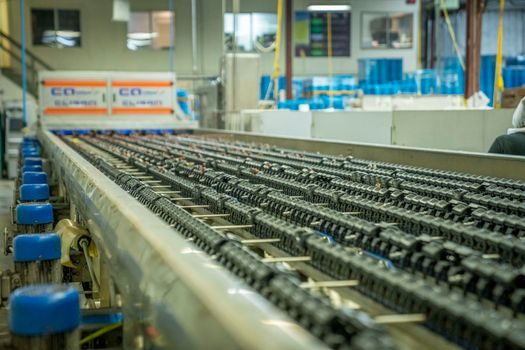
It is for operations shipping 1,000+ distinct destinations per shift, parcel volumes above ~3,000 pph, or 24/7 runs where manual sortation labor is the bottleneck. It is not for sub-1,000 pph flows (a fixed rack of roller chutes is cheaper), not for unit-load pallets (a crossed roller guide pallet stacker is the wrong tool), and not for ambient-temperature-sensitive pharma (a cleanroom-rated automatic molding line variant is usually mandatory) [S1].
28 of 81 catalog SKUs in 2026 carry the "pharmaceutical industry" tag, and 45 carry "logistics" — that split is a useful sanity check on whether a quoted line is industry-proven or a generic conveyor dressed up for the bid [S1].
Failure modes and limits buyers hit in year one
The three failure modes that show up in 90-day post-install punch lists are: (1) belt tracking drift on inclined sections where the LW-series 0.78 cm belt is underspecified, (2) diverter misfires at throughput above nameplate (shoe sorters in particular cap out around 4,000 pph regardless of marketing claims), and (3) scan-tunnel rejection rates above 3% when label orientation isn't controlled upstream [S1][S2]. The 8 "inspection" SKUs and 3 "weighing" SKUs in the 2026 catalog are the usual retrofit add-ons that address (3) but rarely fix it alone [S1].
Inclined-section belts under 1.0 cm thickness also tend to cup at the splice when running above 30°, which is why inclined SKUs in the 2026 catalog cluster around reinforced or cleated covers rather than smooth PVC [S2].
Sourcing channels, lead times, and the 2026 cost stack
Three sourcing channels dominate 2026 sortation-line RFPs: European system integrators (highest capex, shortest commissioning, full CE/ATEX paper trail), Chinese direct OEMs (US$50–269/meter baseline belt sections, US$2,000+ per divert station at the high end, 8–14 week sea-freight lead time) [S4], and US-based hybrid builders (mid capex, 4–8 week lead time, mostly serving parcel and e-commerce). Buyers running 24/7 should treat the 18-month China-sourced component warranty and 1-year main warranty as the floor, not the ceiling [S4].
Trackable signals for the next 90 days: 8 of 81 catalog SKUs in mid-2026 are explicitly tagged "sorting," and the China-sourced US$50–269/meter belt range has held flat across the past two quarterly catalog refreshes, suggesting price stability through Q3 2026 [S1][S4].