
Electronics-handling sorting lines differ from parcel sortation in three measurable ways: belt surface resistivity must sit in the static-dissipative band (typically 10^6 to 10^9 ohm per ESD S541), product pitch is short (75-300 mm common for boxed handsets, PCBs, and accessories), and induction is rarely used because the parts are not metallic singles [S1][S2].
Current OEM build sheets from conveyor and sortation system suppliers show modular belt conveyors, cross-belt sorters, narrow belt sorters, and swivel wheel sorters as the four platform choices carried as standard catalogue items for this segment, with ICONVEY listing all four under its Sortation Conveyor Systems menu [S3]. The selection question for an electronics plant is which platform combination hits the throughput, footprint, and ESD targets without overpaying for pharmaceutical-grade stainless frames it does not need.
Define the product envelope before picking a sorter
Sortation accuracy is governed first by product dimensions and weight, not by belt speed. Cross-belt sorters typically handle items from roughly 100 x 100 mm up to 600 x 800 mm at 30-60 sorts per minute per carrier, and they carry the discharge belt on a moving carrier loop that diverts at fixed angles (commonly 30 or 90 degrees) [S3]. Narrow belt sorters work in a smaller window (about 50 x 50 mm to 400 x 400 mm) and run faster, in the 60-120 units/min range, because the carriers are lighter and track tighter [S3]. Swivel wheel sorters are the lowest-cost divert for parcels above 300 mm and are not normally specified for small electronics unless the SKU is a router or set-top box.
For PCB trays, blister-packed accessories, and boxed handsets under 400 mm length, the narrow belt sorter and the cross-belt sorter are the two credible answers. The decision should be made on three numbers: peak items per minute, longest item length, and the worst-case divert angle available in the building layout. Cross-belt needs a straight run of roughly 1.5-2.0 m before the discharge wheel to develop carrier speed, while narrow belt units divert inside a much shorter footprint (often 0.6-0.9 m) [S3].
Belt class, resistivity, and ESD control
Electronics sorters must use static-dissipative belt materials because a single 100 V discharge through an ungrounded IC handling line can latch-up CMOS or damage MOSFET gates. Standard catalogue options for ESD-controlled lines are PU (polyurethane) impregnated fabric belts with surface resistivity in the dissipative range, antistatic PVC, and modular plastic belting (PP or POM) with conductive fillers [S1][S3]. Carbon-loaded PU is the most common in this segment because it keeps a low coefficient of friction for small-box tracking and dissipates charge through embedded grounding brushes or a grounded steel slider bed.
Frame grounding is not optional. The conveyor frame must bond to the facility ESD ground bus with a measured resistance under 1.0 ohm at the drive end, and idler pulleys need conductive lagging or grounded brushes at every change of direction where the belt separates from the pulley. A practical spec to put on a purchase order: belt surface resistivity between 10^6 and 10^9 ohm measured per ESD S541, frame-to-ground resistance below 1.0 ohm, and stainless or zinc-plated steel slider bed where the product rests. material handling integrators such as Progress Material Handling explicitly list belt, chain driven live roller, and ball transfer tables as part of their conveyor build menu, which is relevant when the line needs right-angle transfers that preserve ESD continuity [S1].
Throughput math and divert logic for electronics
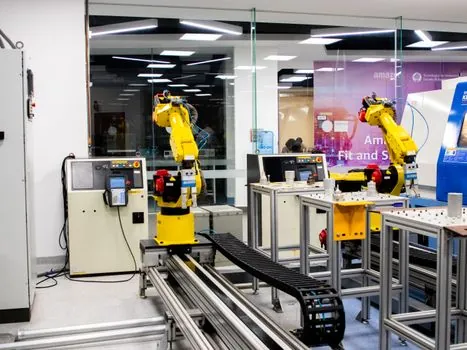
Sortation throughput scales linearly with linear speed and product pitch, but the limiting factor on most electronics lines is the divert decision time, not the belt. A vision-based bar code or QR read at 30 frames per second with a 200 mm read window at 1.5 m/s gives roughly 133 ms of read time, which is enough for a 2 of 5 industrial code or a Data Matrix; 1-D high-density codes on small labels need a higher-resolution camera or a laser scanner, otherwise read failures drive mis-sort rate up. Collaborative Conveyor's case work on low line pressure accumulation is directly relevant here, because accumulation zones in front of diverts must release product without back-pressure that would misalign a 75 mm pitch box on the belt [S2].
For a typical consumer electronics DC shipping 20,000 units per shift over 8 hours, the required steady-state rate is 42 units/min, with peaks of 60-70 units/min during wave releases. A single narrow belt sorter running at 60 units/min with 100 mm pitch covers steady state and most peaks; a cross-belt sorter at 40 units/min covers the same average but with a longer dwell window for the read, which is the right call when mis-sort cost is the dominant expense. conveyor sorting line capacity tables from ICONVEY's sortation product line list these platform choices without committing to throughput numbers, leaving the integrator to size against the SKU mix [S3].
Frame, motor, and cleanroom considerations
Electronics assembly is not cleanroom-grade semiconductor fab work, but it is cleaner than general parcel sortation. ISO Class 8 (formerly Class 100,000) is the common spec for handset and accessory packing areas, and it drives three hardware choices: powder-coated or stainless steel frames instead of painted mild steel, sealed-for-life gear motors (IP65 minimum) rather than open drip-proof units, and belt materials that do not shed. Aluminium extrusion frames with plastic corner caps and snap-on covers, as standard on ICONVEY's modular belt conveyor line, are widely used in this segment because they allow re-configuration without welding [S3].
Drive selection for a sorter carrier loop typically lands in the 0.75-3.0 kW range, with 24 V DC motorized drive roller (MDR) sections used on the take-away conveyors to keep the control panel simple and let each zone ramp independently. Progress Material Handling's product menu explicitly lists motorized drive roller, belt driven live roller, and chain driven live roller as standard build types, which is the same vocabulary used on most electronics DC lines [S1]. For 24 V MDR sections the typical roller diameter is 50 mm with 1.5-2.0 m section lengths, and each section carries about 35-50 kg of product at 0.3-1.5 m/s.
Comparing the four sorter platforms for electronics
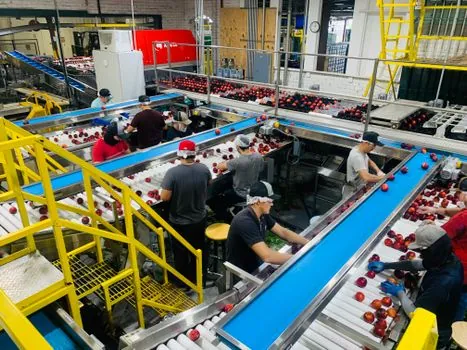
Cross-belt, narrow belt, swivel wheel, and modular belt sortation each map to a different cell in the product-size vs. throughput grid. Cross-belt handles the widest product range (roughly 100-800 mm) at moderate speed; narrow belt is the fastest on small items (50-400 mm) at the cost of divert precision; swivel wheel is cheapest and is used for medium-to-large items above 300 mm where high-friction diverts are acceptable; modular belt sorting systems are usually specified when the conveyor itself must also serve as the sorter, which is a low-throughput but very flexible configuration [S3]. For a 30-120 items/min electronics line, the credible platform set is narrow belt and cross-belt; swivel wheel is out for handsets, and modular belt sortation is out unless the line is short and the SKU count is high.
Cost direction follows the same order: swivel wheel and modular belt sortation are the lowest cost per divert station, narrow belt is mid-range, and cross-belt is the most expensive because each carrier is a complete moving belt mechanism. Lead time on cross-belt sorter carriers is typically 10-14 weeks from European or US OEMs, while modular belt and swivel wheel can ship in 4-6 weeks from regional fabricators in India and China [S3][S4]. Advance Equipment Co. in Thane describes its own conveyor and elevator product range (belt, roller, slat, chain, screw, bucket) as built around standard precision bearings for loads of 250 kg and above, which sets the local supply baseline for non-sorter sections of an electronics line [S4].
Integration, controls, and the upstream feeding problem
The sorter is the visible part of a sorting system, but on electronics lines the constraint is usually upstream: the merge from multiple packing stations into a single pitch-controlled lane. Induction conveyors with singulators, gap control, and barcode or vision read at the merge define whether the sorter runs at rated throughput or sits idle waiting for product. A practical build for a 60 units/min sorter is two infeed conveyors each at 30 units/min, merged through a right-angle transfer onto a single lane with a 200 mm read window, then a 1.0-1.5 m gap-creation zone before the divert. The Modular Belt Sorting System and the Cross-belt Sorter listed on the same product menu are normally sized together for this reason [S3].
Controls typically use a PLC with a fieldbus stack (PROFINET or EtherNet/IP), and the sorter's divert logic runs off a tracking encoder so each carrier knows its position relative to the discharge chute. ESD monitoring is a separate I/O layer: ground-bond resistance on each sorter station is read back to the PLC, and a high-resistance alarm drops that divert out of service until a tech verifies the bond. Collaborative Conveyor's published case on cleanroom conveyor systems for headlight lens coating and curing is a useful analogue, because the same stainless frame and sealed-for-life motor choices carry over to a clean-adjacent electronics DC [S2].
Limitations, failure modes, and what not to specify

Cross-belt sorters are not the right call for products below 100 mm or for any item that can snag on a moving discharge belt edge, and they lose accuracy above about 90 units/min per carrier loop because the divert decision window shrinks. Narrow belt sorters jam on products above 400 mm, and their belts wear faster than flat modular belts because the carrier bearing surface is small. Swivel wheel diverts mark soft-pack SKUs and cannot handle bagged product. Modular plastic belts shed under UV and degrade in oil mist, so they are out for any line that sees coolant or stamping oil carry-over from upstream cells. [S3]
For a spec-first buyer, the most common over-spec is the pharmaceutical-grade stainless frame and IP66 wash-down motor on what is actually a dry ISO Class 8 packing area. Stainless adds 30-60% to frame cost, and IP66 motors add 20-40% over IP65 sealed units, with no measurable reliability gain unless the line sees daily wash-down. The most common under-spec is omitting frame-to-ground bonding or specifying a dissipative belt without specifying a grounded slider bed underneath; the belt dissipates, but if the bed is painted mild steel the charge has nowhere to go and the line fails an ESD audit at first measurement. storage handling upstream of the sorter is also a frequent weak point, because tote queues feeding the induct conveyors sit on painted racks that re-charge the totes between stations.
Two trackable signals to watch before the next PO: OEM-published sortation throughput curves for narrow belt and cross-belt units on sub-300 mm electronics SKUs, and the revision status of ESD S541 belt-resistivity test methods. Both will reset the spec floor on a quote refresh within the next two quarters, and any sorter vendor selling into electronics DC work will be updating their standard product sheets against those signals. For related spec-first work on chemical shipping sortation, see Spec-First Conveyor Sorting Line Selection for Chemical Shipping Operations, and for the cleanroom and hygiene dimension of pharmaceutical sortation, see Pharma Distribution Conveyor Sorting: Spec Map, Hygiene Rules, Throughput Cuts.