
Core drilling machines recover intact rock cylinders through a rotating annular diamond bit while a stationary inner barrel holds the sample, with current production rigs covering 100-400 m depths at 152-1,016 mm (6-40 in) hole diameters [S1][S2]. Rotary drilling rigs, by contrast, are built to displace volume: they drill and remove cuttings from large-diameter holes for water wells, piling, and mine dewatering rather than recover core [S2][S7].
The two classes share hydraulic powerpacks and crawler or truck carriers, but diverge sharply on rotation speed, torque, mast geometry, and tooling. Specifying the wrong class costs a project weeks of rework — a core rig cannot install a 600 mm casing, and a rotary piling rig cannot deliver a clean NX-size core for assay.
Operating Envelope: Depth, Diameter, Sample vs Cuttings
The Acker Drill Company MARK III HILLBILLY diamond core rig weighs 1,461-1,764 kg (3,221-3,889 lb) on a skid frame measuring 100 in long x 40 in wide x 64 in moving height, with a 4-speed transmission delivering 201 / 416 / 761 / 1,286 RPM at the spindle [S1]. The hydraulic drill head offers 30 in (76 cm) spindle travel and a 3-5/8 in (92 mm) ID spindle bore sized for NX-series wireline tooling, with an optional 750 ft (228 m) wireline hoist for 3/16 in (4.8 mm) cable [S1].
Foremost's DR-24HD dual rotary rig targets the opposite end of the envelope: 400 m (1,312 ft) depth, 152-1,016 mm (6-40 in) diameter, truck-mounted, with a gear-driven lower drive producing 2.5x the torque of the standard DR-24 [S2]. Foremost acquired the dual rotary technology from Barber Industries in 1993 and has refined it for municipal/industrial water wells and mine dewatering [S2]. The DR-24HD is one of several models in the Foremost DR family, alongside the DR-12, DR-24, and DR-40 covering different diameter and depth bands [S2].
Head Assembly, Power Pack, and Carrier
Core rigs use a high-speed, low-torque rotary head optimized for diamond bit cutting efficiency — the HILLBILLY tops out at 1,286 RPM and pairs with a 48 HP @ 3,000 rpm three-cylinder diesel power unit and 12 V electric start [S1]. Spindle-style core drills such as the Chinese XY-5/5N, XY-6B/6N, and XY-8 rely on full-hydraulic drives with variable displacement pumps and motors for stepless speed control, suiting both high-speed small-diameter diamond drilling and high-torque low-speed engineering work [S10].
Rotary drilling rigs run the inverse profile: low RPM, high torque, and large-diameter toolstrings. The DR-24HD stacks two counter-rotating drives — a top-drive and a gear-driven lower drive — that simultaneously rotate the casing and the inner drill string in opposite directions, letting casing follow the bit through overburden without casing-advancer tooling [S2]. Chinese suppliers such as Shandong Tenggong International Trade and Jiangsu Wuxi Mineral Exploration Machinery (Jiangsu XiTan, founded 1956, registered capital 20 million) also build rotary piling and CFA rigs in this class [S7][S8].
Tooling System: Wireline Core Barrel vs Auger / Bucket
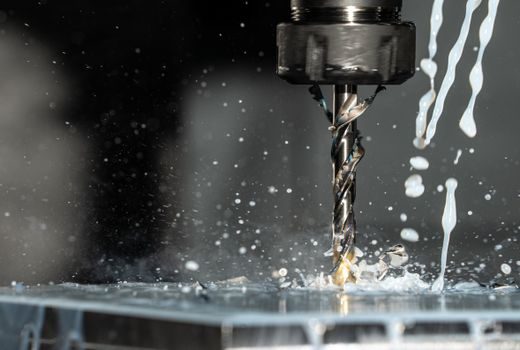
Core rigs centre on a wireline core barrel: an outer barrel advances with the bit while an inner barrel stays stationary to capture the intact cylinder, and the inner assembly is retrieved to surface through the drill string on a wireline cable without tripping rods [S1][S2]. Acker's optional Ackermatic "H" chuck handles rods and casings up to 3-1/2 in (88.9 mm) OD, and the HILLBILLY's swivel head and 360-degree drill head allow angled holes [S1]. Chinese manufacturers Changsha Miracleland Drilling and Wuxi Jinfan Drilling supply matched core bits, core barrels, reaming shells, and drill rods to pair with these rigs [S5][S6].
Rotary rigs use continuous flight augers (CFA), drilling buckets, or roller-cone bits to evacuate cuttings through the annulus or through the tool's hollow stem. On the Foremost DR-24HD, cuttings rise between the drill pipe and casing and exit through a discharge swivel at the top of the casing, with an optional cyclone collector slowing the discharge for continuous formation sampling [S2]. Tilting top-drives let the operator add pipe at ground level, reducing manual handling on deep large-diameter holes [S2].
Application Matrix: Where Each Class Fits
Spec a core drilling machine when the deliverable is an intact rock or soil sample for geological logging, assay, or geotechnical lab testing — mineral exploration, geotechnical site investigation, and engineering rock-mechanics studies all depend on continuous, oriented core recovery [S1][S6]. Small-hole wireline systems (NQ, HQ, PQ) dominate hard-rock mineral exploration, while trailer- or skid-mounted hydraulic core rigs cover 200-400 m geotechnical and water-investigation boreholes [S1][S6].
Spec a rotary drilling rig when the deliverable is an open hole — water supply wells, mine dewatering, geothermal loops, foundation piling, or anchor installation. Foremost's DR-24HD and DR-40 in the dual-rotary family target 152-1,016 mm (6-40 in) cased holes to 400 m, used for municipal/industrial water wells and mine dewatering where casing must be advanced simultaneously with drilling [S2]. Chinese suppliers Shandong Tenggong and Jiangsu XiTan build rotary piling rigs, CFA rigs, and anchor drilling rigs for civil-construction and slope-stabilization work [S7][S8]. Wuxi Jinfan's anchor and crawler rigs span exploration diamond coring to high-torque piling [S5].
Cost, Lead Time, and Supplier Landscape
Trailer- or skid-mounted Chinese hydraulic core rigs list in published wholesale ranges from US$2,000-9,000 (300-400 m class, 1-piece MOQ) up to US$9,000-12,000 FOB for 200 m geotechnical wireline rigs and US$4,100-9,500 for 200-300 m geological core machines [S3][S4][S6]. Larger full-hydraulic crawler core rigs with Cummins engines list at US$5,350-5,560 per set with MOQ of 1-3 sets, OEM/ODM and CE/ISO 9001:2000/2008 certification available [S3]. Mid-size anchor/crawler rigs for diamond core exploration list at US$53,800-67,000 per set with 1-set MOQ from Wuxi Jinfan [S5].
Specialty Western-built core rigs such as the Acker HILLBILLY and the Foremost DR-24HD are sold direct through manufacturer RFQ rather than listed pricing, reflecting custom configuration of mast, carrier, and power pack. For buyers comparing DTH vs rotary drilling rig selection criteria, the same rule applies: a DTH hammer is a tool inside a rotary rig, not a competitor category, while a wireline core rig is a fundamentally different machine class oriented to sample recovery.
Limitations and Common Mismatches
Core rigs fail on large-diameter cased holes — the HILLBILLY's 92 mm spindle bore and 88.9 mm chuck capacity physically cannot pass a 400 mm casing string [S1]. Conversely, dual rotary rigs are sample-poor: the DR-24HD's cyclone gives continuous but disturbed cuttings, not intact core, so they cannot substitute for a core rig on a mineral-exploration program where geological structure and assay grade must be measured [S2].
Spindle-style full-hydraulic core drills (XY-5/5N, XY-6B/6N, XY-8) cover small-diameter diamond work well but lack the rotary head geometry and pullback force for piling-class diameters and crowd forces [S10]. Operators regularly push 1,016 mm dual rotary rigs past 400 m in soft overburden with casing advance, but the same diameter on a core rig would require an entirely different machine class. For buyers evaluating OEM vs ODM sourcing on Chinese-built core rigs, see the 3D printing OEM vs ODM decision map for similar audit patterns on certification (CE, ISO 9001:2000, ISO 9001:2008), MOQ, and customization terms [S3].
Track the next concrete data points: a wireline-over-shot retrieval standard for >600 m deep NQ/HQ core, and updated Chinese GB/T classification for full-hydraulic spindle core drills (XY-5/5N, XY-6B/6N, XY-8) — both will tighten the spec envelope separating core rigs from rotary piling rigs in 2026 sourcing.
Component reference pages worth checking: shell core machine.