Foundries producing wear parts for cultivators, walking tractors, and reaper binders typically run 1–6 t/h batch sizes in iron and 50–200 kg pours in copper alloys, with a crucible furnace sized in the 100–500 kg range for steel/iron and 50–200 kg for non-ferrous alloys [S4].
Agricultural-machinery parts span plough shares, tiller blades, gearbox housings, and rotor shafts, so the casting mix is dominated by grey iron, ductile iron, and brass bushings rather than high-alloy steels [S2][S5].
Why Medium-Frequency Electric Melting Is the Default for Ag-Machinery Foundries
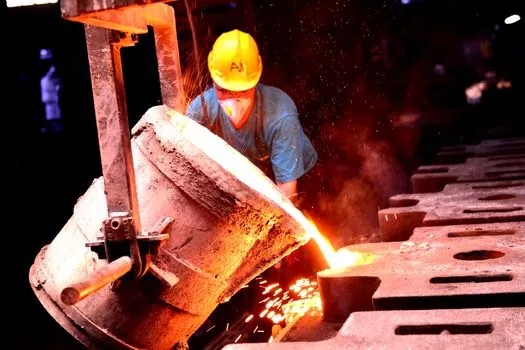
Medium-frequency induction melting at 1–10 kHz delivers a 6 ton rated capacity with 145 kW class power, producing 0.8–6 t/h melt rates in iron and shorter tap-to-tap times than gas-fired crucible setups [S4]. For an ag-machinery job shop that pours grey iron tiller bodies and ductile iron plough points in 200–500 kg batches, this maps directly to a 250 kW, 500 kg crucible class unit [S4].
Electric melting furnace designs also eliminate combustion flue gas, which matters for foundries co-located with farm cooperatives or in regions with strict particulate rules; induction is reported as the cleanest widely available melting method for iron and copper [S4].
Capacity and Power Sizing by Part Family
Capacity selection should track the heaviest single pour, not annual tonnage. Reaper binder gear housings and tiller rotor hubs commonly cast in 50–150 kg iron pours, while walking-tractor gearbox cases reach 200–500 kg [S2][S5]. A 1 ton crucible at 250–350 kW handles the upper end with a 30–45 min meltdown per charge at 1450 °C iron; a 500 kg unit at 150–200 kW is the typical mid-range choice for a single-shift job shop [S4].
For copper and brass bushing production, a 50–200 kg, 50–150 kW unit sized 0.5 ton rated is common, with reported tap-to-tap of 25–40 min at 1200 °C and a smaller coil diameter suited to non-ferrous chemistry [S4]. When a plant runs both iron and copper, two separate crucibles are usually specified, because iron-grade crucibles (silicon carbide, 1600 °C+) and graphite/ceramic non-ferrous crucibles have incompatible lining lives.
Selection Criteria: Lining, Atmosphere, and Crucible Material
Sintered silicon-carbide crucibles dominate iron service in this capacity band because they survive the 1450–1550 °C iron range for 80–200 heats before reline, with a thermal-shock rating that suits batch loading from a preheater at 600–800 °C [S4]. For copper/brass, clay-bonded graphite or fused-silica linings are typical, limited to roughly 1200 °C top temperature and 50–150 heats, but they tolerate the higher thermal cycling from small-batch pours.
Atmosphere control is mostly passive in the ag-machinery market: no vacuum, no protective inert gas, because the parts are commodity iron or brass with no aerospace-grade cleanliness callouts. This keeps the spec simple, a refractory-lined steel shell, water-cooled copper coil, medium-frequency (1–10 kHz) power supply, and a tilting or bottom-pour spout sized to the mould line.
Power Supply, Cooling, and Site Constraints
Most ag-machinery foundries run 380–415 V three-phase utility, and medium-frequency power cabinets in the 100–500 kW range need 600–1200 A supply at full load. APS Induction lists units from 10 kW to 800 kW on the wholesale market, with quoted ex-works pricing of 10,000–145,000 USD per set depending on capacity, supply frequency, and PLC option set [S4].
Cooling-water demand for a 250 kW class furnace sits at 8–15 m³/h of closed-loop water at inlet temperatures below 35 °C; without a chiller or cooling tower sized for that, the coil will trip on over-temperature. The furnace footprint is roughly 1.2 m × 1.5 m for a 500 kg unit, plus 0.8–1.2 m clearance for crucible change-out and a 2 t hoist for the lid and coil.
Comparison: Electric Crucible vs Gas-Fired vs Channel Induction
Gas still wins where scrap is dirty, oily, or variable in shape, because the burner accepts bulky charge without bridging.
Channel induction furnace designs offer higher thermal efficiency on long holding cycles but are unsuited to the pour-and-reload rhythm of an ag-machinery job shop, where most shifts pour 3–6 batches and shut down. For the same reasons, a separate holding furnace is rarely needed unless the foundry runs a high-pressure die-casting cell beside the sand line.
Common Failure Modes and Sourcing Pitfalls
The three most common field failures on ag-machinery spec'd electric crucible furnaces are coil water leaks from scale build-up, crucible cracking from cold-charge impact (preheat to 600 °C minimum is the standard fix), and refractory wash-out from overly aggressive deslagging [S4]. Sourcing pitfalls include paying for a '1 ton' unit that is actually a 500 kg body with a 1 ton-rated coil, and missing the medium-frequency vs. mains-frequency distinction, which determines melt rate more than nominal kW.
For a comparable spec-driven walkthrough on a related foundry asset class, see Holding Furnace Selection for Rail Components: 2026 Spec Map; for broader steel-mill electric-melt context, the induction furnace encyclopedia page is the closest reference. The CCCME export channel lists induction melting equipment as a standalone machinery category with active Chinese OEM participation, confirming the supply depth in this segment [S8].
Track these signals over the next quarter: Chinese OEM price moves on 100–500 kW medium-frequency cabinets [S4], Indian/Southeast-Asian farm-machinery output growth driven by walking-tractor demand [S7], and any new CCCME technical guideline for induction melting under 1 ton [S8].