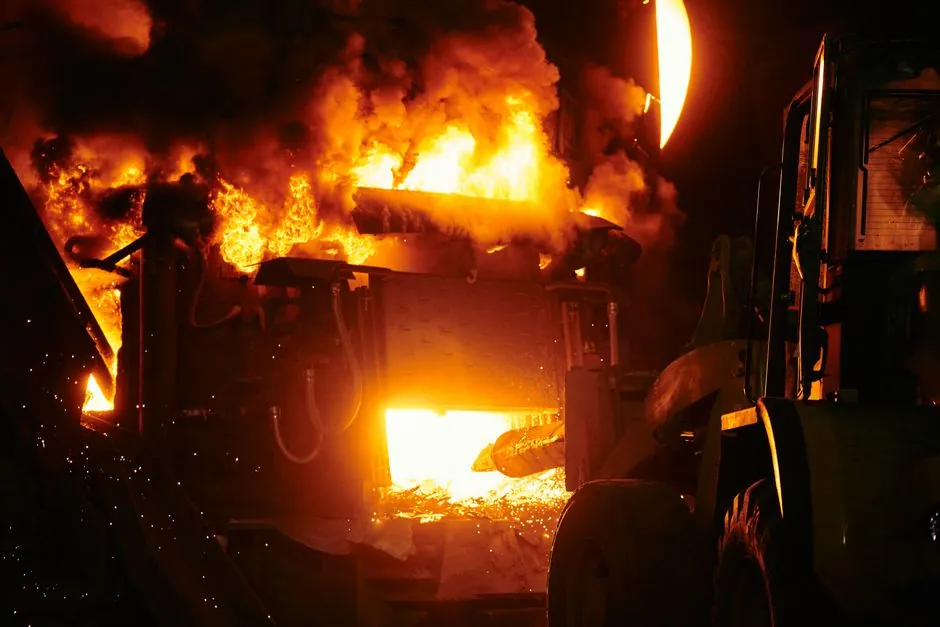
The vertical temperature distribution inside a foundry cupola rises through the charge preheat zone, peaks inside the combustion (coke bed) zone above the tuyeres at roughly 1600°C, then falls through the melting zone as liquid droplets descend toward the well, where collected iron typically sits between 1400°C and 1500°C before tap [S3][S6].
Two-row tuyere geometry, oxygen-enriched blast and water-cooled tuyeres each move that profile upward and tighten its peak, which is the single most useful lever a melter has on iron temperature, carbon pickup and refractory life [S1][S2][S4].
Zone-by-zone temperature bands and what sets each band
The charge preheat zone above the tuyeres is essentially a counter-current shaft: ascending CO/CO2 combustion gases from the coke bed transfer heat into descending metallic charge, and published profiles place the upper preheat at roughly 200–400°C, rising to around 1093°C as the charge approaches the tuyere belt [S6]. This preheat is what allows the iron to absorb latent heat quickly in the melting zone rather than quench the coke bed on entry.
Inside the combustion zone, just above the tuyeres, the coke bed temperature reaches about 1600°C under stoichiometric coke combustion, which is hot enough to melt mild steel, cast iron and pig iron alike in laboratory and small-scale cupola trials [S3]. BCIRA-derived work and similar two-row tuyere studies show this peak flattens and shifts slightly upward when a second, higher row of tuyeres is added, because additional oxygen is delivered into the upper part of the coke bed rather than only at the bottom [S4].
The melting zone is the narrow band where descending solid charge crosses the liquidus. Iron droplets form here and continue to absorb sensible heat as they fall, reaching a superheat of roughly 100–200°C above the Fe-C liquidus before entering the well. The well itself, the bath space below the tuyeres, holds the accumulated liquid iron and acts as a thermal buffer; its temperature is what the operator actually taps, and it typically runs 50–150°C cooler than the combustion-zone peak [S1][S6].
How tuyere design, blast enrichment and bed height move the profile
The tuyere belt is the control plane of the entire cupola: it fixes where oxygen enters, where the combustion peak sits and therefore where the melting zone forms. Single-row tuyeres concentrate combustion at one elevation and produce a sharper, taller peak; two correctly spaced rows widen the high-temperature band and lift the effective stack height, which BCIRA and successor work have linked directly to higher melting rate and better thermal efficiency at constant coke rate [S4].
Blast temperature and oxygen enrichment work on the same profile from the other side. Refractory-lined cupola furnaces using oxygen injection or enrichment [S2] can develop very high combustion-zone temperatures, with the tuyere area reported at around 5,000°F where iron oxide forms [S5], above the well located below the tuyeres [S6]. The trade-off is higher refractory wear at the tuyere belt and higher FeO vaporization losses, which become significant once local gas temperature exceeds about 2760°C (5000°F) in the tuyere raceway [S5].
Effective stack height, defined as the vertical distance from tuyere centerline to the charge door, sets how long the charge sits in the preheat zone. Modern Casting's 2025 medium-rating criteria (2.8–3.3) credit cupolas that combine good effective stack height, refractory lining and oxygen enrichment with both higher melt rate and lower specific coke consumption [S2]. Reference cupola geometry for a 0.5 t/h foundry unit places the tuyere belt about 1.5–2.0 m below the charging door, with a total shaft height of roughly 4–5 m to give the preheat zone enough residence time [S3].
Comparison: profile shape by furnace configuration
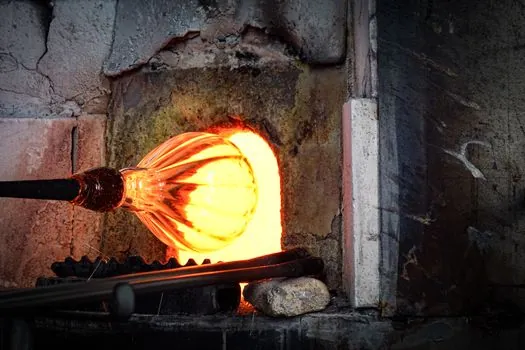
The practical question for a melter is not the textbook number, but which configuration gives the highest well temperature for the lowest specific energy. Three common configurations compare as follows on the criteria that matter: ambient-air single-row, hot-blast two-row, and oxygen-enriched single-row. [S3]
Ambient-air single-row: combustion peak around 1600°C, well temperature typically 1400–1450°C, lowest capital cost but highest specific coke rate and the steepest refractory wear at the tuyere belt; best suited to small jobbing foundries running intermittent shifts [S3][S4]. Hot-blast two-row: peak roughly 1700–1800°C, well temperature 1480–1530°C, lower specific coke rate because the second tuyere row completes combustion higher in the bed, but higher blower and recuperator capital cost; favoured in mid-sized iron foundries running two or three shifts [S2][S4]. Oxygen-enriched single-row: peak 1750–1850°C, well temperature 1500–1550°C, smallest diameter shell for a given melt rate, but the highest FeO vaporization and the most aggressive tuyere refractory duty [S2][S5].
The takeaway: two-row and oxygen-enriched designs both move the curve upward, but two-row does it by widening the high-temperature band (lower thermal gradient, gentler on refractory), while oxygen enrichment does it by sharpening the peak (higher local temperature, harder on tuyere refractories and prone to FeO fume). The choice is usually capital versus coke, not temperature versus temperature.
Sensing the profile: where thermocouples actually live in a cupola
Because the cupola interior is hostile, only a handful of fixed measurement points survive in a working furnace: shell-mounted thermocouples on the well and stack, an infrared or suction pyrometer at the tuyere belt, and occasional drop-in thermocouples during a campaign survey. Continuous temperature monitoring of the well, the stack and the blast main gives the operator the three signals that map back to the profile: well temperature tracks iron superheat, stack temperature tracks preheat completion, and blast temperature tracks energy input [S1].
Demin and co-authors describe the practical method as a heat-loaded-zone determination: combine measured gas composition, measured temperature at the tuyere and stack, and an energy balance on the coke bed to back-calculate the height of the peak and its width [S1]. For melting furnace operators this is the difference between running blind on tap temperature and actually controlling the combustion-zone location, which is the variable that most affects carbon pickup, silicon loss and refractory campaign life [S1][S2].
Selecting the right temperature controller for the blast main and the well is the cheapest single upgrade a foundry can make. Closed-loop blast-temperature control tightens the preheat zone, which stabilizes the melting-zone position and reduces the day-to-day drift in well temperature that otherwise forces the melter to compensate with extra coke. For a more general view of how the tuyere belt and well geometry fit together, the cross-section reference at cupola furnace cross section: tuyere belt and well zone geometry lays out the same zones in diagram form.
Failure modes, limits and what the profile does not tell you
The textbook profile hides several real failure modes. Bridging in the shaft collapses the preheat zone, charge hangs up and a cold slug drops into the coke bed, briefly driving local temperature below the iron liquidus and producing a "skull" that survives to the well. The opposite failure, channelling, lets blast gas bypass the coke bed, the profile flattens, and well temperature drops even though the blast meter shows full flow [S4].
Refractory campaign life is set by the time-integrated temperature at the tuyere belt, not the peak value, which is why oxygen-enriched units see shorter lining life despite higher melt rate: the tuyere refractories sit at peak temperature for more minutes per ton of iron [S2][S5]. FeO fume generation scales with local temperature above about 2760°C (5000°F) in the tuyere raceway, and that fume re-condenses on cooler charge above, raising apparent charge weight loss and changing the preheat-zone heat balance [S5].
The profile also does not predict iron quality directly. A 1500°C well is necessary but not sufficient for low-oxidation, low-nitrogen iron; the melter still has to control coke rate, blast humidity and oxygen enrichment together. Reference points for temperature measurement at the well and tuyere belt are usually given as type-K or type-S sheathed thermocouples with a 1–2 second time constant, mounted in protection tubes that are replaced on a scheduled basis rather than run to failure.
Sourcing and standards for cupola profile data
Open-literature cupola profile data is unusually thin compared with the volume of operational data sitting inside foundry DCS systems. The two accessible engineering references are the Demin study on heat-loaded-zone determination, which gives the inverse method for back-calculating the peak from measured shell and tuyere temperatures [S1], and BCIRA's cupola design, operation and control work, which provides the two-row tuyere geometry and the linkage between effective stack height and melt rate [S4]. Modern Casting's August 2025 cupola rating framework adds a current operational lens, weighting refractory lining, oxygen enrichment, hot-blast availability and effective stack height as the four highest-impact factors on the profile [S2].
Foundry-facing safety standards for refractory, dust collection and coke handling apply to the cupola shell, but the temperature-profile numbers themselves are engineering data rather than standardized limits, which is why different sources report different peak values. A melter planning a control upgrade should anchor on measured shell temperature, tuyere belt pyrometer reading and well thermocouple, then use the inverse method in [S1] to reconstruct the in-bed peak for trend tracking rather than relying on a single published number.
The next trackable signal is the rollout of oxygen-enriched, two-row tuyere retrofits in mid-sized iron foundries through 2026, which will pull the median well temperature upward by 30–50°C relative to the ambient-air single-row baseline, and shift the industry standard for tap temperature closer to 1530°C. A secondary signal is the appearance of continuous tuyere-belt pyrometer packages with automated trim on blast oxygen, which finally closes the loop between measured profile and controlled profile [S1][S2].
