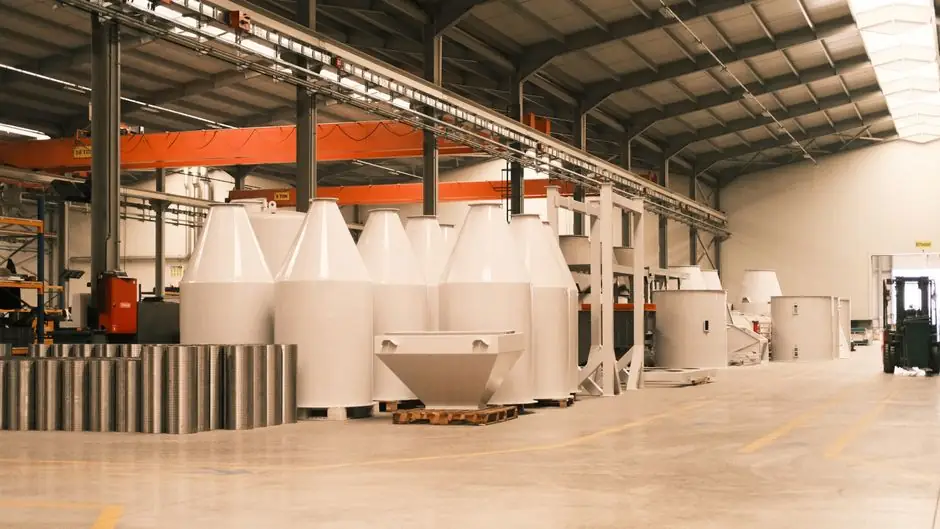
Blending-only curing compound lines start at roughly $30,000 for a 5 TPH bulk-blend (BB) configuration and run to about $200,000 at 40 TPH, based on the equipment-package pricing published for analogous fertilizer BB lines that share the same batching, mixing and bagging architecture [S3][S4].
Full emulsion or wax-resin curing compound production, which requires heated reactors, high-shear homogenisers and packaging skids, sits in a different cost band: published project reports for comparable cement-waterproofing compound facilities place total capital investment (land, civil works, plant and machinery) in the low-to-mid six figures, scaling with capacity, technology and location [S9]. The line type you pick, blending versus full emulsion polymerisation, sets the entire CAPEX trajectory.
Line types and what each one actually contains
Powder or pre-blended curing compound lines are physically a concrete batching plant with the pan mixer swapped for a ribbon or rotary drum blender, fed by 4–8 dosing hoppers, with a bagging scale and loadout conveyor at the tail [S3][S6]. Capacity classes published for bulk-blend fertilizer lines (which share the architecture) run 2–100 TPH, with $30,000–$600,000 equipment packages depending on hopper count, automation and bin volume [S6].
Emulsion-based curing compound lines add the chemistry step: paraffin is melted with emulsifiers (commonly sorbitan esters and triethanolamine), blended with 85–100 parts water under high shear, then dosed with nano-calcium-carbonate slurry, coalescing agents, and either acrylic monomers or sodium silicate for silicate-based formulations [S2]. The reactor vessel, high-shear homogeniser, holding tanks, filter press and filling line are the additional capex line items that push a blending-only $80,000 package into a $200,000–$500,000+ full plant, consistent with the range reported for cement waterproofing compound facilities whose process flow is structurally similar [S2][S9].
Cost drivers ranked by how much they move the number
Capacity tier is the single largest lever. Small BB packages (1–10 TPH) are reported in the $102,000–$213,000 range when including a granulator, while a 20 TPH NPK blending line quoted as a reference case sits near $300,000 equipment-only, and full 50,000–100,000 t/y organic/complex plants with drying and finishing reach $500,000+ [S1][S3][S7]. On a USD-per-tonne basis, smaller lines carry a steeper installed-cost penalty because the same dosing, weighing and bagging ancillaries are required regardless of throughput.
Material of construction is the second lever. Standard BB equipment is offered in carbon steel for non-corrosive dry blends, with stainless-steel contact parts (hoppers, ribbon blades, discharge chutes) a typical upgrade for moisture-sensitive or chloride-bearing formulations [S6]. The wet side of an emulsion line (reactor, homogeniser, filter) defaults to stainless; specifying SS304 versus SS316L or adding jacketed reactors for heated paraffin melt typically moves the reactor skid price 20–40% within the same vendor model.
Formulation chemistry is the third lever. Wax-resin emulsions, acrylic emulsions and sodium-silicate penetrating sealers all share the same basic reactor + homogeniser footprint, but silicate variants require pH-controlled dosing and lined tanks; acrylic variants add a monomer feed skid, inhibitor dosing and a chiller loop. ASTM C309-compliant and AS3799-compliant products command a small formulation-engineering premium versus non-spec generic emulsions [S2].
Selection criteria that actually matter at order time
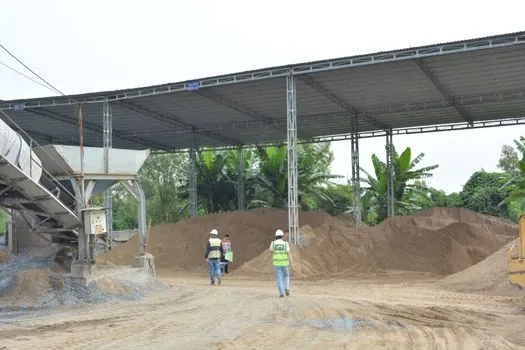
Annual output versus operating hours sets the equipment size. A 4,800 h/year design basis (single-shift or 2-shift with seasonal downtime) requires larger blenders, bigger storage bins and higher-capacity conveyors than a 7,200 h/year near-continuous basis for the same annual tonnage, and the lower-hours case carries higher CAPEX but lower automation demands [S5].
For a blending-only line, choose a concrete batching plant as the procurement reference point: the dosing accuracy specification (±0.1–0.3% on declining-weight feeders) and the number of nutrient or additive bins are the same engineering decisions, and oversizing critical units 15–30% above nominal capacity is standard practice to absorb seasonal peaks and formulation changeovers [S5].
For a full emulsion line, the construction machinery and equipment class that drives quality is the high-shear homogeniser; rotor-stator tip speed, batch turnover time and clean-in-place (CIP) capability determine whether the line can hold ±2% solids loading and pass ASTM C309 moisture-retention tests consistently [S2]. Generic industrial mixers marketed as suitable for curing compound production are usually inadequate for the nano-CaCO₃ dispersion step.
Comparison of the three realistic line options
Side-by-side on the four criteria that drive a purchase decision: a 5–10 TPH powder-blend BB package, a 20–40 TPH powder-blend BB package, and a 1–5 TPH full emulsion plant. [S3]
Capital cost band: $30,000–$80,000 for the small BB [S3][S4]; $80,000–$200,000 for the large BB [S3][S4]; $200,000–$500,000+ for the emulsion plant, with the cement-waterproofing compound reference case confirming that total installed investment scales with capacity, technology and location [S9]. Formulation flexibility is lowest on a pure BB line (dry-blend only, no wax or resin), highest on an emulsion plant. Lead time on a Chinese-origin BB package is typically 30–60 days ex-works, while a fabricated-skid emulsion line commonly runs 90–150 days because of the pressure-vessel and electrical work. Operating cost per tonne favours BB lines by a wide margin because there is no steam, chiller or homogeniser electrical load; an emulsion line typically adds 80–150 kWh/t of electrical consumption and either steam (for wax melt) or hot-oil heating, which must be priced into the operating budget before the CAPEX comparison is finalised [S1][S2][S8].
What the cost reports do and do not cover
Public production-cost reports for concrete curing compound cover raw materials (paraffin, emulsifying monomers, sodium silicate), utility requirements, infrastructure, machinery, manpower, packaging and transportation, and identify ASTM C309 and AS3799 as the dominant moisture-retention and performance standards cited by industrial buyers [S2]. They do not publish a single all-in turnkey number; the figure is reconstructed from the machinery line item plus a typical 1.4–1.8× multiplier for civil works, utilities tie-in, instrumentation and commissioning that is standard for similar waterproofing-compound facilities [S9].
Total cost of ownership is therefore higher than the equipment price by a predictable margin. Use the lighting equipment and electric lamps and anti-static equipment classes only as a sanity-check reference for the electrical and hazardous-area buildout cost lines, since emulsion plants handling paraffin and solvent-borne acrylics are typically classified for hazardous-area lighting and static control on the same risk basis as chemical batching halls.
For whom each line type is and is not appropriate
A blending-only BB package suits a regional contractor or precast yard that buys paraffin emulsion concentrate in bulk and re-blends with additives (pigments, anti-slip grit, accelerators) for site-specific end-products, and is unsuitable for a producer needing ASTM C309 wax-resin or acrylic emulsion from raw paraffin and monomers [S2][S3]. A 20–40 TPH BB line with stainless contact parts suits an export-oriented blender serving road, pavement and bridge-deck demand, but is over-specified for a domestic precast operation with sub-5,000 t/y consumption [S5]. A full emulsion plant suits an established chemical manufacturer entering the curing compound market with a proprietary ASTM C309 formulation, and is not appropriate as a first asset because the operating-experience requirement on the high-shear homogeniser and reactor chemistry is non-trivial [S2][S9].
Trackable signals and procurement traps
Watch for the small-scale plant bias in vendor quotations: published case studies for analogous powder lines note that powder blending costs far less than a complete granular line with drying and finishing, and that buyers should compare total installed cost rather than per-machine quotes, because the ancillaries (bins, conveyors, dust collection, automation) routinely double the headline equipment number [S8]. For emulsion plants, a non-destructive examination (NDT equipment) programme on the reactor and jacketed piping is a procurement-line item that is often omitted from vendor scope and falls back to the buyer, materially shifting the delivered cost [S2][S9]. A useful next step is to request a vendor package split into equipment, civil/structural, electrical and instrumentation, and commissioning, and benchmark it against the 1.4–1.8× multiplier published for similar waterproofing-compound projects before signing the PO.
See also our earlier report, LOLER thorough examination intervals for vehicle-mounted lifting equipment.