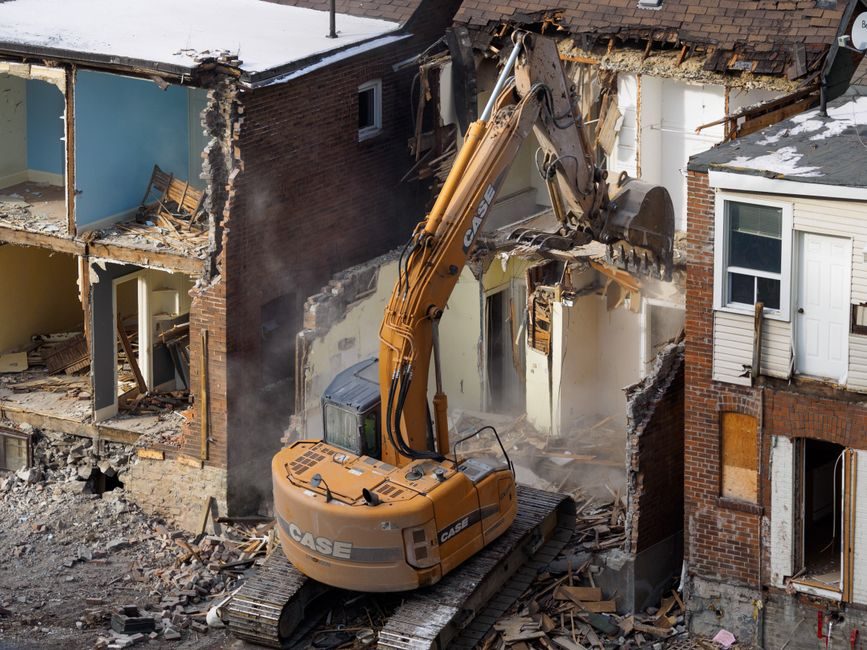
A 30 HP Fox 2-C swing-frame abrasive cut-off from Vulcan Engineering cuts at 14,200 SFPM (72 m/s) on a 30 in × 1/4 in × 1-3/4 in (762 × 6 × 44 mm) wheel and pivots 90° clockwise / 75° counter-clockwise, the geometry that lets a demolition crew swing a heavy section into a wall opening without repositioning the crane [S3].
At the other end of the duty scale, the Minli 61215 handheld cut-off saw runs on 220-240 V / 50-60 Hz at 1,400 W input with 110/125 mm blade diameter — the package a single operator carries onto a slab to slice rebar, embedded conduit, or thin-wall steel plate [S4]. Selection between these two extremes is driven by section thickness, finish tolerance, and dust-control obligation, not by brand familiarity.
Duty Class Tier 1: Handheld Abrasive Cut-Off Saws (≤125 mm Blade)
Minli's 61215 ships with a 110/125 mm abrasive wheel, 1,400 W rated input, 220-240 V supply, 50/60 Hz compatibility and a compact die-cast gear housing that drops the bare-tool weight into a single-operator-carry class [S4]. On a reinforced-concrete demolition slab this size handles rebar up to roughly 20 mm diameter, threaded rod, light-gauge channel, and embedded EMT conduit without overloading the motor thermally.
Selection rule: for cuts under 3 mm wall thickness in steel or under Ø20 rebar, the 110 mm wheel is the lower-vibration choice; for Ø20-Ø32 rebar and 4-6 mm plate, step to the 125 mm wheel. Pair every handheld abrasive cut-off with a Type-G dust extractor on the Class M hazard class — concrete and masonry dust carry respirable crystalline silica, and OSHA/NIOSH-class shrouds are no longer optional on US job sites.
Duty Class Tier 2: Swing-Frame Abrasive Cut-Offs (Foundry/Demolition)
The Fox 2-C from Vulcan runs a 30 HP (22 kW) two-speed drive turning a 30 in × 1/4 in × 1-3/4 in abrasive wheel at 14,200 SFPM (72 m/s) starting speed and an average 12,500 SFPM across wheel life [S3]. The two-speed pulley recovers peripheral speed as the wheel wears down, so a demolition contractor who burns through three wheels a day keeps a constant cut rate instead of fighting a slowing cut. The sealed-for-life spindle uses acme threads (not V-threads) on a high-strength alloy-steel shaft, an explicitly anti-contamination detail for the concrete slurry and grinding swarf a demolition site throws at the machine.
Swing geometry is the spec that actually decides the job: 90° clockwise plus 75° counter-clockwise on the Fox 2-C [S3] covers horizontal-to-vertical cuts in a single crane-suspended position. The whole unit hangs from a bridge crane or jib hoist, so the cut-off follows the cut line instead of the operator dragging a 1,130 lb (513 kg) machine across the deck. For heavy-section demolition — gate and riser removal on castings, splitting reactor nozzles, cutting thick-wall process pipe — this duty class replaces handheld work because the swing frame absorbs the lateral load a 1,400 W handheld cannot.
Selection rule: any section above 6 mm wall thickness or above Ø50 mm solid bar, specify a swing-frame or chop-stroke machine with ≥15 HP and a wheel diameter ≥20 in; otherwise the cut stalls and the wheel glazes. See the Cut-Off Machine Spec Map for Steel Construction Sites for a parallel comparison on structural steel rather than demolition debris.
Duty Class Tier 3: NC Electrochemical (ECG) Cut-Offs for Burr-Free Tolerance Work
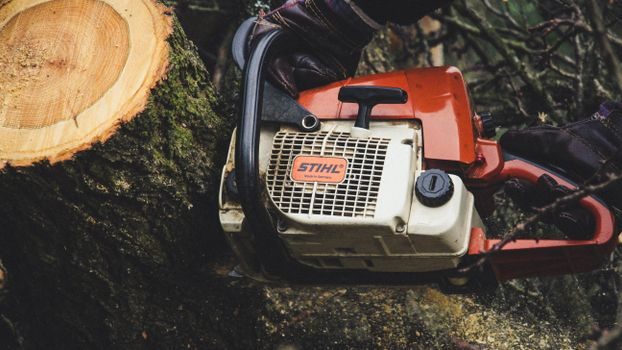
The Tridex CS1-E from MMT is an electrochemical (ECG) rotary-blade cut-off, not an abrasive wheel, and the spec is in a different league: positioning accuracy 0.01 mm (0.0004 in), repeatability 0.01 mm, tube diameter range 0-80 mm (0-3 in), cutting speed 0.254 m/s (0.833 ft/s), mass 1,497 kg, supply 380/460 V [S1]. Safety compliance is to CE and ISO 13849-1, and the spindle is a 5 HP direct-drive servo on ceramic bearings with air purge — the bearing spec is the giveaway that the duty is precision tube, not heavy section.
ECG cutting is electrically dissolving the metal in an electrolyte bath rather than grinding it, which is why the CS1-E ships an all-stainless 50-gallon (200 L) electrolyte tank, no painted surfaces, and tool-free quick-change fixtures [S1]. For demolition this duty class almost never applies — the unit is built for medical tubing and small-batch high-purity components — but it appears in the selection map because the same spec discipline (tolerance ±0.01 mm, CE + ISO 13849-1, controlled-material work envelope) is the reference benchmark you compare handheld and swing-frame units against.
Selection rule: ECG is over-spec for demolition and under-spec for nothing; treat it as a reference benchmark, not a candidate machine on a teardown site.
Selection Comparison: Tier 1 vs Tier 2 vs Tier 3 on Four Decision Criteria
Four decision criteria sort the three duty classes cleanly. Power: 1.4 kW (Tier 1) vs 22 kW (Tier 2) vs 3.7 kW spindle on a 1,497 kg machine (Tier 3) [S1][S3][S4]. Section capacity: ≤6 mm plate / ≤Ø32 rebar (Tier 1) vs heavy section up to the wheel diameter, typically 30 in (Tier 2) vs 0-80 mm tube (Tier 3) [S1][S3]. Tolerance: operator-controlled, typically ±1 mm (Tier 1) vs operator-controlled, ±2-3 mm on heavy abrasive cuts (Tier 2) vs ±0.01 mm NC (Tier 3) [S1]. Site mobility: carried by one operator (Tier 1) vs crane-suspended, 1,130 lb (Tier 2) vs bolted cell with electrolyte containment (Tier 3) [S1][S3].
The comparison shows a clean ladder: Tier 1 wins on single-operator mobility and low capex, Tier 2 wins on heavy-section throughput and the swing geometry that reaches awkward cuts, Tier 3 wins on burr-free finish and NC repeatability but loses on every demolition-site mobility metric.
What a Cut-Off Machine Is For vs What It Is Not For

A cut-off machine is the right tool for slicing through a continuous member — rebar, pipe, plate, casting gate, riser, tube — at a defined line, with the kerf, the spark stream, and the swarf contained. It is the wrong tool for impact breaking of concrete, for prying, for surface grinding (use an Angle Grinder Selection Map for Bridge Construction Sites for that duty), and for material where the section is so thick that no abrasive wheel on the market can make the cut in one pass. [S1]
A 30 HP swing-frame abrasive cut-off at 14,200 SFPM is engineered to remove gates and risers from castings and separate runner-tied castings; the OEM states it is "a fast and economical means for removing gates and risers" with cuts "very close to the casting" that eliminate follow-up grinding [S3]. That same geometry — crane-suspended, 90° + 75° swing — is what a demolition contractor needs when cutting a process pipe out of a vessel nozzle or severing structural steel during a strip-out.
Safety, Standards, and Failure Modes to Engineer In
Three failure modes kill cut-off machines on demolition sites. Wheel shatter from excessive lateral feed rate — the cure is a two-speed drive like the Fox 2-C, which lets the operator recover wheel speed as the abrasive wears [S3]. Dust load on the motor and bearings — the cure on the MMT CS1-E is ceramic bearings with air purge and an all-stainless splash guard [S1], and on a Tier 1 saw the cure is a sealed-for-life spindle plus a Class M dust extractor. Electrolyte or slurry contamination of the spindle threads — the cure is acme threads (Vulcan) orceramic bearings (MMT) instead of standard V-threads [S1][S3].
Standard references: CE plus ISO 13849-1 on the MMT CS1-E covers functional safety of the control system [S1]. The 220-240 V / 50-60 Hz rating on the Minli 61215 covers global single-phase job-site supply [S4]. Always verify the abrasive wheel's maximum operating speed (MOS) in m/s or SFPM matches the machine's published wheel speed — 14,200 SFPM on the Fox 2-C is well inside any 30 in reinforced abrasive wheel's MOS [S3].
Operator-side controls: adjustable handle length and angle on the Fox 2-C let the operator stand outside the spark stream and cut line [S3]; the MMT CS1-E uses a colour touchscreen HMI and operator pendant so the operator is never in front of the electrolyte bath [S1].
Procurement Signals and Trackable Next Nodes
Continental Pipe & Tube is gearing up production and support of the Rabbit Tool rotary cut-off line in 2026, after 40+ years of Rabbit Tool fabrication-shop installed base [S2] — a procurement signal worth tracking if you standardise on rotary cut-offs for tube/pipe demolition and want a US-supported supply line. Vulcan Engineering's Fox 2-C spec sheet was last refreshed on the page in 2026-07 [S3], confirming active manufacture, not legacy stock. Track (1) the 2026 Continental/Rabbit Tool production-ramp press release for delivery lead times, and (2) the next CE / ISO 13849-1 re-certification cycle for any NC cut-off on your approved-vendor list.
Spec-level background on the components involved: demolition hammer, aerial work platform, and aerial work truck.