
An industrial assessment of a Foundry Degassing Unit (FDU) running AlSi9Cu3(Fe) at MOTOR JIKOV Slévárna a.s. recorded a 26-32 °C melt-temperature drop across the refining cycle and held hydrogen porosity to a Density Index of 3-4% [S3]. The same trial logged Si 9.075 wt%, Fe 0.793 wt%, Cu 2.075 wt%, and Mg 0.244 wt% against the DIN 226 limits of Si 8-11, Fe ≤1.3, Cu 2-4, and Mg 0.05-0.55 wt% [S2].
FDUs in commercial foundries fall into four practical classes — lance injection, rotary impeller (RID), porous-plug / diffuser, and tablet/flux addition — and each maps to a different throughput, hydrogen-removal ceiling, and oxide-inclusion removal profile.
How a Foundry Degassing Unit Is Classified: Gas-Injection Principle
An FDU is classified first by how the purge gas is delivered into the melt, because hydrogen removal is mass-transfer-limited at the bubble interface and depends on bubble surface area, residence time, and turbulence [S3]. The four functional classes are: (1) lance-type, where a stationary or hand-held graphite/steel tube injects Ar or N2 near the bath bottom; (2) rotary impeller degasser (RID), where a motor-driven shaft shears the gas into fine bubbles at typically 300-500 rpm; (3) porous-plug / diffuser, where a refractory plug meters gas through a permeable element; and (4) tablet/flux addition, where solid degassing tablets release gas in-situ [S1][S3]. Tablet-type additives also cover refining functions beyond hydrogen — they control molten-metal chemistry and aid aluminium-scrap separation during recycling [S1].
Selection between these classes is driven by melt mass, hydrogen starting point, and required Density Index. For AlSi9Cu3(Fe) the trial cited a maximum allowable Density Index of 3-4% to guarantee casting soundness, with the refining cycle tuned to hit the steepest hydrogen drop on the degassing curve [S3]. Cross-reference: for an in-depth look at the degassing unit component class and its integration with holding furnaces.
What Each Class Delivers: Hydrogen Removal, Oxide Capture, Melt Loss
Lance injection is the lowest-capex option and is common in small foundries, but bubble size is large and residence time is short, so it rarely reaches the 3-4% Density Index band without long hold times. Rotary impeller units are the workhorse for mid-to-large aluminium plants; the impeller shears the gas into 1-6 mm bubbles and disperses them through the bath, which is why most published industrial data — including the 26-32 °C temperature-drop measurements — comes from this class [S3]. Porous-plug diffusers sit between lance and rotary on cost and on bubble-size control, and are frequently used in continuous in-line treatment. Tablet/flux dosing is typically paired with one of the gas-injection methods to handle inclusion floatation and chemistry correction, since tablets alone cannot sustain the agitation needed for deep hydrogen stripping [S1].
The decision boundary is straightforward: if the alloy is high-Mg (≥0.5 wt%) or recycled scrap with high oxide load, rotary impeller plus flux is the default; if the line is high-throughput and continuous, in-line porous-plug plus filter is the default; if the line is low-volume job-shop work, lance plus tablet is acceptable. Note that the hydraulic power unit driving rotary impeller shafts is a separate sizing exercise, since impeller torque scales with bath diameter and rotor speed.
Comparison Across the Four FDU Classes
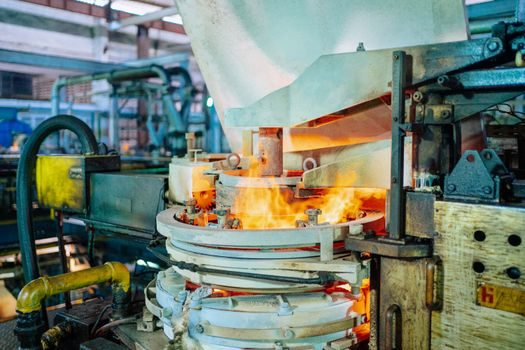
Four decision criteria line the classes up clearly for a specification review.
1) Hydrogen removal efficiency — rotary impeller > porous-plug > lance > tablet-only. The Springer trial demonstrated the rotary class can hold Density Index in the 3-4% band with measurable hydrogen drop inside the standard cycle window [S3].
2) Oxide / inclusion capture — tablet + impeller > tablet + lance > impeller alone > lance alone. Tablets formulated for refining flux function as carriers that float non-metallic inclusions into the dross layer [S1].
3) Melt temperature loss per cycle — rotary impeller typically 26-32 °C end-to-end as measured at the industrial site, which is within the foundry's accepted thermal budget for AlSi9Cu3(Fe) [S3]. Lance systems lose less per minute but take longer to reach the same Density Index, so total temperature drop can be comparable.
4) Capital and maintenance — lance < porous-plug < rotary impeller, with rotary impeller requiring the most aggressive preventive maintenance on shaft seals and graphite rotors. Tablet dosing is consumable-driven, not capital-driven [S1].
Operating Spec Map: Temperature, Time, Density Index, Gas Purity
The industrial trial defines the operating envelope most foundries accept for AlSi9Cu3(Fe): pour the melt into the ladle, refine until the Density Index drops into the 3-4% window, and budget a 26-32 °C total temperature loss from pour to end-of-refine [S3]. The chemical composition during the test stayed well inside the DIN 226 spec — Si 9.075, Fe 0.793, Cu 2.075, Mn 0.260, Mg 0.244, Zn 0.900 wt% — which is the metallurgical confirmation that the FDU cycle did not over-oxidize or alter the alloy [S2].
Gas purity matters: any FDU class is undermined by wet argon or nitrogen, since moisture re-hydrogenates the bath. Standard practice is to specify Ar/N2 with a -40 °C or lower dew point, and to size the flow at roughly 0.1-0.3 L/min per kg of melt for rotary impeller systems — a figure consistent with hitting the 3-4% Density Index band within a 10-15 minute cycle. For continuous in-line porous-plug systems, residence time replaces cycle time as the controlled variable. Related reading: the flow meter sizing on the gas line is a frequent overlooked item when retrofitting an existing station.
Failure Modes and Constraints Buyers Should Plan Around
The four common FDU failure modes are: (a) inadequate hydrogen drop because rotor speed is too low or gas flow is starved — visible as a Density Index stuck above 4%; (b) excessive dross generation when tablets are over-dosed or when the impeller entrains too much air at the surface; (c) melt-temperature drop outside the 26-32 °C window, forcing the foundry to re-heat and re-hydrogenate the bath; and (d) refractory attack on porous plugs and ladle linings from high-Fe or high-Mg alloys. The Springer data confirmed the temperature window but flagged that the steepest hydrogen drop on the degassing curve is a specific moment in the cycle — operators who stop refining too early miss the steepest part of the curve and end up over-treating the bath [S3].
FDUs are not the right tool for every alloy. Magnesium-rich alloys (≥0.5 wt% Mg) demand rotary impeller with SF6-free cover gas and tight flux control; zinc-rich alloys tolerate simpler lance systems. For ferrous foundries, the same classification collapses — see the related cupola furnace types reference for the iron-side equivalent. Pure copper and copper-alloy melts are outside the FDU scope entirely.
Sourcing, Standards, and What to Verify at Quotation
At quotation stage, three items must be verified: (1) the OEM's measured Density Index performance on a comparable alloy — demand the degassing curve, not just a passing rate; (2) the consumables path, including degassing/refining tablets, rotor graphite, and porous-plug spares [S1]; (3) the pressure transmitter and instrumentation package on the gas line, because a stable gas pressure is what keeps bubble-size and flow constant across the cycle. Reference standards for aluminium alloy chemical composition in this application include DIN 226 for AlSi9Cu3(Fe) [S2].
Specifications to lock in writing: rotor speed range (typically 300-500 rpm on industrial rotary units), gas flow range per kg of melt, allowable Density Index at handover, maximum allowable melt-temperature drop (commonly 26-32 °C for this alloy family), and tablet chemistry (whether the formulation is a refining-flux type or a degassing-gas-releasing type) [S1][S3]. Related coverage of cupola furnace operating range gives a useful contrast for buyers who run both iron and aluminium lines.
Selection Summary: Which Class Fits Which Foundry
A 200-500 kg/hr job-shop aluminium foundry running AlSi9Cu3(Fe) and similar alloys is well served by a lance-plus-tablet system if the Density Index target sits at 3-4% and the cycle can tolerate 20+ minutes. A 1-5 t/hr automotive or aerospace parts foundry should specify a rotary impeller FDU with flux-tablet dosing, sized to hold the 3-4% Density Index window within a 10-15 minute cycle and a 26-32 °C temperature drop [S3]. A continuous in-line casting line is the natural fit for a porous-plug diffuser paired with a ceramic foam filter, with tablets reserved for chemistry correction rather than hydrogen stripping [S1].
Track the following signals when validating a vendor: published degassing curves on AlSi9Cu3(Fe) or a near-eutectic Al-Si alloy, written confirmation that Density Index was measured by the reduced-pressure test (not estimated), and a rotor-shaft service interval quoted in operating hours rather than calendar months. The sand reclamation unit encyclopedia entry is a useful cross-reference for foundries integrating melt treatment with mould-loop recovery, since the two systems often share a single process-engineering owner.