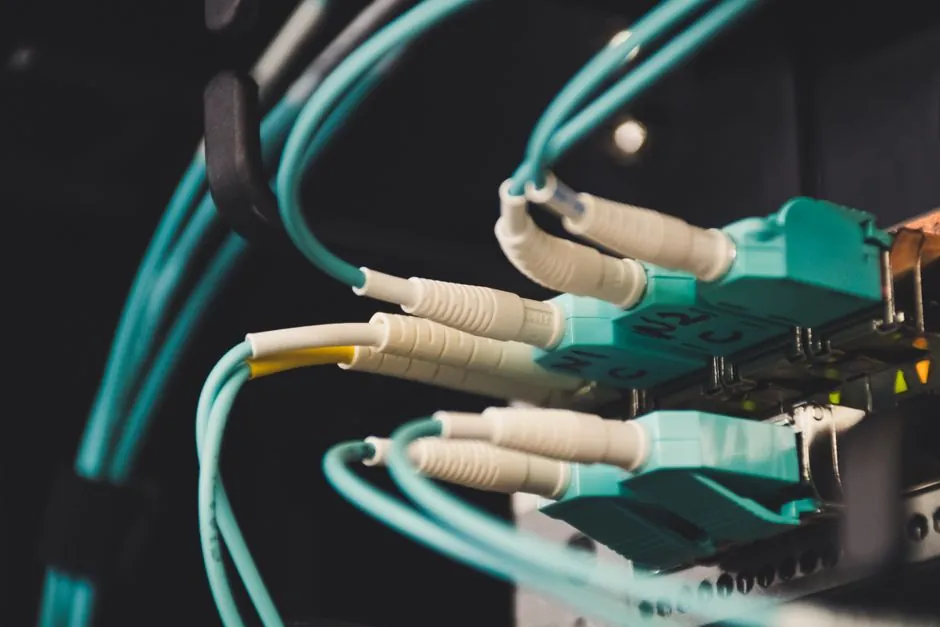
A DeviceNet-to-EtherNet/IP gateway is a standalone protocol converter that maps up to 240 bytes of process data between a CIP-over-CAN fieldbus trunk and a CIP-over-Ethernet backbone, letting plant engineers keep installed DeviceNet scanners, drives, and I/O in service while migrating the controller layer to EtherNet/IP [S1][S3].
Available hardware spans dedicated converters (RTA 460ECDS for DeviceNet master to EtherNet/IP adapters, Anybus X-gateway AB7916 for DeviceNet scanner to EtherNet/IP adapter, ProSoft DeviceNet Router) and compact fieldbus gateways from Hilscher and Helmholz that handle DeviceNet alongside real-time Ethernet variants such as EtherCAT [S1][S2][S5][S7].
Why a Gateway, Not a Native Module
Allen-Bradley 1756-DNB DeviceNet scanner modules are still used in ControlLogix racks but cost more per slot and tie a chassis to a single legacy network, and a typical 460ECDS-class gateway exposes up to 32 EtherNet/IP adapter connections without consuming a rack slot or requiring AOI development on the Logix side [S1][S6].
The 460ECDS reports Class 1 I/O scanner operation with implicit cyclic messaging, supports BIT8/16/32, INT8/16/32/64, UINT8/16/32/64, float and double data types, and maps up to 496 bytes per EtherNet/IP adapter connection in each direction [S1].
Scanner Placement: The Real Decision
Scanner placement is the first engineering call when sizing a fieldbus gateway: the gateway can sit on the DeviceNet side as a slave bridge, on the EtherNet/IP side as an adapter, or act as a native scanner that owns DeviceNet poll/cos connections [S9].
RTA 460ECDS operates as a DeviceNet slave with one connection, meaning the existing DeviceNet scanner on the legacy PLC retains poll ownership and the gateway simply exposes EtherNet/IP adapter data into the master image up to 240 bytes in 15 data groups [S1].
ProSoft's DeviceNet Router since the 2023 firmware release can be configured as a DeviceNet scanner, allowing a new EtherNet/IP-only ControlLogix or Modbus controller to reach into a legacy DeviceNet trunk through polled or change-of-state I/O plus Class 3 explicit messages and Direct-to-Tag reads [S5].
AB 1788-EN2DN, Anybus AB7916, and the ProSoft router are commonly listed as interchangeable options for bridging DeviceNet I/O to EtherNet/IP, but the AB7916 is described as a DeviceNet scanner to EtherNet/IP adapter bridge while the 1788-EN2DN targets EN2DN remote I/O topologies [S7][S9].
Throughput, Cycle Time, and Data Width
DeviceNet runs at 125, 250, or 500 kbit/s on the CAN physical layer, so gateway cycle time is bounded by the slower trunk even when the EtherNet/IP side runs at 100 Mbit/s, and Hilscher's NT 50-DN-EN documents an I/O data conversion period under 20 ms for a DeviceNet slave to Ethernet mapping [S3].
RTA's 460ECDS supports up to 240 bytes of DeviceNet input and 240 bytes of output in 15 data groups, paired with up to 496 bytes per EtherNet/IP adapter connection, and the embedded web server configures mapping without installed software [S1].
For raw TCP telemetry, the 460DSTCP maps 240 bytes of TCP payload per direction with delimiter parsing, automatic stripping, and up to 50 concatenated segments, and operates as either a TCP client or server against a DeviceNet master with a single connection [S4].
Selection Criteria: Comparing the Common Options
Four spec lines matter when picking a protocol gateway: DeviceNet role (slave, master/scanner, or router), data width per direction, EtherNet/IP messaging class, and configuration tooling. [S5]
The RTA 460ECDS fits a "keep the old DeviceNet scanner" project, with DeviceNet slave, Class 1 implicit I/O only, 240-byte DeviceNet I/O, and 32 EtherNet/IP adapter connections [S1]. The Anybus AB7916 fits the inverse, a DeviceNet scanner to EtherNet/IP adapter bridge for projects where the new controller is EtherNet/IP-native and must reach a DeviceNet trunk [S7]. The ProSoft DeviceNet Router covers both directions plus Modbus TCP/RTU, with Class 1, Class 3 explicit, and Direct-to-Tag [S5]. The Hilscher NT 50-DN-EN targets compact DIN-rail installs needing DeviceNet slave to Ethernet with sub-20 ms I/O conversion [S3]. Helmholz's "Gateway Real-Time Ethernet to DeviceNet" goes a step further and runs a DeviceNet master for up to 63 slaves while bridging 200 EtherCAT slaves, which suits CNC and motion-heavy cells [S2].
Adfweb's HD67154, Aparian's DeviceNet Router/B, and HMS Anybus modules round out the field with Ethernet/IP-to-DeviceNet master converters and combined EtherNet/IP/Modbus TCP routers, with prices for the RTA 460ECDS and 460DSTCP listed in the $963.56 to $979.31 range [S4][S8][S10].
Wiring, Power, and Network Limitations
DeviceNet trunks require a 24 VDC trunk supply, 121-ohm termination at both ends, and a maximum drop length of 6 m with cumulative drop budget dictated by baud rate; connecting a gateway in the middle of a trunk adds a drop and must be counted against the budget, not the trunk length [S3][S7].
Most compact DIN-rail gateways in this category (Hilscher NT 50, Helmholz RTE-to-DeviceNet) target IP20 inside cabinets and run on 24 VDC, while remote-IO bridge modules such as the 1788-EN2DN are typically deployed in field IP67 nodes [S3][S7][S9].
Cycle time is constrained by the slowest link: at 125 kbit/s a full 240-byte DeviceNet I/O update is bounded by CAN framing, so a Class 1 cyclic gateway does not accelerate the DeviceNet trunk, it only translates [S1][S3].
When a Gateway Is the Wrong Tool
If the new controller already supports a native DeviceNet scanner module, adding a fieldbus gateway introduces a hop, a configuration web server, and an extra failure point that a 1756-DNB or CompactLogix 1769-SDN scanner would not, and a PLCtalk user migrated twenty 22B PowerFlex 40 VFDs off a 1756-DNB onto EtherNet/IP by swapping the 22-COMM-D comm cards rather than installing a gateway [S6].
High-speed motion or peer-to-peer CIP Safety traffic is a poor fit for a generic converter because deterministic CIP Safety over DeviceNet requires an end-to-end safety chain that off-the-shelf Class 1-only bridges do not certify, and explicit Class 3 messaging is explicitly unsupported on the 460ECDS [S1].
Standards and Sourcing Footnotes
DeviceNet and EtherNet/IP both ride on CIP (Common Industrial Protocol), defined by ODVA, with DeviceNet using the CAN physical layer at 125, 250, or 500 kbit/s and EtherNet/IP using standard IEEE 802.3 Ethernet, which is why a gateway is doing CIP-to-CIP translation, not just byte forwarding [S5].
ProSoft's update (March 2023) is the most recent documented firmware feature push for a DeviceNet router acting as a scanner, and RTA 460ECDS/460DSTCP datasheets (Hilscher and Helmholz product pages accessed within the past 6 months) confirm a 5-year warranty, in-stock US shipping from Wisconsin, and the data-width figures cited above [S1][S3][S4][S5].
Track these signals: (1) any new ODVA CIP Security profile applied to gateway-class devices, (2) firmware updates enabling CIP Safety passthrough on the ProSoft Router and AB 1788-EN2DN, and (3) successor part numbers to the NT 50 family as Hilscher's netX 100/500 platform rolls out, since replacement-cycle stock is the most common procurement trigger for legacy DeviceNet users.
Spec-level background on the components involved: pressure transmitter.
This topic is covered further in Automotive Semiconductor Content per Vehicle: 2026 Numbers, Drivers, and Risk Map.