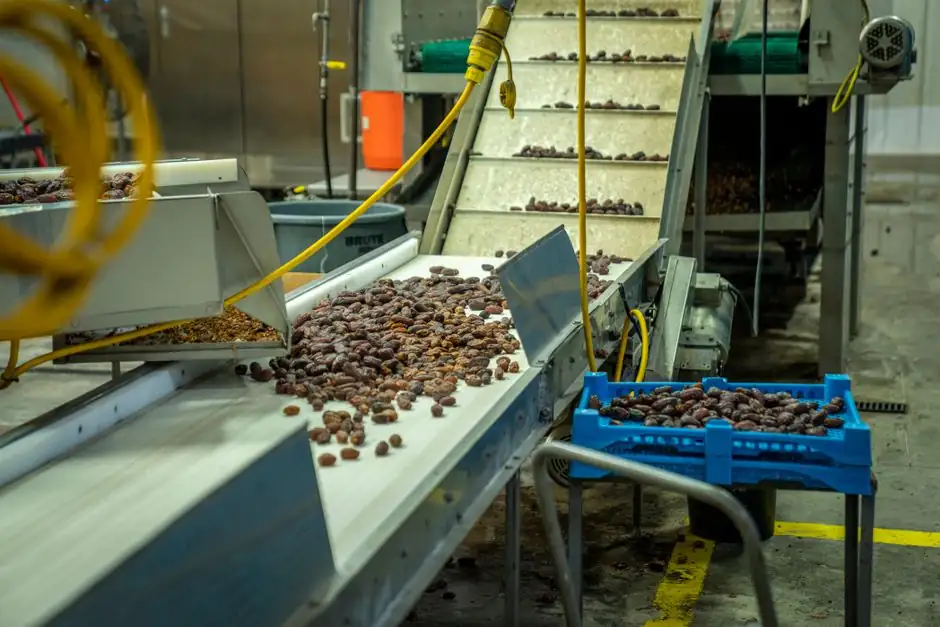
Stainless disc couplings with single-disc packs and no internal lubricant are the default specification for washdown pump, mixer, and conveyor drives in food plants, where the standard maintenance-free design drops into the same CIP/SIP cleaning regime as the driven equipment [S1][S2].
Selection in food processing is driven less by torque alone than by cleanability, material traceability, sealing integrity, and the ability to handle frequent hot-water and chemical exposure without corroding or shedding particles, which is why 304/316 stainless hubs, encapsulated disc packs, and IP69K-rated enclosures dominate the spec sheet [S2][S4].
Stainless material, surface finish, and cleanability requirements
A food-grade disc coupling is typically built from 300-series stainless steel, with 316 specified where chloride-rich cleaners (sodium hypochlorite, hot caustic) or salt brines attack 304, and hub surfaces finished to Ra ≤ 0.8 µm to support the smooth, non-porous surface that 3-A Sanitary Standard 64-04 and EHEDG Doc. 2 expect on product-contact and splash-zone equipment [S1][S4].
Unitized disc packs (4, 6, or 8 bolt designs, as offered on Lovejoy lines) eliminate crevices between stacked laminations, and the all-metal, lubrication-free architecture removes the lubricant-leakage failure mode that disqualifies gear and lubricated jaw couplings in washdown zones [S1][S6]. Hubs machined from solid bar rather than cast reduce porosity and improve electropolishing behaviour, which is the practical reason most OEM datasheets for food-grade disc couplings list 316 bar-stock hubs as the premium option [S4][S7].
Misalignment capacity, torque density, and service factor
Modern stainless disc couplings are typically rated for angular misalignment of 0.5–1.5° per disc pack, parallel offset of 0.1–0.3 mm per pack, and axial end-float of 1–3 mm, with double-disc (spacer) builds used to bridge the wider shaft gaps between motor and gearbox on conveyor or mixer skids [S1][S2][S3].
Torque density, the torque per unit bore or per kilogram, is the metric that lets a 1.5–3.0 kW pump drive shrink from a size-4 elastomeric coupling to a size-2 disc coupling, which lowers rotating mass on the shaft and reduces reaction loading on the bearing and seal set when the process pipe pulls [S1][S4]. For food-line applications, apply a service factor of at least 1.5 over the motor nameplate to absorb the start-stop cycles of filling lines and the peak torques of positive-displacement pumps, and never size from running torque alone [S5][S6].
Comparison: disc vs gear vs jaw in food processing
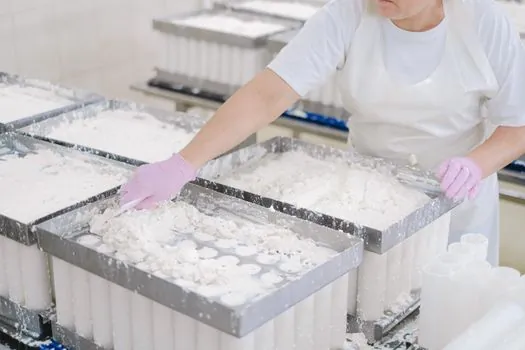
Against gear couplings and jaw couplings, the disc design is the only one that meets the typical food-plant maintenance and hygiene brief without compromise: gear couplings transmit the highest torque per bore but require lubricant and periodic re-greasing, which is incompatible with product-zone splash exposure, while jaw couplings use an elastomeric spider that absorbs CIP chemicals, swells, and becomes a particle-shedding consumable on a 6–12 month cycle [S1][S4][S5].
On a 2.2 kW centrifugal pump at 1,750 rpm, a size-2 stainless disc coupling will typically deliver roughly 50–80 Nm of rated torque, 0.3–0.5 mm of parallel offset per disc, and a 100,000+ hour L10 life under proper alignment, while a comparable gear coupling reaches similar torque at the cost of grease service every 4,000–8,000 hours, and a jaw coupling offers the lowest cost but caps out near 2,000 rpm on continuous duty in washdown conditions [S1][S4][S5]. For lines that need a spacer between motor and gearbox, double-disc builds extend that envelope and remain the preferred pick over spacer gear couplings in hygienic zones [S2][S7].
Speed, balance grade, and washdown enclosure rating
Stainless disc couplings routinely run at 3,600–6,000 rpm on pump and compressor shafts because the thin-laminate disc pack has no sliding contact and keeps dynamic imbalance low; the working ceiling for most 4-bolt and 6-bolt unitized designs sits at 10,000–15,000 rpm when balanced to AGMA 9000 or ISO 1940 G2.5 [S1][S4][S7].
For the food-zone housing and seal interface, specify IP66 as the minimum for hose-down areas and IP69K for high-pressure, high-temperature washdown (typically 80–85 °C water at 80–100 bar), which is the rating that lets the coupling survive daily detergent exposure without water ingress into the bore or the disc-pack cavity [S2][S4]. Where the coupling sits in a cold-room or freezer tunnel, verify the elastomeric components in any optional spacer element stay above their glass-transition point, otherwise creep and brittle fracture become the dominant failure mode rather than the usual misalignment-driven disc fatigue [S3][S6].
Failure modes, lubrication, and maintenance differences
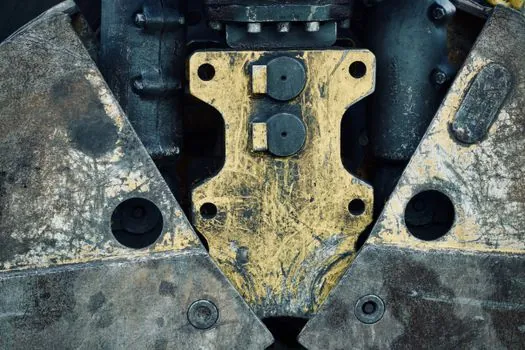
The three coupling families fail differently in food service: gear couplings wear at the tooth mesh and lose lubricant through seals, jaw couplings shed elastomer fragments and absorb CIP chemicals, and disc couplings fail by fatigue cracking of the thin stainless laminations when alignment, torque, or speed are mis-specified for the application [S1][S3][S4].
Because disc couplings have no lubricant, no sliding surfaces, and no elastomer in the torque path, the maintenance schedule collapses from the 6-month re-grease of a gear coupling or the 12-month spider swap of a jaw coupling to an annual visual inspection and a laser alignment check after the first 500 operating hours and after any base settling event [S1][S4][S5]. Shaft coupling selection in hygienic zones should therefore start from the assumption that the coupling is a one-time install with periodic inspection, not a planned-consumable item, and that any lubricant or elastomer in the torque path is a contamination liability, not a feature [S1][S2][S4].
Standards, documentation, and traceability
For US dairy, beverage, and ready-to-eat plants, the coupling hubs and any spacer hardware should be specified to 3-A Sanitary Standard 64-04, with material certificates to ASTM A276 (stainless bar) or ASTM A479, and a surface-finish certificate showing Ra ≤ 0.8 µm on product-contact or splash-zone surfaces [S1][S4].
For European plants, EHEDG Doc. 2 cleanability principles and EC 1935/2004 food-contact compliance are typically cited in the datasheet, and many OEMs pair these with FDA Title 21 CFR or USDA H1 incidental-contact statements for the optional elastomer or set-screw compound [S2][S4]. Buyers should require a documented MTR (mill test report) for the stainless grade, a torque-versus-misalignment curve for the actual coupling size, and confirmation that the disc pack is a unitized, laser-welded or riveted pack, since a loose-lamination disc cannot be reliably cleaned in place [S6][S7].
Track two signals over the next procurement cycle: the share of 316 stainless disc couplings being quoted on EU food-line RFQs (rising as chloride cleaning regimens expand), and the adoption of laser-welded unitized disc packs as the default over glued or riveted stacks on hygienic builds [S1][S6][S7]. For drives in adjacent heavy industries, the same spec discipline maps directly onto cement-plant and wastewater applications, where a parallel disc coupling selection for cement plant drives reference applies the same torque-density and misalignment logic to a much harsher dust and load profile.