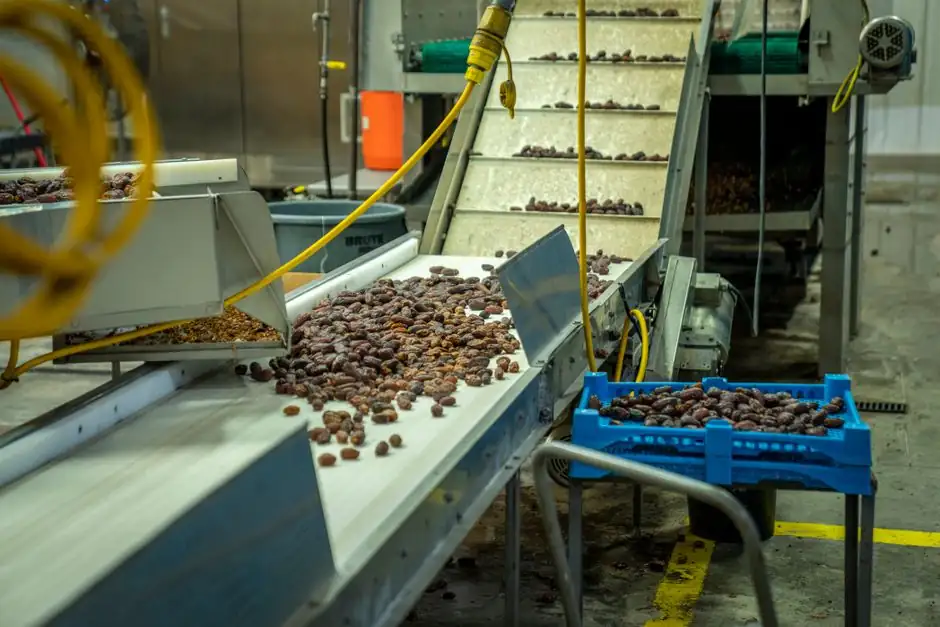
In a USDA-inspected processing line, the tensioner is a food-contact risk surface, not a commodity bracket: every wetted part must meet FDA 21 CFR and survive peracetic acid, chlorinated cleaners, and hot-water CIP at 82-85°C [S2][S4].
Specifying a belt tensioner for a meat, dairy, bakery, or IQF line comes down to four variables: contact material, tension mechanism, hygiene geometry, and the belt type it is matched to, whether a flat belt, ribbed belt, or timing belt drive [S2][S3].
Food-Grade Material Requirements for Tensioner Contact Parts
FDA 21 CFR compliance is the baseline for any tensioner arm, pulley, idler, or spring cover that can shed into the product zone, and neoprene is explicitly not food grade even in non-contact positions because wear particles migrate [S2]. Food-grade polyurethane (PU) and 304/316 stainless steel are the two default contact materials, while PTFE and silicone covers are used where belt release or extreme temperature exposure (from -40°F IQF cold to 260°C+ bakery oven exits) is in play [S2][S4]. Metal-detectable PU in blue or natural is the practical default on lines with downstream x-ray or metal-detection inspection, because a fragment that breaks free still gets rejected [S2].
Stainless selection should be pinned to AISI 316 over 304 in any zone exposed to brine, lactic acid, or chloride-bearing sanitizers, since 304 shows visible corrosion in chlorinated wash water within weeks of CIP cycling [S2][S5]. Spring steel, plated carbon steel, and zinc-plated hardware should be excluded from USDA zones regardless of grease or epoxy coating, because coating damage during sanitation exposes ferrous substrate and creates both a rust and a contamination source [S2].
Tension Mechanism: Spring, Pneumatic, or Weighted vs Manual Slide
Manual slide-base adjusters require a tool and an operator to re-tension, which means the tensioner is rarely re-tensioned between sanitation shifts, and a belt conveyor running loose after a stretch event is the most common cause of pulley-rim slippage and edge damage on PU food belts [S2][S4]. Spring-loaded automatic tensioners maintain a near-constant take-up force across the belt's elongation curve, and pneumatic-bladder units add a controlled, adjustable preload that can be dialled in from the cabinet without breaking the washdown seal. Weighted gravity tensioners are mechanically simple and survive high-pressure wash better than spring enclosures, but they need vertical clearance and a guarded cable or rod path that does not drip lubricant.
For timing-belt drives on enrobers, depositors, and form-fill-seal packaging machines, the tension window is narrow because steel- or Kevlar-cord PU belts have very low elongation (typically under 1% over service life), and a pneumatic or fine-thread spring tensioner is the only practical way to hold the set point [S2]. For V-belt or ribbed belt drives on motor-to-gearbox couplings, a spring-loaded tensioner with the spring preloaded to roughly 1.5x the calculated running tension is the usual baseline, and the spring rate should be selected so the additional deflection from peak torque does not drop the belt below the wrap-angle minimum on the smallest sheave [S1].
Hygiene Geometry and Washdown Construction
A food-zone tensioner must have a smooth, non-absorbent surface with no exposed fabric edges, no threaded pockets that trap debris, and no internal cavities that hold wash water, three of the five HACCP-relevant design points that audit programs (SQF, BRC, FSSC 22000) flag during line walks [S2][S5]. Open-frame tensioner brackets with horizontal flat surfaces should be reworked to a sloped or radiused geometry, because a horizontal ledge inside the product zone becomes a condensate and bacterial reservoir even when the rest of the line is sanitary [S3][S5].
Sealed-bearing idler pulleys (typically 2RS or 2RSH contact-lip seals, stainless raceways, and food-grade H1 grease) are mandatory on any tensioner pulley that lives inside the washdown zone, because open bearings ingest wash water and the first failure mode is grease purge, followed by shaft seizure and belt-edge damage [S3]. Spring enclosures on automatic tensioners should be either fully sealed bellows-type stainless covers or open rod-and-spring designs with the spring located outside the product zone on a bracket arm, never a tensioned coil spring sitting in the open above a food contact belt [S2][S3].
Matching Tensioner Travel and Force to Belt Type
Tensioner travel is sized to the maximum expected belt elongation over the re-tension interval plus the wear-take-up of any pulley groove: timing belts typically need only 5-15 mm of travel, V-belts and ribbed belts 20-40 mm, and flat fabric or modular plastic belts up to 100 mm or more [S1]. Spring force is then calculated from the manufacturer's minimum recommended belt tension at the smallest sheave, divided by the tensioner arm ratio, and a safety factor of 1.3-1.5x applied to cover transient load spikes from product loading or jam-clearing events.
Belt type drives the contact-surface decision: PU and silicone timing belts pair with smooth crowned or flat stainless idlers, while fabric flat belts and modular plastic belts accept either smooth or lightly lagged drive surfaces, and grooved V-belt sheaves should not be reused as flat-belt idlers even when the OD matches [S2][S4]. The metal-detectable PU timing belt on enrober and depositor drives typically runs at 5M, 8M, L, H, T5, or AT5 profile with steel or fiberglass cord and a blue or natural FDA body, and the tensioner must accommodate the specific cord stiffness because Kevlar-cord belts used on frozen-food lines behave more elastically than steel-cord equivalents and need a softer spring [S2].
Standards, Audits, and Common Failure Modes
FDA 21 CFR (food contact), USDA-FSIS sanitation requirements, BISSC for bakery lines, and CE/OSHA for operator safety frame the regulatory environment, while the typical audit program (SQF, BRC, FSSC 22000) requires that any belting or component in the product zone be food-grade in a detectable, non-food color so fragments are rejected downstream [S2][S3]. Internal line standards usually also reference FDA Title 21 CFR 110.93 for storage and distribution, and 21 CFR 117 for the Preventive Controls framework, although the tensioner itself is not directly named in either rule [S2].
The most common failure modes on food-line tensioners, in order, are: (1) bearing seizure from wash-water ingestion, (2) spring corrosion and preload loss on exposed carbon-steel springs, (3) microbial growth on horizontal pockets that were missed during hygienic-design reviews, and (4) belt-edge damage from a tensioner arm that drifted out of square after a sanitation-impact event [S3][S5]. A documented quarterly walk-down that checks tensioner arm alignment, bearing condition, surface finish, and fastener torque catches three of these four before they trigger a foreign-object or HACCP finding [S2][S5].
Selection Comparison: Tensioner Types for Food Processing
On a frozen-food IQF line at -35°C, a pneumatic-bladder tensioner with 316 stainless hardware, sealed stainless bearings, and a 50-80 mm travel range handles the belt's higher thermal contraction without starving the wrap angle on the drive sheave [S2][S5]. On a meat deboning or poultry cut-up line with heavy CIP and blood/brine exposure, a spring-loaded automatic tensioner in 316 stainless with FDA blue PU arm covers and an externally mounted spring is the workhorse option, offering low maintenance and easy sanitation access [S2][S5].
On a dairy or beverage washdown line running hot-water CIP at 82-85°C daily, the best fit is a 304/316 stainless tensioner with PTFE or UHMW sliding surfaces and a sealed spring enclosure, since standard elastomer seals fail quickly in continuous hot water [S2][S3]. On a bakery or confectionery enrober or depositor with a 5M or XL PU timing belt, a compact pneumatic or fine-pitch spring tensioner with a metal-detectable blue PU idler and roughly 10 mm of travel is the spec, and anything with a manual slide adjuster will drift out of spec within a shift, as a related spec-first guide on adjacent food-line components also stresses explicit travel and force numbers in the BOM [S2][S5].
The criteria comparison below lines the four common options against the decisions a process engineer has to make on a new line or retrofit:
Manual slide-base adjuster: lowest cost, fails to maintain tension between shifts, unsuitable for USDA zones, not recommended on any drive that loses more than 1% tension through normal stretch [S1][S2]. Spring-loaded automatic: mid cost, maintains preload, requires hygienic spring enclosure, default on most meat and dairy lines [S2][S5]. Pneumatic bladder or piston: highest cost, field-adjustable preload, best for timing-belt drives and applications with frequent product changeovers [S2]. Weighted gravity: simple, no enclosed spring, needs vertical clearance and a guarded cable path, common on long flat-belt conveyors in dry-goods packaging [S1][S3].
Trackable signals for a spec-first buyer: the FDA 21 CFR compliance statement on the tensioner arm material, the AISI grade (304 vs 316) of every wetted stainless part, the bearing seal class (2RS, 2RSH, or equivalent), and the spring preload setting recorded against the manufacturer's recommended belt tension at the smallest sheave [S2][S3][S5].
See also our earlier report, Warning Tape Selection for Food Processing: Spec-First Buyer's Map.