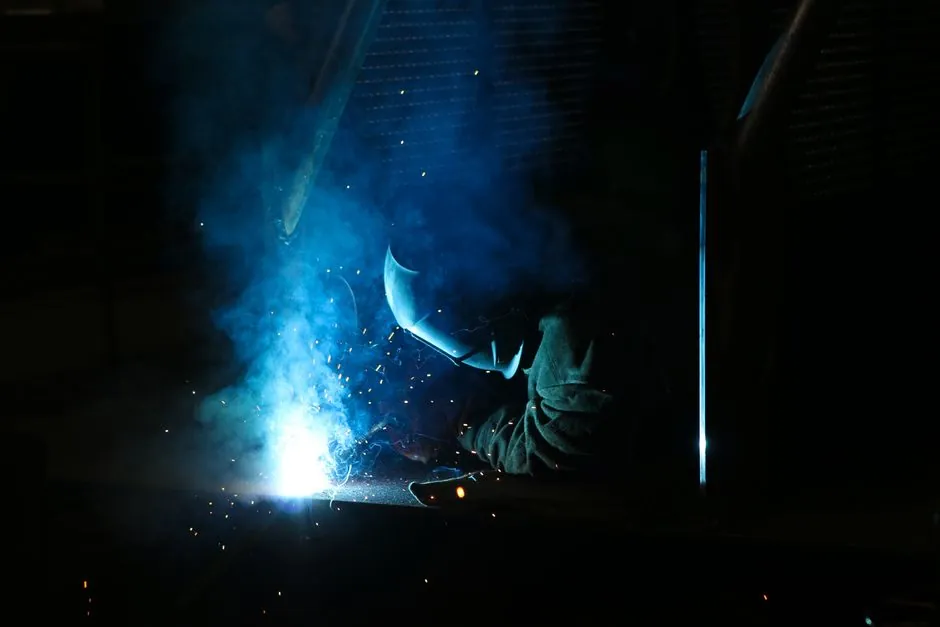
For road-maintenance work on bridge piers, pier columns, pile caps, and abutment stems, an electroslag pressure welder is a portable resistance-and-arc system that joins vertical reinforcing bars end to end inside a flux-filled mold, applying axial upset pressure to forge the joint and leave a visible collar that is later ground flush before concrete placement [S1][S4].
Spec ranges published for 2026 production units cluster at 200-650 A welding current, 35-45 V arc voltage, 16-32 mm (and on larger heads 16-40 mm) bar capacity, and a total system mass split between a deck-side power source and a worker-carried welding head [S3]. The rebar process is governed in China by JGJ 18-2012 and in the US by AWS D1.4/D1.4M, with the analogous plate-electroslag variant ESW/NGI-ESW running under AWS D1.5 (Bridge Welding Code) for built-up girders [S1].
Why the rebar EPW process fits vertical pier-column work
EPW splices two coaxial bars in a single cycle: high no-load voltage strikes an arc that melts granular flux into a conductive slag pool near 1900 °C, current then passes through the slag by resistance to bring both bar ends to a plastic state, and the head drives the upper bar downward under upset pressure to forge the joint and expel slag as a collar [S4]. ACI 318 requires that any welded or mechanical splice develop at least 125% of the bar yield force in tension or compression, which the EPW process is engineered to meet on vertical column bars in the 16-40 mm range [S4].
On a road-maintenance site, the welding head and clamp are light enough for one or two workers to carry up the column cage, while the heavier power source stays on the deck below connected by control and welding cables [S4]. For related on-site rebar sizing and straightening before the splice, see this rebar straightener spec map for road maintenance.
Spec ranges that drive the 2026 purchase decision
Four numbers must be locked before quoting any electroslag pressure welder for road-maintenance rebar work: maximum bar diameter the welding head accepts (commonly 16, 20, 25, 32, 40 mm), welding current rating and duty cycle of the power source, the upset forging force the head can deliver, and the control sequencing of the arc stage, electroslag stage, and upset stage [S1]. A representative Chinese OEM datasheet for a ZX7-630 class inverter lists 200-650 A welding current, 35-45 V arc voltage, 16-32 mm bar capacity, and 1-piece minimum order with FOB/CFR/CIF terms [S3].
The slag-bath operating envelope for the sister plate process ESW is published at roughly 600 A DC at 40-50 V with the slag pool near 1900 °C and a vertical or near-vertical orientation, with deposit rates reported up to 20 kg/h on plate from above 25 mm up to roughly 300 mm thick [S2]. That same DC, high-current, vertical-only logic carries over to EPW heads, where the arc-to-electroslag transition is the critical control moment.
Three rig classes compared on the criteria that matter
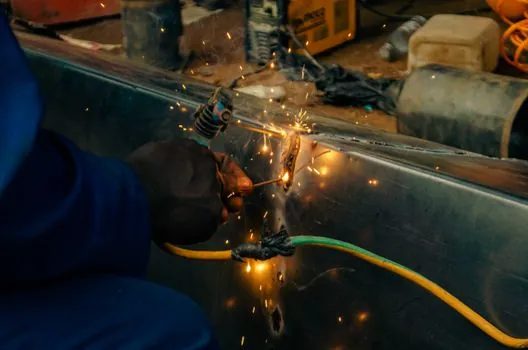
For road-maintenance procurement in 2026, three rig classes cover the realistic option set. A manual-clamp AC transformer welder with a 16-32 mm single-bar range is the lowest cost and lightest head, suited to small pier-column maintenance where operator skill drives collar quality. A manual-clamp inverter DC welder with a 16-40 mm range and a programmable arc-to-upset timer costs more up front but produces more repeatable collars and is preferred on tall piers where the worker climbs with the head. A semi-automatic dual-operator rig with hydraulic upset in a 25-50 mm range gives the best collar consistency on large-diameter bars but adds weight and needs crane lifts to position [S1].
On the criteria of bar-diameter range, collar repeatability, weight on the head, and first cost, the inverter DC manual-clamp rig hits the best balance for most road-maintenance column work. For abutment stems and retaining walls where bars run true and the crew can stage at the splice, the AC transformer unit is still acceptable, while the hydraulic dual-operator rig earns its slot only when the project contains a high count of 32-40 mm vertical splices.
Code paths and acceptance limits that govern the splice
Weld-collar acceptance limits in JGJ 18-2012 set axial offset, bar-diameter mismatch, and visible defect thresholds that the equipment must hit under production rate, not just in a lab [S1]. The comparable US framework for welding reinforcing steel is AWS D1.4/D1.4M, while the plate ESW variant is bound to AWS D1.5 and constrained on fracture-critical members by the FHWA memorandum dated 2018-05-10 [S1].
Engineers should not confuse the rebar electroslag pressure welder with the plate electroslag welder. Both share a molten slag bath that heats the joint, but only the rebar process applies axial upset pressure to forge a bar-to-bar joint inside a flux-filled mold; ESW deposits consumable wire between water-cooled copper shoes to join thick plate [S1][S4]. For the stud-arc cousin used on composite deck plates and shear studs, see this stud welder selection guide for concrete.
Limitations, failure modes, and when not to use EPW
EPW is restricted to vertical or near-vertical bars within roughly a 4:1 gradient, and out-of-position work is mechanically impractical with a standard EPW rig because the molten pool and slag must be held by gravity and the mold [S1][S2]. Bar diameter is bounded at the lower end by the ability to establish the slag pool and at the upper end by the upset force the head can deliver, so thin rebar and very large bars (above 40 mm on most heads) fall outside the documented operating window.
The slag-bath heating principle produces a coarse prior-austenite grain and a wide heat-affected zone on the sister plate process, and on quenched-and-tempered or alloyed grades this drives HAZ hardness above the bands that sour-service or low-temperature toughness regimes will accept, which is why classic ESW was historically linked to brittle fracture on a fracture-critical I-79 member near Pittsburgh and was rescinded on main structural tension members in FHWA notice N 5040.23 dated 1977-02-16 [S1][S2]. The NGI-ESW refinement lowered heat input, eliminated electrode oscillation, and added fixed guide and travel-speed control, restoring process acceptance for non-fracture-critical tension members in AASHTO temperature zones 1 and 2 [S1].
Acceptance checklist before the unit leaves the yard
Before any electroslag pressure welder is dispatched to a road-maintenance bridge job, four checks are non-negotiable. Confirm the head's bar-diameter range covers the largest bar on the drawing (commonly 32 mm, sometimes 40 mm), confirm the power source can sustain the rated current at the duty cycle implied by joint count per shift, confirm the upset force and arc-to-upset timer settings against JGJ 18-2012 collar limits, and confirm that the operator qualification paperwork references AWS D1.4/D1.4M or the equivalent local standard [S1][S4].
For road-maintenance work that runs adjacent to or below an existing alignment and must use mechanical splices rather than welded splices, the matching coupler spec map for the same trade is covered in this rebar coupler selection guide for road maintenance. Track the 2026 procurement signal on whether the 16-40 mm inverter DC head with hydraulic upset becomes the de facto road-maintenance default over the lighter 16-32 mm AC transformer unit, and whether the AWS D1.4/D1.4M framework revises the collar-defect thresholds that drive acceptance in the field.
The underlying component specifications are covered under electroslag pressure welder, road roller, and arc welder.