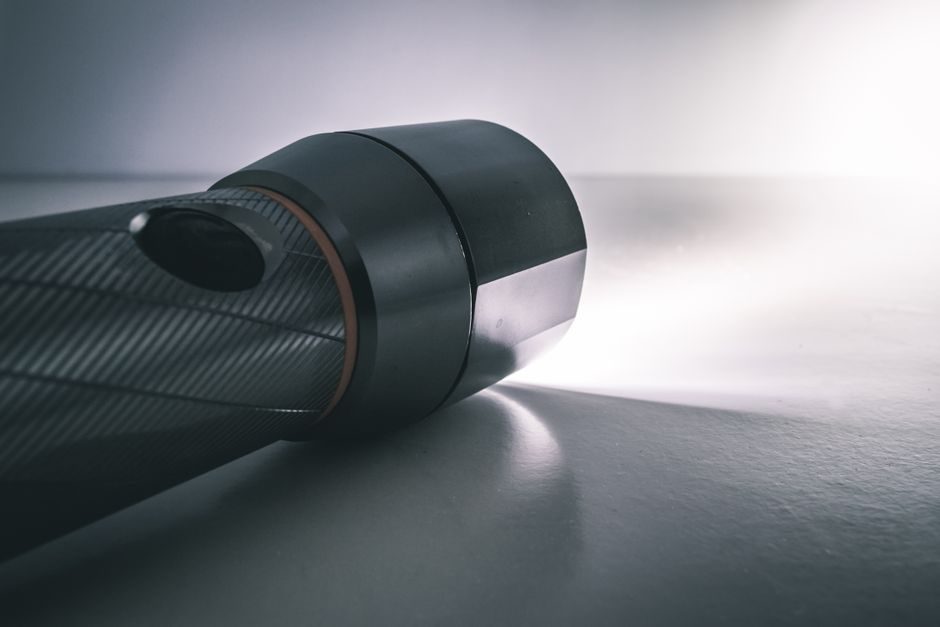
Emergency luminaires are mandated safety hardware: battery-backed fixtures that maintain 90+ minutes of egress-path illumination when utility power fails, defined by UL 924 in North America and IEC 60598-2-22 in most other regions.
Spec range runs from 1.5 W single-head self-contained units for stairwells, to 25-50 W twin-head remote-capable fixtures driving 6-12 V DC remote heads in warehouses and plant corridors [S1].
Defining the Hardware: Self-Contained, Central Battery, and Hybrid
Self-contained emergency lights integrate the battery, charger, and lamp head inside one housing; the luminaire is a UL 924-listed "unit equipment" and operates independently when normal power drops. Central battery systems (CBS) feed multiple remote heads from one bankside battery cabinet at 24 V DC or 120 V AC, preferred in high-ceiling plants and airports where lamp count exceeds ~50. Hybrid mains-transfer-to-LED systems use an upstream normal/emergency transfer switch ahead of a regular LED fixture — this is not the same as a listed emergency luminaire, and is only accepted where the AHJ agrees the listed path covers the load.
Core Advantages: Why the Code Forces Installation
Three concrete wins justify mandatory specification under NFPA 101 Life Safety Code and the IBC. First, the runtime guarantee: 90 minutes minimum at the rated lumen output after loss of normal power, sufficient for a planned evacuation of typical commercial occupancies per UL 924. Second, automatic activation: solid-state chargers hold NiCd, NiMH, or sealed lead-acid (SLA) packs at float; a relay or MOSFET switch transfers the load in under 1 second when line voltage drops below roughly 80% of nominal. Third, low operating cost: LED heads draw 1.5-5 W, so a 50-fixture plant idles at under 200 W on float, and self-test/self-diagnostics (required since the 2016 UL 924 revision) cut the manual monthly test from 30 seconds of walking to a 30-second status-light check.
Spec-Driven Limitations: Where Engineers Push Back
The trade-off list is real and quantifiable. Battery life runs 3-5 years for SLA and NiCd in 25 °C ambient, dropping to 2-3 years above 35 °C, and a missed annual 90-minute discharge test escalates the failure rate of the weakest cells sharply. Lumen output is modest: a typical twin-head LED unit delivers 300-600 lumens total, versus 1,500-3,000 lumens from a normal stairwell fixture, so spacing on the egress path is the design driver rather than coverage. Cold environments penalize SLA below 0 °C; NiCd holds to -20 °C, and LiFePO4 packs are now common on premium units for the -30 °C to 60 °C range. The emergency light category page summarises the same set of chemistry-dependent trade-offs. [S1]
Type-by-Type Comparison: Pick the Right Architecture
Compare the three architectures on the four criteria that drive a real spec sheet: cost per luminaire, maintenance burden, runtime scalability, and suitability for hazardous areas. Self-contained: $80-$250 per unit, lowest install cost, single-point-of-failure — when the battery dies the fixture dies, so monthly 30-second visual checks and annual 90-minute tests remain mandatory. Central battery systems: $2,000-$15,000 per cabinet feeding 10-100 heads, higher upfront but one battery room replaces dozens of point-of-use packs, and remote heads are listed separately as components. Explosion-proof variants fall under UL 844 / IEC 60079-0 and are required in Class I Div 1 and Zone 1 process areas; standard emergency units are NOT acceptable in those locations. The explosion-proof light reference covers the Zone/Class system that the specifier has to map before choosing. The emergency stop button page sits next to this in the safety hardware category but is a different device — the stop button kills machine power, the emergency light guides people out, and conflating the two is a common spec error. [S1]
Selection Criteria for Process Plants and Commercial Sites

Walk through five filters in order: (1) Code basis — confirm whether the AHJ enforces NFPA 101, IBC, or the local equivalent and what occupancy classification applies; (2) Ambient and IP rating — outdoor or wet-location heads need IP65 minimum, food-processing areas need IP66/69K; (3) Hazardous area classification — Class I/II/III Div 1-2, Zone 0-2, or unclassified; (4) Photometric spacing — at 3 m mounting height, a 300 lm twin-head covers roughly 6 m × 2 m of path, so a 30 m corridor needs at least 5 units; (5) Battery chemistry — NiCd for cold storage and most plant duty, LiFePO4 for long-life critical-care rooms, SLA for the lowest unit cost in conditioned indoor space. Designers who skip filter 4 typically underlight the path and fail the AHJ walk-through. For corridors and stairwells, the emergency stop hardware family — actuators, pull-stations, and mushroom buttons — is a related but distinct spec line. [S1]
Failure Modes and Maintenance Traps
The four most common post-install failures, in order of frequency. Battery sulfation: SLA packs left on float for over 3 years without a 90-minute discharge lose roughly 30% of capacity and fail the annual test; replacement is the only fix, not "topping up". Charger failure under high temperature: electrolytic capacitor life halves for every 10 °C above 25 °C, so attic- and boiler-room-mounted units fail first. Wiring/transfer relay sticking: mechanical relays in pre-2015 units occasionally weld closed, so the lamp never transfers — solid-state relays in current designs eliminate this but cost more. [S1]
Standards and Sourcing Notes for 2026
UL 924 remains the listing standard in the US; IEC 60598-2-22 plus IEC 62034 (central battery systems) cover most non-US installations, and EN 1838 supplies the photometric minimums (1 lux minimum on the egress path). For hazardous areas, the emergency variant must additionally be listed to UL 844 / IEC 60079-0. Specifiers should require a self-test feature per UL 924 paragraph 27.6 to reduce the manual monthly test, and should verify the listed ambient — 20 °C is a common UL 924 default that does not match a foundry or boiler room. Buyers tracking tariff impacts on imported LED packs can cross-reference the UPS system supply chain 2026 update, which covers parallel duty on lithium cells, and the related industrial coating trade-off map for the housing/corrosion layer. [S1]