Emergency luminaires are not a single product line but four operationally distinct families defined by BS 5266-1:2016, and the differences between maintained, non-maintained, combined and sustained units drive both the wiring architecture and the photometric test regime [S6].
Specifying the wrong family is the single most common root cause of an emergency-lighting installation failing its annual discharge test, because the lamp is either energised continuously when it should not be, or starved of charge current when the building expects it to be lit [S6][S5].
Mode-of-Operation Classification: The Four BS 5266-1 Families
BS 5266-1:2016 codes emergency luminaires by how their lamp behaves in the healthy (mains-on) state — maintained units run the emergency lamp 24/7 alongside the normal luminaire; non-maintained units keep the lamp off until mains fails; combined units carry two lamps in one housing, one mains-fed and one emergency-fed; sustained units (sometimes called “switch-maintained”) only energise the emergency lamp when the local switch is off [S6]. A SUREALL AES-series 1 W LED exit sign published with 220–240 V AC input, 6.4 V DC battery rail, IP66 enclosure and a 0 °C to +40 °C ambient rating is a concrete data-point of the non-maintained/combined exit-sign class used in industrial aisles [S5].
The mode choice is dictated by the room function, not by installer preference. Cinemas, sleeping-accommodation corridors and public-evacuation routes typically use maintained so the exit sign is visible at all times, while plant rooms and back-of-house escape routes rely on non-maintained because the luminaire is doing double duty as a normal fitting that should look unlit during occupancy [S6].
Function-of-Light Classification: Escape, Open-Area, and High-Risk Task
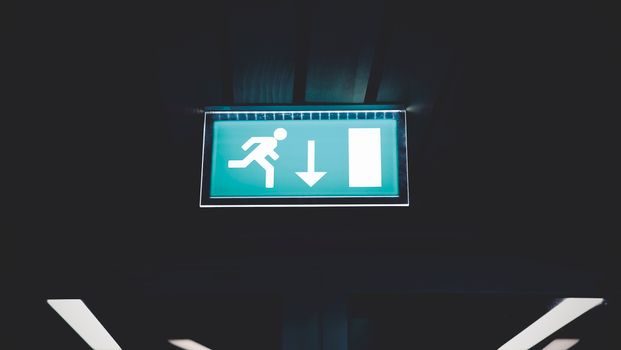
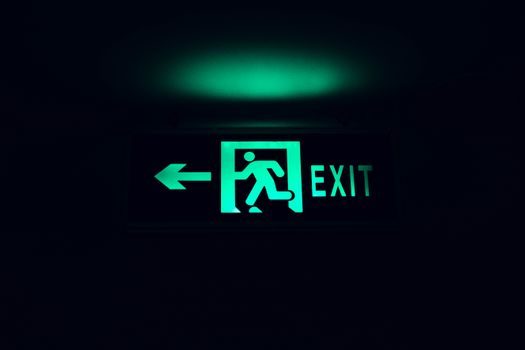
BS 5266-1:2016 partitions emergency lighting by what it has to do for the occupants, splitting it into three photometric roles: escape-route lighting (≥1 lux on the floor along the defined route), open-area / anti-panic lighting (≥0.5 lux across the core floor area, excluding a 0.5 m border), and high-risk task-area lighting (≥10 % of the normal task illuminance or 15 lux minimum, held for the full duration of the hazard) [S6]. Emergency sign luminaires — the green-running-man EXIT panels — are a parallel requirement of BS 5266-1:2016 and must be sited at every change of direction, every floor level change, and at final exits [S6].
The data point that catches engineers out is the open-area 0.5 m exclusion border, which means a 20 m × 20 m open-plan office needs anti-panic coverage over a 19 m × 19 m area inside the perimeter, not the full floor plate, and the calculation must use the maintained factor and the luminaire’s published polar curve — not the headline lumen figure [S6].
Power-Source Classification: Self-Contained vs Centrally-Supplied Systems
Self-contained (single-point) luminaires each carry their own battery, charger, inverter and indicator LED, and BS 5266-1:2016 treats them as the default for premises under 10 000 m² of escape route because testing and fault-isolation are local [S6]. Centrally-supplied systems use a common battery bank feeding a 230 V AC or 230 V DC “permanently alive” distribution loop — the right answer for high-rise, multi-storey car parks, hospitals and any installation where a single battery room is preferable to 2 000 scattered LiFePO4 packs [S6].
The published 1 W LED / 3 h rated-duration / IP66 exit sign cited above is a self-contained unit, which is why its DC bus is 6.4 V (one 6 V sealed lead-acid or four Li-ion cells in series) and why the ambient window stops at +40 °C — at higher cell temperatures the battery derates and the 3 h claim collapses [S5].
Duration and Battery-Chemistry Sub-Classes
BS 5266-1:2016 ties the rated duration to the re-occupancy time of the building: 1 h is normally acceptable only for premises where evacuation is effectively instantaneous, 3 h is the workhorse figure for most office, retail and light-industrial occupancies, and 1 h is also acceptable for self-contained units where a central system backs them up [S6]. The 3 h figure is what the AES-series exit sign publishes, and it implies a battery sized for roughly 4–5× the 1 h load once Peukert losses and the +40 °C derate are folded in [S5].
Chemistry choices are NiCd (still the most tolerant of ambient swings but now restricted under the EU Battery Directive 2023/1542 from 2026-08 onward), NiMH (intermediate energy density, less memory effect), sealed lead-acid (lowest cost, 5-year typical service life) and LiFePO4 (longest cycle life, best weight, but tight BMS requirements) [S6]. Designers that pick LiFePO4 for a 3 h unit have to publish a cell-level UN 38.3 transport certificate and a cell-level IEC 62133-2 safety report, not a generic “Li-ion” data sheet.
Hazardous-Area Sub-Classes: When the Luminaire Has to Be Ex-Proof
Where the emergency luminaire is installed in a Zone 1 or Zone 2 gas atmosphere, or a Zone 21/22 dust atmosphere, the enclosure classification moves from IP65/IP66 to a full Ex d, Ex e, Ex nR or Ex tb marking under IEC 60079-0 / IEC 60079-1 / IEC 60079-31, and the unit carries an additional explosion-proof light marking with its Ex db IIB T4 Gb or equivalent string printed on the nameplate [S2]. Emergency supply units for explosive atmospheres appear in the wholesaler product mix alongside light fittings and installation material for the same hazardous locations, confirming that explosion-protected and emergency-lighting duties are routinely co-specified [S2].
For sites that sit close to a process skid, an Ex-proof twin emergency bulkhead with a 90-minute rated duration and a self-contained NiCd pack is the default, and the same luminaire is almost always paired with an emergency stop button at the access door so the operator can kill the skid before opening the enclosure.
Comparison Map: Choosing Between the Four Main Families
Across the four primary BS 5266-1:2016 families, the decision matrix lines up as follows. Maintained units score high on visual always-on compliance (best for cinemas, sleeping risk, public routes) but draw standby current 24/7 and need a longer-rated battery. Non-maintained units give the longest battery service life and the lowest standby drain, but are unsuitable for any space where the EXIT sign has to be visible during normal occupancy. Combined units (two lamps, one housing) are the right answer where one fitting replaces a normal and an emergency luminaire in a refit, at the cost of a larger housing and dual-circuit wiring. Sustained units give the installer a single switched live feed and are common in stairwells where the local switch is normally on, but they fail open-circuit tests more often than self-contained combined units because the standby lamp is rarely exercised. [S4]
Where a building owner is comparing self-contained vs centrally-supplied on a 5 000 m² industrial unit, the rule of thumb is to stay self-contained below 200 luminaires and go central above that, because the labour cost of monthly discharge-testing 200+ individual battery packs overtakes the cost of one battery room [S6].
Failure Modes and Acceptance Tests That Decide Sign-Off
The most common field failure is a battery that holds 1 h but not 3 h, which BS 5266-1:2016 addresses by mandating a half-duration test annually and a full-duration test annually, with the result logged in the on-site logbook [S6]. The second most common failure is an LED indicator that has been on for years and has failed silently, leaving the duty engineer unaware that the charger is no longer running; the cure is a monthly LED-indicator visual check plus a recorded annual discharge test [S6].
A frequently overlooked field issue is the photometric re-check after a tenant change — when a landlord fits out a 200 m² office as an escape route and the new partitions are added, the original 1-lux calculation is no longer valid, and the luminaire positions must be re-modelled against the new floor plan, not just re-tested for duration [S6]. Independent coverage of pipe fitting and flange compatibility and the field acceptance of glass curtain wall systems underscores the same spec lesson: an installed system must be re-verified against its design intent, not merely powered up.
Linked Safety Disciplines Worth Naming in the Same Spec Pack
An emergency-lighting pack is rarely a standalone document — it sits next to the safety light curtain layout on a machine-cell drawing, the emergency stop circuit diagram for the same cell, the pushbutton pilot light arrangement on the control panel, and the emergency light itself at the cell door. Likewise, hazardous-area builds that bundle the emergency-lighting spec with an explosion-proof light schedule typically share a common ATEX/IECEx certification dossier across the whole skid, which keeps the notified-body audit to a single file. [S3]
Watch the BSI catalogue and the OPSS enforcement bulletin for either event.