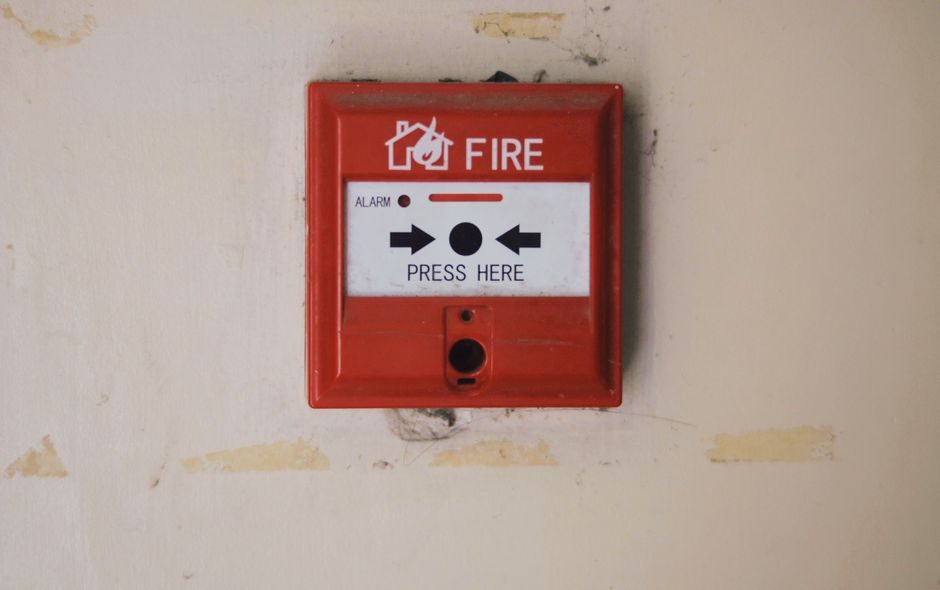
An emergency stop button is a fail-safe control device wired in series with a machine's control circuit, designed per ISO 13850 and EN 418 to interrupt power when an operator strikes the red mushroom actuator [S2].
Common mushroom head diameters are 29 mm, 30 mm, 40 mm, and 60 mm, with the 40 mm size dominating conveyor, packaging, and CNC retrofit panels [S2]. The contact block must use a direct-opening (positive-opening) NC element with mechanical self-holding; release requires an authorised deliberate action, twist, pull, or key turn, to prevent an inadvertent restart [S2].
Standards Anchor: ISO 13850 and EN 418 Mechanical Rules
ISO 13850 (the international successor to EN 418) sets three hard constraints that no compliant emergency stop can violate: red colour, mushroom-head geometry, and yellow background [S2]. The push button must be highly visible in colour, label, and shape so that an operator under stress can actuate it within fractions of a second [S2].
The direct operation mechanism must act on the NC contact and latch mechanically; reset is by twist-release, pull-release, or key-release, never by simple spring return [S2]. For explosion-proof button duty in Zone 1 / Zone 2 hazardous areas, the same ISO 13850 geometry is overlaid with IEC 60079-series certification, and the enclosure must carry an Ex d or Ex e marking on its nameplate in addition to the CE mark.
Contact Architecture: NC Positive-Opening vs. Auxiliary NO
Each E-stop station needs at minimum one positive-opening NC contact wired into the safety relay or contactor coil; a second NC and one or two NO auxiliaries are normal for status feedback to the PLC [S2]. Wiring the E-stop in series with the control circuit means a single actuator press breaks the coil path and removes power to the machine [S2].
Positive opening is the non-negotiable spec: the NC contact must be mechanically forced open by the plunger travel, not rely on spring return alone, so a welded contact cannot prevent tripping. Selector push button switches from the same vendor family (e.g. the GQEM GXB2 / GXB4 / LA115 accessory lines) share mounting hole patterns but must NEVER be substituted for an E-stop block because their contacts are not positive-opening [S1].
Ingress Protection and Environmental Duty Mapping

Standard panel-mount E-stops ship at IP54, sufficient for indoor control cabinets with light dust exposure [S2]. Washdown zones in food, beverage, and pharmaceutical lines require IP65 minimum, and outdoor or marine skid packages often demand IP67 with stainless steel bezels and silicone gaskets [S2].
Temperature rating is the next gate: commercial blocks are typically rated -25 °C to +70 °C operating, with storage to -40 °C; cold-room or foundry duty may force a derate or a specialist polymer actuator. Mounting hole standards cluster around 16 mm, 19 mm, 22 mm, 25 mm, and 30 mm, with 22 mm being the de-facto global default for industrial panels [S1].
Release Variant Comparison: Pull vs. Twist vs. Key
Pull-release E-stops suit low-traffic panels where a deliberate hand pull signals clear intent to reset, common on elevators and lifts [S2]. Twist-release is the most common industrial default: a ¼ to ½ turn of the mushroom head releases the latch, balances tamper-resistance against ergonomic speed, and is what most 22 mm panel builders default to [S2].
Key-release E-stops are mandatory where unauthorised reset is a liability: press tools, robotic cells, and energy-isolated maintenance lockouts. The physical key provides an audit trail of who re-enabled the line and aligns with the lockout-tagout (LOTO) workflow. A side-by-side engineering view: pull-release is fastest to reset but easiest to defeat; twist-release is the balanced industrial default; key-release is the audit-grade option for Category 3 / Category 4 safety circuits under ISO 13849-1.
When an E-Stop Is NOT Required, and When It Is

Not every machine legally requires an E-stop. ISO 13850 / EN 418 leaves the decision to a documented risk assessment: if the hazard analysis shows no plausible emergency-stop scenario that would reduce risk, the E-stop can be omitted [S2]. Examples include hand-held power tools, some fully enclosed automated test equipment, and low-risk consumer appliances.
Where an E-stop IS required, the rule is one per operator station plus one per identified hazard zone, never a single device guarding a long conveyor with multiple access points. Machines exported to the EU under the Machinery Directive (2006/42/EC) carry a presumption of needing ISO 13850 conformance unless the technical file justifies otherwise [S2]. North American NFPA 79 has parallel language for industrial machinery, while UL 508A governs the panel build that hosts the device.
Selection Shortlist Logic and Field Signals
Default shortlist for a greenfield 22 mm panel build: a 40 mm red mushroom, twist-release, IP65, 1 NC + 1 NO positive-opening, IEC 60079-rated if any Zone 1 / Zone 2 equipment is within the line. The vendor range GQEM publishes, covering 16 mm to 90 mm indicators, 12 mm to 30 mm metal push buttons, and 22 mm emergency stop push button switch blocks, gives panel builders a single accessory ecosystem for a coherent BOM [S1].
Trackable signals for the next six months: (1) IEC 60079-0 / IEC 60079-1 revision activity affecting Ex d enclosure marking on E-stop stations; (2) wider rollout of illuminated red mushroom heads that combine the E-stop actuator and a status indicator in one 22 mm hole; (3) growth of IO-Link or safety-PROFINET enabled E-stop blocks that report latch state to the PLC without hard-wiring the auxiliaries. For related panel-component selection logic, the isolating switch selection spec map covers the upstream disconnect, while the relay module selection map governs the safety relay that reads the E-stop NC loop.