Selecting emergency stop devices for open-pit and underground mining in 2026 means matching ISO 13850 stop categories to equipment risk class, picking IEC 60947-5-5 compliant hardware with the right contact count and reset behaviour, and wiring the e-stop chain into an ISO 13849-1 or IEC 62061 safety function that survives vibration, dust, and moisture [S1][S4].
Push-button e-stops still dominate at 60.51% of 2025 unit share, while 1 NC contact configurations led at 37.83% and push-pull reset mechanisms accounted for 47.54% of deployments; safety interlock-integrated e-stops are forecast to grow at an 11.11% CAGR through 2031 [S4]. For mining fleets, that mix maps directly onto haul trucks, LHDs, continuous miners, and conveyor drives, where the emergency stop button is only one element of a full emergency stop safety function.
Stop Category Choice: ISO 13850 Category 0 vs Category 1
Category 0 (uncontrolled stop, immediate removal of power) and Category 1 (controlled stop with power maintained until the stop is achieved, then removed) selection is a risk-assessment outcome, not a preference, and the choice must align with the machine's overall safety strategy [S1]. For mining haul trucks, conveyors, and crushers, Category 0 is the default for hazards that cannot be decelerated safely (rotating drums, high-pressure hydraulics, traction motor regen), while Category 1 is specified where controlled deceleration protects the asset (long downhill conveyors, large pump drives).
Underground equipment amplifies the choice: continuous miners and longwall shearers carry significant rotating inertia and hydraulic stored energy, so a pure Category 0 cut can introduce secondary hazards from uncontrolled hydraulic lock-up; a Category 1 controlled stop with STO (safe torque off) at the end is increasingly specified for these duty cycles, paired with separate hardwired Category 0 mushroom emergency stop buttons at operator stations for catastrophic events [S1][S2].
Device Specification Under IEC 60947-5-5
The 2026 update to IEC 60947-5-5 forced manufacturers to refresh latch testing, illuminated device behaviour, and conformity files, which directly affects what mines can legally install and what retrofits must be revalidated [S4]. For a mining environment, that means specifying a device with an explicit IEC 60947-5-5 declaration, not just a generic "e-stop" label, and confirming the contact block rating (typically 1 NC or 2 NC for mining safety chains) and the IP/IK enclosure rating for dust and impact.
Configuration data that drives selection: 1 NC contact blocks led the market at 37.83% share in 2025, but multi-contact blocks with more than 2 NC contacts are forecast to grow the fastest at a 12.12% CAGR through 2031, reflecting the shift to dual-channel safety wiring [S4]. For a single emergency stop function, the conservative mining spec is 2 NC + 1 NO with positive-guided contacts, but a single 1 NC device is acceptable when wired into a safety relay or safety PLC that performs the dual-channel monitoring.
Reset Behaviour and Operator Interface
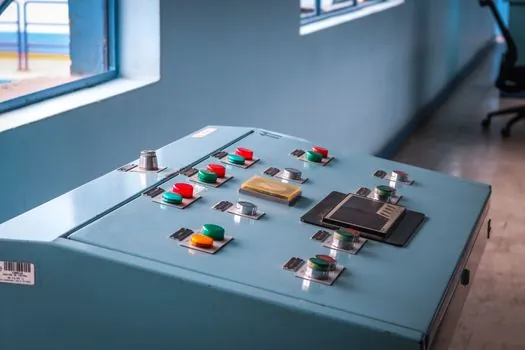
Reset is a frequent failure point in mining e-stop systems: push-pull reset held 47.54% of 2025 share, while automatic and electronic reset variants are projected to grow at an 11.02% CAGR through 2031, driven by autonomous and remotely operated equipment [S4]. For manned machines, a twist-to-release or key-reset is preferred so that restart is a deliberate, authorised action; for autonomous haul trucks and remotely controlled LHDs, electronic reset gated through the machine's safety controller prevents remote reset without confirming the hazard zone is clear.
Indicator behaviour matters underground: illuminated e-stops are useful for fault diagnostics, but the 2026 IEC 60947-5-5 revision tightened the rules on illuminated device behaviour, so any retrofit on a mining dump truck cab or continuous miner panel must be revalidated against the updated conformity file rather than the legacy declaration [S4].
Functional Safety Integration: ISO 13849-1 and IEC 62061
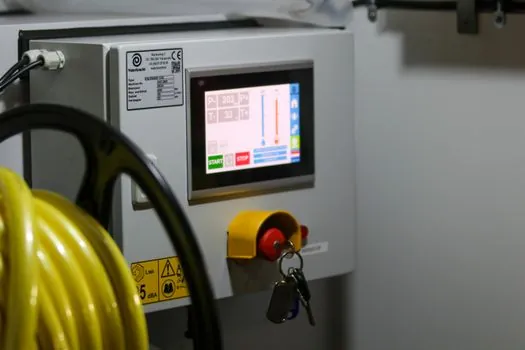
A modern mining e-stop is not a stand-alone switch: it is the initiating element of a safety function whose Performance Level (PL) or Safety Integrity Level (SIL) is defined by the risk assessment, with the wiring, contactors, and reset logic all part of the verified chain [S1]. Typical targets for operator-station e-stops on a haul truck or LHD are PL d (ISO 13849-1) or SIL 2 (IEC 62061), achieved with dual-channel wiring, a monitored contactor pair, and a tested reset sequence.
Verification must cover the full safety function, not just the pushbutton: hazardous motion must stop, energy must be removed or controlled, reset behaviour must not allow unexpected restart, and any fault detection or monitoring function must be exercised [S1]. Skipping the contactor and wiring fault check is the single most common root cause of e-stop systems that pass a button-press test but fail when a real event occurs.
Collision Prevention as a Complementary Layer
Advanced Level 9 collision prevention systems now actively slow or stop machinery when a collision is imminent, sitting above the manual e-stop layer in the safety hierarchy and reducing reliance on human reaction time [S3]. On autonomous and semi-autonomous mining fleets, this Level 9 intervention shares the same safe-stop actuator chain as the manual e-stop, so the device selection must support both manual initiation and controller-initiated STO commands without conflict.
That dual-use requirement pushes the spec toward devices with explicit safety-controller integration (e.g. safety inputs on a SIL-rated PLC) and away from simple hardwired-only buttons, especially on equipment already fitted with AI cameras, LiDAR, and UWB tracking for proximity detection [S3].
Test Cadence and Failure Modes Specific to Mining
Common mining-specific failure modes include vibration-induced contact welding, dust ingress jamming the latching mechanism, water ingress corroding the contact block, and reset springs weakened by repeated actuation, all of which a passive visual inspection will miss [S1][S6]. Test intervals should be set by risk, machine usage, and system architecture rather than a fixed calendar; high-utilisation equipment (continuous miners, haul trucks on 24/7 shifts) is typically tested at shift change or daily, while standby plant can be tested weekly or monthly [S1].
Functional testing must be distinguished from validation: a button-press test is functional verification, while periodic validation re-confirms that the safety function still meets the original PL or SIL target after component ageing or retrofit [S1]. On an underground conveyor, that means not just pressing the e-stop, but also timing the stop, confirming the belt does not restart on power return, and checking that the pull-cord emergency stop along the gallery is still latching correctly under tension.
Selection Comparison: Options Against Mining Criteria

Across the main device types, the criteria that drive a mining purchase are: IEC 60947-5-5 compliance, IP/IK rating, contact count, reset type, and integration with the safety controller. Push-button e-stops score highest on familiarity and cost, safety interlock-integrated e-stops score highest on tamper resistance and diagnostic coverage, and rope-pull / cable-pull e-stops score highest on conveyor coverage but lowest on reset ergonomics. For each option, the trade is between unit cost and the amount of external wiring and monitoring the safety chain still needs to achieve the target PL or SIL. [S4]
As a rule, underground mobile equipment (LHDs, drill jumbos, continuous miners) is best served by panel-mounted 2 NC mushroom e-stops with twist-to-release; long conveyors are best served by rope-pull e-stops with monitored tension and end-of-line reset; and autonomous or remotely operated machines benefit from e-stops that share an input with the safety PLC so the same contactor pair handles both manual and automatic stop commands [S1][S2][S3].
Procurement Signals to Track Next
Two specific dates and standard revisions will reshape 2027 mining e-stop specifications: the EU Machinery Regulation 2023/1230 applies from January 2027, driving early compliance spending on upgraded devices and conformity files [S4], and any mine operating under ISO 13849-1 should expect audit pressure to verify that the e-stop function still meets the original PL after every major retrofit of the driven equipment. Tracking the published list of IEC 60947-5-5 declarations from the OEM, and the PL/SIL calculation on file, is the most reliable proxy for whether a site's e-stop chain is still compliant in the second half of 2026.
This topic is covered further in PEEK Selection for Energy Equipment: Spec-First Criteria and Process Window.