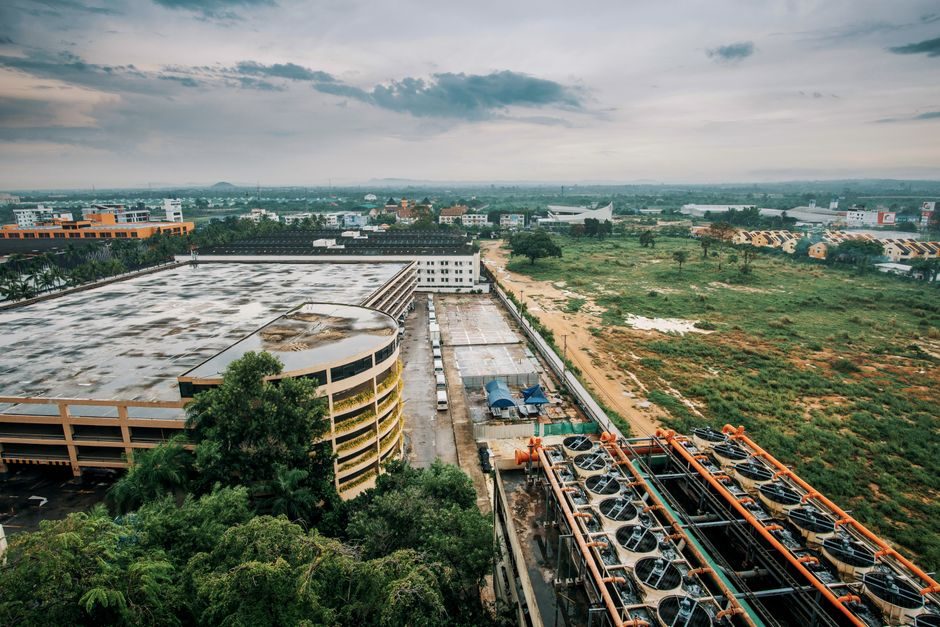
China's EV battery sector stretches from lithium brine, cathode precursors, and copper foil upstreams to cell, module, and pack assembly downstreams, with each node requiring dedicated process control hardware [S1].
The upstream segment covers lithium carbonate, nickel and cobalt sulphates, graphite anode, separator film, electrolyte, and copper/aluminium current-collector foil; the midstream covers cell formation and ageing; the downstream covers module-to-pack (MTP) lines, BMS calibration, and vehicle integration [S1][S2].
Lithium, Cathode Precursor and Anode Material Sourcing
Lithium carbonate equivalent (LCE) cost still anchors battery cell bill-of-materials, and brine versus spodumene routes yield different impurity profiles that downstream cathode lines must handle with parallel flow meters on acid and alkali dosing [S1].
Nickel-cobalt-manganese (NCM) and lithium-iron-phosphate (LFP) cathodes split the cell market by energy density and cost target, with LFP gaining share in entry-level and commercial-vehicle packs and NCM retaining dominance in long-range passenger cells [S1].
Upstream chain data services such as the Wind Product Database map over 5,154 industries and 160,000 upstream-downstream relationships, allowing buyers to trace a precursor supplier back to its mine, refinery, and reagent feedstocks in one query [S2].
Separator, Electrolyte and Current Collector Foil
Polyethylene and polypropylene separator films are specified by thickness (commonly 9-25 μm), porosity (target 40-55%), and melt-integrity temperature; wet-process biaxially oriented PE is the dominant specification for high-energy NCM cells [S1].
Electrolyte is a 1 mol/L LiPF6 blend in mixed carbonate solvents with vinylene carbonate and fluoroethylene carbonate additives; dosing accuracy on the pressure transmitter feeding the electrolyte mixing tank sits in the ±0.5% FS band for trace-water control below 20 ppm [S1].
Copper anode foil is rolled to 6-10 μm and aluminium cathode foil to 12-20 μm; pinhole density, tensile strength (≥ 300 MPa for Cu foil), and surface roughness Ra (≤ 0.3 μm) are the three release-spec numbers that electrode coating rooms monitor inline [S1].
Cell Manufacturing: Mixing, Coating, Calendaring and Slitting
Slurry mixing is done under vacuum with planetary or centrifugal mixers; solid loading 70-78% for cathode and 50-60% for water-based anode, with viscosity held at 3,000-10,000 mPa·s depending on coating speed [S1].
Electrode coating uses slot-die or comma-bar applicators on copper and aluminium foil at line speeds of 30-100 m/min, with coating weight uniformity typically held within ±1.5% measured by beta-ray or X-ray fluorescence gauges [S1].
Calendering compresses coated electrodes to 30-45% porosity, with roll force, gap, and temperature interlocked through a PLC and servo-driven hydraulic system; the same line is the natural place to install a pressure sensor on the hydraulic ram for closed-loop force control [S1].
Cell Finishing, Formation and Ageing
Notching, stacking (or Z-stacking for prismatic), and tab-welding precede electrolyte injection in a dry-room maintained at -40 °C dew point; laser-welding seam integrity is checked by ACIR (alternating-current internal resistance) screening at sub-mΩ resolution [S1].
Formation cycles the cell through a slow first charge to build the SEI layer, typically C/20 to C/10 for the first 20-30% SOC window; ageing rooms hold cells at 25-45 °C for 7-28 days with continuous voltage relaxation logging [S1].
DCIR (direct-current internal resistance) and capacity grading at the formation step bin cells into A, B, and C grades, with parallel industrial valve arrays on thermal-management loops used to stabilise chamber temperature within ±0.5 °C [S1].
Module-to-Pack Assembly, BMS and Vehicle Integration
Module-to-pack (MTP) and cell-to-pack (CTP) architectures are pushing cell counts per pack from ~100 in legacy PHEV modules to 200-400 cells in CTP designs, requiring busbar laser-welding current to be tunable from 1.5 kW peak for copper to 0.8 kW for aluminium through a servo motor driven XY table [S1].
Battery management system (BMS) calibration covers voltage sensing (±0.5 mV), temperature sensing (±1 °C NTC), and current sensing (Hall or shunt, ±0.1% FS); the same platform publishes State of Health (SOH) and State of Charge (SOC) over CAN or 100BASE-T1 in-vehicle Ethernet [S1].
Vehicle integration sends the pack through end-of-line (EOL) testing for vibration (battery UN 38.3 profile), thermal-shock cycling between -40 °C and +85 °C, and IP67/IP6K9K sealing; the EV Smart Manufacturing 2026 reference frame covers how digital twins and vision gates are now deployed on these EOL lines.
Selection Criteria and Process Tooling Map
A battery cell line buyer's shortlist is built on four axes: (1) line speed (m/min) on the electrode coater, (2) dew point (°C) on the dry room, (3) cell-format flexibility (cylindrical 18650/21700/4680 vs prismatic vs pouch), and (4) inline metrology density (coating weight, alignment, laser-weld seam, ACIR/DCR) [S1].
Choosing between wet-process and dry-process electrode coating is a tradeoff between line speed (wet: 30-100 m/min; dry: 5-30 m/min) and binder-elimination cost, and most 2026-vintage Chinese NCM lines still run wet-process because of the installed base and the tighter porosity control [S1].
Inline metrology, with vision-gate coverage at 100% of every cell plus a beta-ray or XRF gauge on every electrode reel, is what separates a Tier-1 from a Tier-2 cell line; the PV Manufacturing Process: 7 Stages, Tool Sets, and Inline Metrology article maps the same metrology logic on the solar side, useful for cross-industry benchmarking.
Sourcing, Standards and Verifiable Signals

Battery cell and pack buyers verify suppliers against UN 38.3, IEC 62660-1/-2, GB/T 31486, and IATF 16949, with EV-battery line equipment additionally expected to ship with CE, UL, and increasingly SEMI E84-compatible cleanroom ratings [S1].
Traceability is now a hard requirement under EU Battery Regulation 2023/1542 due-date phasing, with battery passports covering carbon footprint, recycled-content share, and supply-chain due-diligence; Chinese exporters are responding with factory-level PLC data historians tied to the same database that tracks upstream precursors [S1][S2].
Trackable signals for the rest of 2026: (1) LFP cell-to-pack penetration into European and ASEAN passenger BEVs; (2) sodium-ion cell pilot lines running parallel to LFP for two-wheel and stationary storage; (3) the share of dry-process electrode coating on new 2026-vintage NCM gigafactory lines [S1].