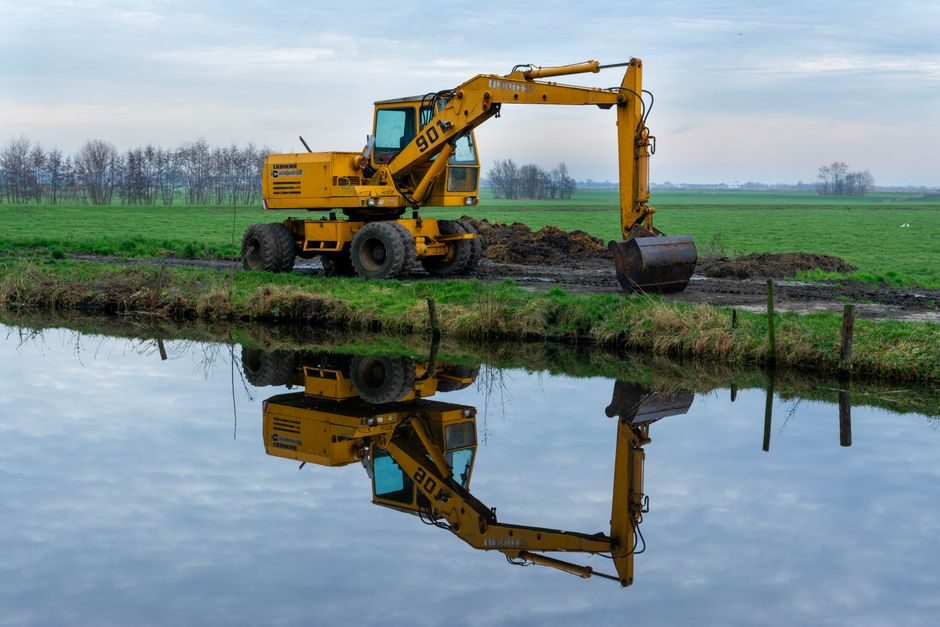
An excavator is a 360-degree swing machine designed for digging, trenching, and loading, with operating weights that commonly span 1 tonne mini-class up to 100+ tonne mining-class; an asphalt paver is a linear, forward-tracked machine that receives hot-mix asphalt from a feed truck and places it as a pre-compacted mat, with typical placement widths from roughly 1.8 m up to 9 m on highway-class models [S3].
Both appear in road-building fleet line-ups from manufacturers such as Sumitomo Construction Machinery, which lists both excavators and asphalt pavers in its global product catalogue alongside wheel loaders, rollers, and asphalt sprayers [S1][S2]. The two machines are rarely substituted for each other, but procurement teams regularly compare them on cost, crew, and site footprint when scoping a new project.
Working Principle and Mechanical Architecture
Excavators dig via a hydraulically actuated boom, stick, and bucket assembly mounted on a rotating upper structure, giving the machine a full 360-degree swing radius and a digging depth that scales with boom length — compact 1-2 tonne minis reach roughly 2-2.5 m, while 30-tonne class machines commonly dig past 7 m. Power is delivered from a diesel engine through hydraulic pumps to boom, stick, bucket, swing, and track motors [S1].
Asphalt pavers work as a continuous linear placement train: a receiving hopper feeds asphalt through slat conveyors to a distribution auger, which spreads material in front of a floating screed that strikes off and pre-compacts the mat. Tracked undercarriages provide the straight-line traction needed to hold the screed in a stable attitude under load, and most highway-class pavers run on diesel engines coupled to hydraulic or hydrostatic drives [S2][S3].
Operating Weight, Engine Power, and Production Output
Excavator operating weight and engine power scale tightly with bucket capacity; common production-class models sit in the 20-30 tonne range with 120-160 kW engines and 1.0-1.5 m³ bucket volume, while compact 3-5 tonne minis run 20-30 kW engines and 0.1-0.2 m³ buckets. These figures are typical engineering ranges, not manufacturer-specific claims. [S1]
Asphalt paver output is rated in tonnes per hour or square metres per minute at a given layer thickness; tracked highway-class pavers are commonly rated in the 300-800 t/h range with 100-200 kW engines, and placement widths adjustable from roughly 2.5 m up to 8-9 m on extendible screeds. Screed plate vibration and tamper systems, frequently running at 1,500-3,000 rpm, deliver the initial compaction that lets rollers finish the mat to target density.
Selection Criteria: Which Machine Fits Which Job
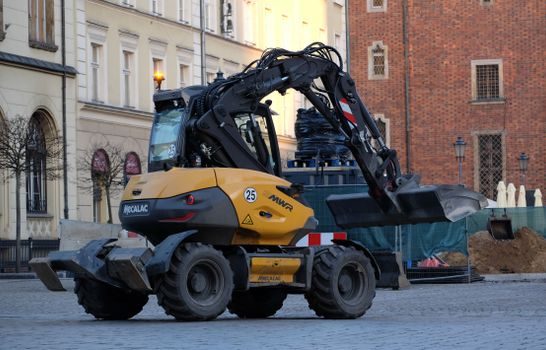
Choose an excavator when the task is below-grade: foundation digging, utility trenching, river dredging, demolition loading, or slope cutting on a road job site. Its bucket forces in the 100-300 kN range (for 20-30 t class) make it the workhorse for breaking and loading blasted or ripped material [S1].
Choose an asphalt paver when the task is surfacing: laying hot-mix asphalt (HMA) courses from base layer to wearing course on highways, urban streets, airport runways, and parking lots. The screed controls mat thickness, pre-compaction, and initial smoothness, all of which feed the final ride quality measured by the International Roughness Index.
For mixed job sites that need both, fleets typically run one or more excavators feeding loading shovels or dump trucks, plus a paver served by a feed truck and a tandem roller train. Equipment traders such as Geerdink Handel list both categories alongside rollers, asphalt sprayers, and drilling units, reflecting this multi-machine site model [S3].
Comparison on Cost, Crew, and Site Footprint
Across four decision criteria the two machine types diverge sharply: [S2]
- Capital cost: a new 20-30 tonne excavator typically costs several hundred thousand USD; a new tracked highway-class paver with extendible screed costs broadly the same order of magnitude, with screed options and emissions packages shifting the figure. Pre-owned units of both types move through European used-machinery dealers [S3].
- Crew and skill: an excavator needs one operator with ground crew for spotting; a paving train needs a paver operator, a screed operator, multiple dump-truck drivers, and a roller operator, plus a quality technician running density and temperature checks behind the screed.
- Site footprint: an excavator swings within its own track length and tail radius; a paver train extends along the placement direction, requiring room for the feed truck to approach the hopper without stopping the laydown.
- Daily production: an excavator's output is measured in cubic metres of bucket payload per shift, while a paver's output is measured in tonnes of asphalt placed per hour and lane-kilometres completed per shift. The two metrics do not convert, because they measure fundamentally different work.
Limitations, Failure Modes, and Standards to Watch
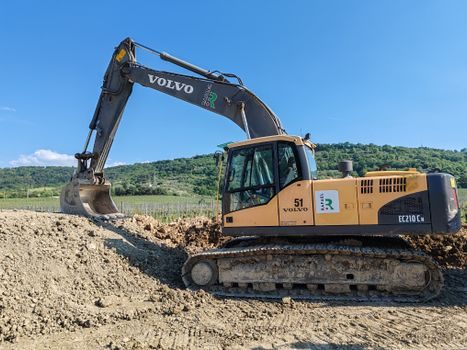
Excavator limits are tied to stability and reach: lifting over the side of the tracks reduces rated capacity, hydraulic overheating under sustained load, and undercarriage wear on abrasive rock. Asphalt paver limits are tied to mix temperature, layer thickness, and paver speed: cold mix stops the screed from compacting, while excessive paver speed causes tearing and aggregate segregation behind the auger. Mat density and temperature are typically checked with a nuclear or non-nuclear density gauge and an infrared surface pyrometer behind the screed. [S3]
For heavy civil fleet planning that mixes tracked machines, the shield machine versus dynamic compactor comparison covers another pair of specialised units, while the angle grinder versus demolition hammer pairing is a useful contrast at the small-power end of the same construction-equipment domain. Buyers comparing tracked machine line-ups for site prep work can also cross-reference the excavator reference page and the asphalt paver reference page for spec ranges and selection gates.
Sourcing, Manufacturer Coverage, and After-Support
Global construction-equipment manufacturers including Sumitomo list both excavators and asphalt pavers as separate product lines, with regional availability that varies by distributor network and emissions certification [S1][S2]. Australia is one of the explicitly covered markets for Sumitomo's excavator and paver lines, alongside Turkey, CIS, Eastern Europe, and several Asian regions [S1].
Used-equipment dealers in Western Europe, such as Geerdink Handel in the Netherlands, stock both categories alongside wheel loaders, forklifts, telescopic loaders, rollers, asphalt sprayers, and drilling units, which is a useful secondary channel for buyers looking at late-model pre-owned units with documented service histories [S3]. For a broader materials-side context that often runs alongside paving and earthworks procurement, the aluminum alloy versus carbon-steel selection guide covers a different but adjacent spec-driven buying decision.
Track Sumitomo Construction Machinery's product line-ups and distributor announcements on the excavator reference page and the asphalt paver reference page for the next catalogue refresh, and watch used-machinery listings from dealers such as Geerdink Handel for late-model pre-owned units entering the European market in the second half of 2026 [S2][S3].
For component-level specifications, see pressure transmitter.