
Explosion-proof lighting selection is governed first by hazardous-area classification: Zone 1 and Zone 2 (IEC 60079-10-1) for gas atmospheres, or Zone 21 and Zone 22 for dust, must be matched to the luminaire's Ex marking before wattage, lumen output, or mounting style is even discussed [S1].
Two reference fixtures in the current market — the BSC8200 explosion-proof LED light and the 150 W high-power explosion-proof floodlight from GUANMN — both carry ambient ratings of −40 °C to +55 °C, with die-cast aluminium housings and tempered-glass diffusers, demonstrating the typical spec envelope buyers should expect when shortlisting [S2][S5]. All-plastic explosion-proof lighting switches in the same category extend the same −40 °C to +55 °C envelope but substitute polycarbonate enclosures, illustrating a material-driven trade-off [S4].
Decoding the Ex Marking on a Luminaire Nameplate
Every explosion-proof light carries a string of certified codes — Ex db eb IIC T6 Gb, Ex tb IIIC T80 °C Db, and similar — and each token is a hard gate, not a suggestion. "Ex db" denotes flameproof enclosure, "eb" denotes increased safety, "IIC" is the most demanding gas group (hydrogen, acetylene), and "T6" caps surface temperature at 85 °C, the tightest gas ignition bracket in common industrial use [S1][S3].
For a Zone 1 paint booth or hydrogen compressor skid, an IIC T4-T5 fixture is the baseline; an IIB T6 unit that costs less will not satisfy acetylene or hydrogen service regardless of its IP or lumen advantage [S3]. Selection logic is therefore: read the Ex string first, then verify ingress protection (IP66 minimum for outdoor/oily areas), confirm ambient range, and only then evaluate photometric output.
Comparison: Four Main Luminaire Types for Hazardous Areas
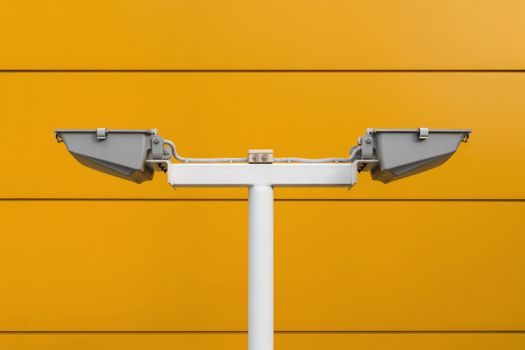
Four luminaire architectures dominate current procurement, and the choice is driven by mounting height, beam angle, and maintenance access rather than lumen count alone. Linear LED fittings (40 W–80 W) suit low-bay corridors and walkways; high-bay UFO fixtures (100 W–200 W) cover 6 m–12 m ceilings; floodlights (50 W–250 W) such as the GUANMN 150 W unit target tank farms and perimeter lighting; and sight-glass / sight-port lights deliver narrow-beam task illumination for reactor and filter vessels [S5].
Against four decision criteria, the trade-off looks like this: <strong>Linear LED</strong> — best for 2 m–5 m mounting, narrow beam (~120°), lightest, easiest to retrofit; <strong>High-bay UFO</strong> — best for 6 m–12 m, wide 120°–160° beam, heavier die-cast body, higher cost per fixture but fewer units; <strong>Floodlight</strong> — best for 8 m–15 m throw, 60°–90° beam, IP66/IP67 typical, suitable for outdoor hazardous process yards; <strong>Sight-glass light</strong> — best for local task illumination, ≤30 W, threaded port mount on a stainless-steel sight glass or filter housing [S1][S2][S5].
Materials, Sealing, and the IP Rating Stack
Die-cast aluminium alloy with epoxy powder coat remains the default for Zone 1 LED luminaires, paired with tempered or borosilicate glass diffusers and silicone gaskets to deliver IP66 / IP67 protection, suitable for offshore and salt-spray atmospheres [S1][S5]. Where corrosion is the dominant failure mode — chemical plants handling HCl, NaOH, or brine — all-plastic polycarbonate enclosures trade thermal mass for chemical resistance and weight reduction, though they are typically specified for Zone 2 and Zone 22 rather than the heavier Zone 1 [S4].
Stainless-steel 316L variants enter the picture for offshore decks, pharmaceutical wash-down areas, and food-grade chemical lines; expect a 30 %–60 % cost premium over aluminium equivalents and a longer lead time. The CISPR 15 / EN 55015 EMC compliance is rarely negotiable for plants running DCS and wireless instrumentation; buyers should request the EMC test report, not just a CE/CCC declaration [S3][S5].
Wattage, Lumen Output, and Photometric Reality
This is the spec envelope; fixtures claiming more than 160 lm/W in hazardous-area certification should be cross-checked against the LM-80 / TM-21 report.
For area lighting calculations, the spacing-to-mounting-height ratio is the practical gate: 1.0–1.2 for uniform task lighting, 1.5+ for perimeter floodlighting, and 0.8 for sight-port task lights where glare control matters. Buyers evaluating an explosion-proof distribution panel alongside lighting should match breaker curves to the LED driver's inrush (typically 5–10× rated current for 1–3 ms at cold start).
Who Should NOT Pick the Lowest-Cost Ex Fixture
A low-cost IIB T6 fixture is the wrong pick for any service involving hydrogen, acetylene, carbon disulphide, or ethylene oxide — these gases demand IIC. It is also the wrong pick for ambient temperatures outside −20 °C to +40 °C: an arctic LNG loading terminal at −45 °C, or a Gulf refinery deck in summer at +55 °C, will both exceed the certified window of an economy unit [S1][S4].
Similarly, indoor-only fixtures (IP65) are not safe for offshore platforms, chemical wash-down, or any environment where water jetting or salt fog is expected. Verifying that the certification covers the specific ambient range and the specific gas group is the single most common cause of rejected tender bids; the explosion-proof motor on a nearby pump skid may be Zone 1 IIC, and a Zone 2 IIB light beside it is a non-conformance waiting for an audit [S3].
Certification, Documentation, and Sourcing Logic
Every explosion-proof luminaire should ship with three documents: an IECEx Certificate of Conformity (CoC) or ATEX EU Type Examination, a manufacturer test report for IP and impact (IK07/IK08 minimum), and photometric data file (IES / LDT) for lighting design software. Shenhai Ex, GUANMN, and Tanghai Green Lighting all publish CoCs and full spec sheets, but the buyer should verify the certificate number on the issuing body's online database rather than trusting a PDF copy [S1][S2][S5].
For project buyers evaluating 2026 procurement cycles, the hardness tester selection guide touches on the same verification discipline — check the standard, check the certificate, then check the spec. Cross-equipment reference logic is the same: a 12-month warranty, a 20-day lead time from order to factory dispatch, and traceable batch numbers are baseline requirements from the current generation of Chinese and Taiwanese explosion-proof manufacturers [S2][S4][S5].
Shortlist Logic: A Decision Tree in Five Steps
Step 1: classify the area per IEC 60079-10-1 — Zone 0/1/2 gas, Zone 20/21/22 dust, or non-hazardous. Step 2: identify gas/dust group and temperature class (T1–T6 or Tmax surface). Step 3: define ambient range and IP requirement (IP65 minimum indoor, IP66/IP67 outdoor or wet, IP68 submersible). Step 4: select luminaire family — linear, high-bay, floodlight, or sight-glass — based on mounting height and beam angle. Step 5: verify CoC, photometric file, and EMC report, then compare 2–3 short-listed models on lm/W, warranty, and lead time [S1][S3][S5].
Spec discipline beats brand loyalty in this category: an explosion-proof light selected on Ex string + IP + ambient + photometric file will outlast a premium-branded unit chosen on reputation alone, and will not be returned by an IECEx or ATEX audit team on the first plant inspection.