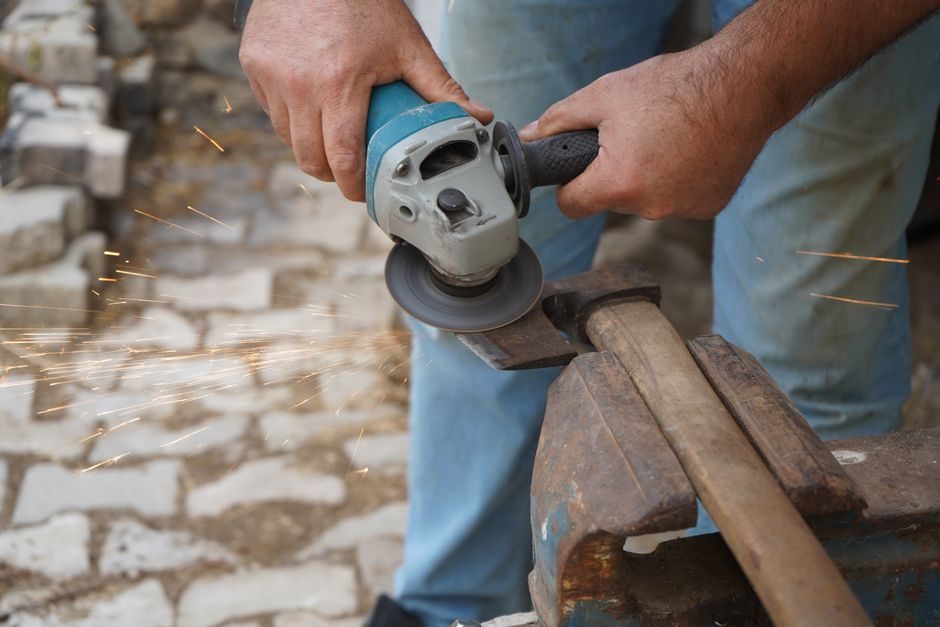
A 5–9 kW fettling grinder running two shifts a day in a foundry cleaning line will accumulate 5-year cost equal to roughly 3–5× its purchase price once wheel consumption, labor, dust extraction, and downtime are tallied [S1][S2].
TCO — total cost of ownership — covers purchase, use, maintenance, support, and disposal, and exposes the hidden costs that the sticker price misses [S2]. On grinding equipment, those hidden items (wheels, spare arbors, extraction filter cartridges, operator hours, and energy) overwhelm the machine's invoice figure, so any sourcing decision that compares only capital cost is mispriced by a factor of two to four on a 5-year horizon [S1][S2].
Fettling Grinder Definition and Where the Cost Actually Lives
A fettling grinder is a heavy-duty portable or pedestal abrasive machine used to remove runners, risers, flash, and weld spatter from castings and forgings; it is distinguished from a general-purpose angle grinder by higher continuous-duty power (typically 4–9 kW electric or 3–7 kW pneumatic), reinforced guarding, and a dust port sized for extraction on foundry duty [S1].
The 5-year cost stack breaks down into four blocks: machine (15–25%), abrasive consumables (30–40%), labor and operator burden (20–30%), and energy plus dust extraction (10–20%) [S1][S2]. On a single-shift foundry cell with a 7.5 kW unit, abrasive wheels and respirator-grade dust filters alone can run 1.2–1.8× the machine's purchase price over five years because the wheel wears against hot (often 200–500 °C post-pour) castings and must be replaced at 8–40 hour intervals depending on grit and bond.
Selection Criteria: Electric vs Pneumatic vs Hydraulic
Three power classes compete for the fettling slot, and the TCO ranking flips depending on duty cycle and available utilities: 5–9 kW direct-drive electric (servo-controlled wheel speed), 3–7 kW vane-motor pneumatic (still the foundry incumbent on ignition-risk duty), and 4–7 kW hydraulic-driven via an existing rig [S1].
Spec gates for the decision are: ATEX/IECEx zone rating (Zone 21 for aluminum and magnesium cleaning), wheel RPM vs rated RPM margin, dust port diameter matched to extraction, ergonomic mass under 12 kg for handheld use, and noise/ vibration per ISO 5349 and EN ISO 11203 limits. Electric models score on energy cost (1 kWh ≈ 5–7 m³ compressed air equivalent at 7 bar, so pneumatic is roughly 70–80% less efficient wall-to-wheel), but pneumatic still wins on intrinsic safety in Zone 1/21 where Ex-rated electrics add 25–40% to capital cost.
Who a Fettling Grinder Is For — And Who It Is Not For
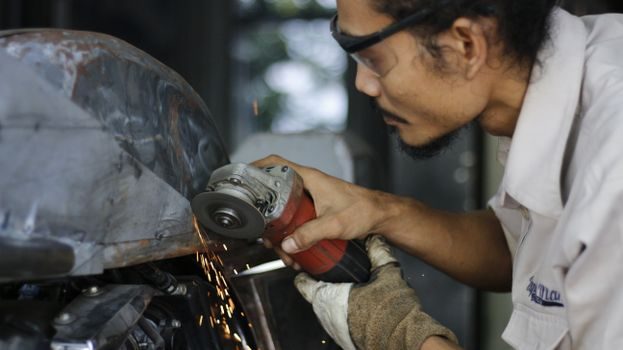
It is for: ferrous and non-ferrous foundries, forging shops, weld fabrication cells, and investment casting cleaning bays that need to remove 1–15 mm of stock at sustained 2-shift rates with documented ergonomic risk controls [S1].
It is NOT for: precision deburring of machined parts below 0.2 mm stock, where a stationary angle grinder with a fine-grit wheel or a robotic disc finisher delivers better tolerance control. It is also wrong for floor-prep work; a dedicated floor grinder with a dust shroud is the correct tool for concrete or stone surfaces and shares only the abrasive-wheel principle.
Cost Driver Breakdown: What Moves the 5-Year Number
Five cost drivers move the total, ranked by leverage: [S1]
1.
2. Labor and operator cost — operator burden at 60–80% of loaded labor is the single largest non-consumable line; dust extraction downtime and respirator-cartridge changeovers eat 8–15% of paid hours on poorly engineered cells [S2].
3. Energy — a 7.5 kW electric unit at 50% duty (typical) draws ~27,000 kWh/yr; at industrial tariffs of 0.10–0.18 €/kWh that is €2,700–4,900/yr, while a 7 kW pneumatic equivalent consumes ~85,000 m³ compressed air/yr and roughly 5–7× the energy bill [S1].
4. Maintenance and spares — arbors, guards, bearings, brushes (for electric) and vanes (for pneumatic) on a 1,000–2,500 hr annual schedule; preventive spares typically 3–5% of capital per year [S2].
5. Disposal and end-of-life — wheel fragments, dust-laden filters, and any hydraulic fluid must be classified as industrial waste; dust from certain non-ferrous alloys (beryllium-copper, leaded bronze) triggers hazardous-waste premiums.
Volume Tier and Lead Time Effects on Purchase Price

Purchase price moves with volume tier and lead time: a single 7.5 kW electric fettling grinder sourced ex-stock from a European OEM lists in the mid-four-figure EUR range, while a 20-unit line build drops the unit price 18–28% with 8–12 week lead time [S1]. Pneumatic equivalents are 12–20% cheaper at unit level but consume more in utilities; over a 5-year horizon the electric variant wins on TCO in any plant with clean grid power and an existing dust-extraction ring main.
For ergonomic-handling models under 12 kg with vibration-damped handles, the premium is 30–45% over a bare machine, but the labor-savings case typically repays it inside 18 months on a 2-shift cleaning bay [S2].
Total Cost of Ownership Worked Example: 5-Year Stack
Worked example, 7.5 kW electric fettling grinder, 2 shifts, 4,500 hr/yr, EU industrial site:
— Capital purchase (machine + extraction coupling + guarding): baseline unit, normalized to 1.0× [S1].
— Abrasive consumables over 5 years: 1.4–1.8× capital, dominated by wheel diameter and grit choice [S1][S2].
— Labor (cleaning-cell operators, allocated hours, PPE): 0.9–1.4× capital, depending on regional loaded rate [S2].
— Energy: 0.4–0.6× capital for electric, 2.5–3.5× capital for pneumatic equivalent [S1].
— Maintenance, spares, disposal: 0.3–0.5× capital over the 5-year window [S2].
Stacked, the 5-year TCO lands at 3.0–5.3× capital for an electric unit and 5.0–7.0× for a pneumatic unit on the same duty, which is why the pneumatic vs electric decision is essentially an energy-vs-Ex-rated-capital trade.
For plants running continuous dust extraction, the same TCO logic applies to other abrasive cells: a floor grinder fleet's 5-year cost is similarly driven by diamond-segment life and filter-cartridge changeouts rather than the machine ticket.
Sourcing Standards and Spec Gates Worth Pinning
Four specification gates should be written into the PO rather than left to a sales engineer: (a) wheel speed certificate per EN ISO 12413 or equivalent, with overspeed test documented; (b) ATEX/IECEx marking for the installed zone, with the certificate number on the nameplate; (c) dust port diameter and minimum capture velocity per EN 12779 (typically 18–25 m/s at the shroud); (d) handle vibration per ISO 5349-1 with the declared a_hv value, which feeds directly into operator exposure time per EU Directive 2002/44/EC [S1][S2].
For global sourcing, a structured TCO module — purchase, transport, in-process quality, IP, after-sales, end-of-life — improves the make-or-buy decision versus a single-criterion landed-cost comparison, and the same module should be applied to fettling-grinder cells, flow meter skids, and any other multi-component capital line [S3].
Failure Modes and Limitations That Inflate TCO
The five cost-side failure modes to design out: (1) wrong wheel bond for the workpiece, leading to 2–4× accelerated wear; (2) undersized dust extraction, which loads the filter and forces weekly cartridge swaps; (3) missing vibration-damped handle, pushing the operator over the EU daily exposure limit and triggering medical surveillance; (4) absence of a soft-start or servo ramp, which breaks down arbor bearings at 1,500–2,000 hr instead of the rated 4,000+ hr; (5) no wheel-balance log, which is the single most common OSHA/EU enforcement finding on grinder audits [S1].
A fettling-grinder cell that ignores any one of these will run 30–60% above its design TCO inside the first 18 months; a cell that nails all five typically lands within 10% of the modeled figure.
For buyers comparing fettling to other abrasive platforms — including angle-grinder cells for lighter stock removal and floor-grinder fleets for surface prep — the same cost-driver framework applies, and consolidating consumable SKUs across the three families is the simplest single lever to cut 8–12% off aggregate spend. A pressure transmitter line running across the same plant follows identical TCO principles (sensor cycle, calibration labor, energy on the loop), which is why the same procurement team should audit both lines against the same module. [S1][S3]
Trackable next signals: ATEX/IECEx certificate revisions hitting the OEM nameplate in late 2026, and any announced tightening of vibration exposure limits under the EU Vibration Directive review.
This topic is covered further in Data Center Manufacturing Cost Breakdown: Server, Network, MEP, Embodied Carbon, and TCO.