A correct FIBC specification locks four variables before price is discussed: safe working load (SWL) class, safety factor (SF) ratio, fabric weight in g/m², and electrostatic (ESD) classification — the combination of which decides UN certification, liner spec, and field-failure risk [S2][S3].
Manufacturers surveyed in June 2026 list standard SWL bands of 500 kg, 1000 kg, 1250 kg, and 1500 kg, with 1000 kg as the warehouse-default SKU on most B2B catalogs [S1][S2][S5]. Two structural designators remain in use: U-panel (2-panel + 4-panel seam) and circular woven (tubular), with baffle and sift-proofing variants added when shape retention or fine-powder retention matters [S3][S5].
SWL, Safety Factor, and UN Packaging Group Mapping
The industry universally pairs SWL with a single SF ratio: SF 5:1 for single-trip bags and SF 6:1 for multi-trip reusable bags, and both are expressed against a 5× or 6× minimum breaking tensile load on the lifting loops [S3]. UN-certified FIBCs used for hazardous goods (Packaging Groups I, II, III) require SF 6:1 plus a UN-mark stamped on the bag label per UN recommendations on the transport of dangerous goods [S3]. Non-hazardous dry-bulk users commonly run SF 5:1 because the 20% higher loop strength reserve in SF 6:1 adds roughly 8–12% to the woven fabric mass and to unit cost on commodity polypropylene tape fabric [S3].
Specifiers should treat SWL and SF as inseparable; a 1000 kg SWL bag with SF 5:1 is a fundamentally different design point than a 1000 kg SWL bag with SF 6:1, even when the dimension and fabric weight are identical. A 4-loop cross-corner lift pattern remains the dominant configuration, though 2-loop and single-strap (jumbo sling) variants exist for crane-handled applications [S1][S5].
Fabric Weight, Coating, and Liner Compatibility
Polypropylene woven fabric weights for bulk bags fall in the 140–220 g/m² window, with 160 g/m² and 180 g/m² the two most quoted production grades on Chinese FIBC catalogs in mid-2026 [S1][S6]. Below 140 g/m² the bag tends to bulge excessively on a 1000 kg load, and above 220 g/m² the cost-to-strength ratio flattens out for non-hazardous dry-bulk SKUs [S1][S3].
Coating options (laminated PP film, conductive coating, aluminum foil) are selected by moisture sensitivity: food-grade sugar and starch typically use an inner food-contact liner, fertilizers and cement use uncoated or lightly coated fabric, and moisture-sensitive chemicals get a foil or aluminum liner [S1][S5]. Baffle bags — internal corner panels that hold the cube shape under load — add roughly 4 corners of sewn fabric and pull the filled-bag aspect ratio close to 1:1:1 for warehouse stacking efficiency [S3][S5]. For a structured comparison the most common liner types line up as follows: aluminum-foil liner for moisture-sensitive chemicals; conductive liner for static-sensitive powders; food-grade PE liner for sugar, flour, and starch; VCI (volatile corrosion inhibitor) liner for metal parts and machined components [S5].
Electrostatic Classifications A, B, C, D and When Each Is Required
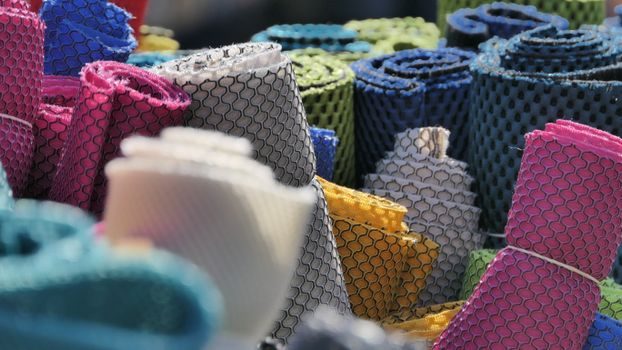
FIBCs are divided into four electrostatic types per IEC 61340-4-4: Type A (no static protection, no grounding — only for non-flammable atmospheres), Type B (breakdown voltage ≤ 6 kV to prevent propagating brush discharge), Type C (conductive, must be grounded during filling and discharge), and Type D (static-dissipative, no grounding required) [S3][S5]. Type C is the workhorse for chemical and pharmaceutical powders, and Type D has displaced Type C on some European sites because the no-grounding requirement simplifies forklift-cycle operations [S3][S5].
Selection rule of thumb: Type A is acceptable only for non-flammable products; Type B is the minimum for dust atmospheres with MIE above 3 mJ; Type C and Type D are mandatory for solvent vapors, fine pharmaceutical APIs, and any Zone 1/Zone 21 area handling flammable powders [S3]. The most common Type-C/D SKU quoted on Alibaba in July 2026 sits in a $6–10 FOB price band at 1,000-piece minimum order, which captures the cost of conductive yarn woven into the body fabric plus a grounding tab [S3].
Dimensions, Discharge, and Top-Fill Options
Standard FIBC base dimensions are 90 × 90 cm, 95 × 95 cm, and 100 × 100 cm; heights range from 100 cm to 200 cm and are sized to fit a standard 40-inch sea-freight container (about 2,400 mm internal) when two bags are stacked on a single EUR-pallet footprint [S1][S3]. Top-fill options are open top, duffle top (with a spout and tie), and cone top (for dust-free filling); discharge is typically a bottom spout of 35 × 50 cm or 40 × 60 cm, with an iris or star-shaped closure for repeatable partial discharge [S2][S3].
Buyers specifying a duffle top with a 35 cm diameter fill spout and a bottom discharge spout with star closure account for the majority of standard catalog SKUs at Chinese mills in mid-2026 [S2][S3]. For repeatable handling economics inside a warehouse, buyers cross-referencing storage equipment should review the storage cage cost guide because the same 90 × 90 cm FIBC footprint stacks cleanly inside a standard 1200 × 1000 mm wire-mesh cage with a rated 1000–1200 kg load [S2][S3].
Price Bands, MOQ, and Lead Time in 2026

FOB price for a standard 1000 kg SWL SF 5:1 uncoated FIBC on Chinese B2B platforms sits in a $4–6 per-piece band at 1,000-piece minimum order, climbing to $6–10 per piece for Type C/D conductive bags, and $8–14 per piece for UN-certified 6:1 SF hazardous-goods bags [S3][S6]. Lead time on Alibaba-tracked suppliers is typically within 15 workdays off-season and roughly one month in peak season (Q3 pre-harvest and Q4 pre-export) [S3].
For a fuller sourcing reference covering UN marking, fabric g/m², and PP jumbo sack selection workflow, the FIBC spec-first buying guide and the wider bulk bag selection criteria encyclopedia entry pair cleanly with this article [S3][S5]. For facilities running gravity or pneumatic conveying upstream of the FIBC fill station, cross-check the bucket elevator capacity and casing spec bands because the rated tonnage per hour on the elevator typically sets the upper bound on FIBC fill-cycle time per bag [S5].
Limits, Failure Modes, and Inspection Discipline
FIBCs fail in the field for three reasons, in roughly this order: broken or abraded lifting loops, seam slippage on the body fabric, and bottom-spout leakage from a torn discharge spout [S3]. The first two scale with SF — a 6:1 bag tolerates about 20% more UV and abrasion before the loops reach their rated working load than a 5:1 bag of identical fabric weight [S3]. UV degradation is the silent killer: polypropylene fabric stored outdoors loses roughly 30–50% of its breaking strength over 6–12 months of direct sunlight, which is why most EU and North American distributors stock ≤ 0.5 million bags in covered warehouses and offer same-day shipping on Type B/C/D SKUs.
Inspection before each fill cycle should include a visual check for fabric abrasion on the loops, any puncture on the body, and correct dust-cover / liner placement when a liner is specified [S3]. For users running bag-in-bag dust-tight configurations (liner tied off inside the outer bag), an industrial valve downstream of the bag dump station typically handles the residual dust extraction, and the flow meter on the pneumatic convey line gives a verifiable fill-mass check against the bag's rated SWL [S5].
Two signals to track in the next sourcing cycle: (1) Chinese mills continue to consolidate around Starlinger and Starlinger-equivalent circular-woven lines, which is pulling the standard fabric weight on 1000 kg SWL bags from 160 g/m² toward 170 g/m² at no unit-cost penalty; (2) Type D static-dissipative bags are migrating from a premium $9–12 SKU toward the $7–9 band as European and US demand scales the volume, which is the single largest cost-down lever for chemical buyers in 2026 [S3][S5].