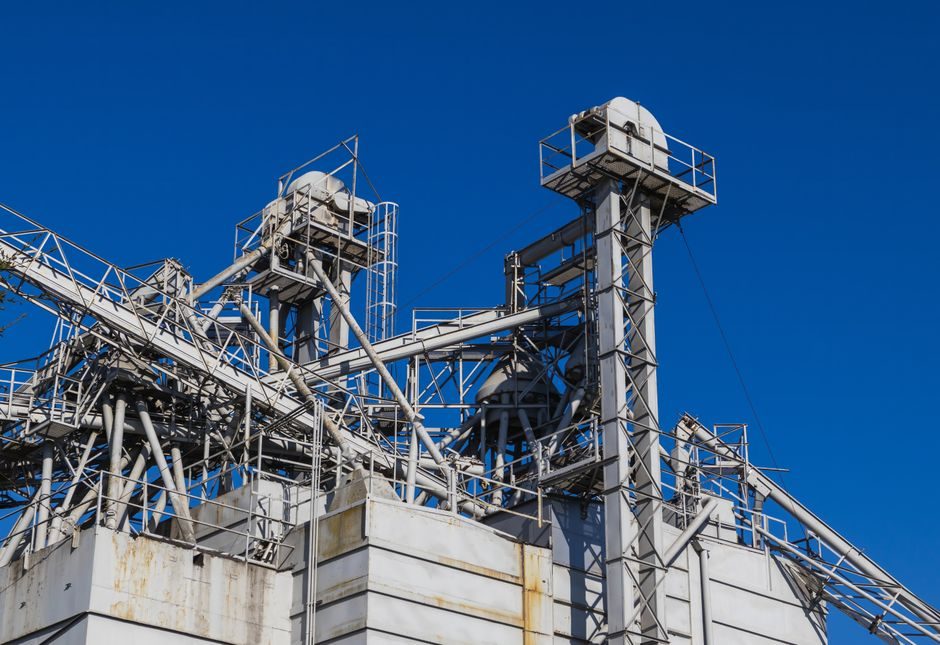
Bucket elevators in the 2026 Chinese OEM catalog cover a feed-size envelope of ≤55 mm and a vertical lift envelope of ≤50 m, with processing capacity banded 34–1112 m³/h and motor power scaled to that throughput [S1]. For a buyer, that single spec block — feed size, lift height, capacity, motor kW — is the first filter; everything else (casing, belt speed, bucket spacing) is a derivative of those four numbers.
This buying guide walks through the four spec levers that actually decide a quotation — capacity, lift, particle/abrasiveness and enclosure rating — and maps them to the three primary equipment families: centrifugal-discharge belt units for free-flowing dry bulk, continuous-discharge (perfect) elevators for friable or slower-draining material, and chain-and-bucket heavy-duty units for hot, abrasive or lumpy product. A side-by-side comparison closes the guide so the reader can score a vendor sheet against the actual application.
Capacity Envelope and Throughput Reality
The published OEM capacity range of 34–1112 m³/h is wide because it spans three different machine families, not three trims of one machine [S1]. A 34–80 m³/h unit is typically a light-duty centrifugal grain elevator with 100–160 mm buckets on a PVC or rubber belt; an 800–1112 m³/h unit is almost always a heavy plate-casing industrial elevator with 250–400 mm buckets, head pulley ≥ 600 mm and a backstop on the head shaft.
Two non-obvious corrections engineers should make before signing a PO. First, the catalogue figure is a *bucket-fill* throughput at rated rpm; if the bulk density, repose angle or moisture content deviates from the OEM test, derate by 15–25%. Second, a Made-in-China grain product sheet showing US$ 1,500–15,000 per piece is a size class, not a model — the same vendor can offer a 5 t/h Z-type and a 60 t/h plate-casing unit in that spread [S8]. A second cluster at US$ 3,000–50,000 confirms the same fragmentation at the chemical/industrial end of the market [S5].
Lead time for a configured unit out of China sits at roughly 15 days ex-works for catalogue machines, with shipping added on top [S2]. For a US-engineered retrofit line, the lead pattern flips — engineered equipment suppliers like Ohio-based Engineered Equipment Sales quote 60+ years of installed base on bucket elevators, conveyors and airlocks, but custom head sections and abrasion-resistant linings run multi-week [S4].
Centrifugal vs Continuous vs Positive-Discharge: Three Families, Three Spec Sheets
Centrifugal-discharge bucket elevators run belt speeds in the 1.0–1.6 m/s band and throw the material out of the bucket at the head pulley; they are the default for dry, free-flowing product such as grain, plastic pellets, fly-ash and cement raw meal [S1]. Continuous-discharge ("perfect") elevators run slower (≈ 0.6 m/s), with buckets mounted in a continuous overlapping train so the discharged stream lays into the chute tangentially — the right pick for sluggish, sticky or friable product such as filter cake, wood chips, sugar, or any material that would shatter on impact.
For a criteria-based comparison, score the three families on four decision axes: throughput density (m³/h per metre of head pulley), gentle-handling suitability, abrasive/lumpy product tolerance, and typical casing/boot access. Centrifugal scores high on throughput density, low on gentle handling, medium on abrasives (depends on belt vs chain), and has a simple side-hinged boot. Continuous scores medium on throughput, high on gentle handling, medium on abrasives, and needs a gravity-take-up boot with a tensioning screw. Chain-and-bucket (positive-discharge) units run 0.4–0.8 m/s with two strands of chain and cast or fabricated steel buckets; they handle +200 °C clinker, sinter, limestone and ore at the cost of throughput density and acoustic footprint.
A fourth, niche line worth flagging is the Z-type (or "grain leg with horizontal discharge") elevator, which is essentially a centrifugal unit folded into a Z-shape to discharge at process height. Xinxiang Jubao's 2026 offering ships in the US$ 1,800–2,000 range per piece, with CE certification valid since 2023-04-25 [S8] — a useful sanity check for any European-bound grain line.
Casing, Sealing and Hazardous-Area Selection
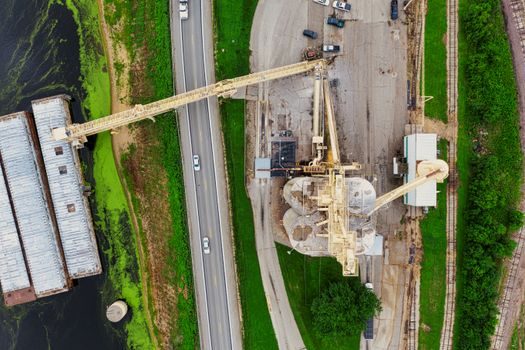
For a bulk-solid line, the elevator's enclosure does more safety work than the buckets. A standard plate-casing unit uses 2–4 mm mild-steel panels with bolted flange joints and a labyrinth seal at the head and boot; an optional dust-tight upgrade adds EPDM strip seals, a vapour-tight inspection door, and pressurised purge on the head bearing housing. For grain-handling, that pressurised purge is the practical equivalent of an ATEX 2/22 zone treatment even where certification is not formally required. [S1]
Material-of-construction data from the Made-in-China 2026 product sheet shows CS (carbon steel), SS304, SS316 and 253MA as the published options, with material-feature flags including oil-resistant, heat-resistant and fire-resistant [S5]. 253MA is the Avesta-grade 22Cr-10Ni-rare-earth austenitic, designed for repeated 1050–1150 °C exposure; selecting it on a bucket elevator is rare but correct for clinker coolers and incinerator-ash lines. For food-grade or pharmaceutical lines, SS316 with a ≤ 0.8 Ra welded-and-passivated finish is the baseline.
Where a bucket elevator is installed in an EX zone 21 (dust) or 22, spec the head motor with ATEX-certified enclosure, a non-sparking bucket-bolt material (aluzinc or austenitic), and a rubber-static-dissipative belt (≤ 10⁹ Ω surface resistivity). HART-connected belt-speed sensors on modern units can be tagged into a pressure transmitter-class asset-health system, but the elevator's own safety chain remains mechanical: belt-misalignment switches, speed switches, bearing-temperature RTDs, and a slack-belt switch at the boot.
What to Verify in the Vendor Quotation
A 2026 bucket-elevator quotation from a Chinese OEM will typically be priced FOB or CIF, valid 30 days, with a 1-piece MOQ for catalogue units [S5][S8]. Three documents have to be requested before the PO is signed: a GA drawing with head-pulley diameter, bucket pitch and belt width dimensioned; a power calculation showing motor kW, start-up factor and backstop sizing; and a casing-pressure-declaration if the unit is to be gas-tight or dust-tight. For a US-domestic or EU-domestic engineered supplier, the analogous documents are structural certification to the local pressure-vessel or machinery-safety code, and a list of wear-part SKUs with on-shelf availability [S4][S7].
For a parallel conveying application where a linear guide or roller conveyor would be the wrong pick, see the side-by-side spec cut for roller conveyor vs bucket elevator. For abrasive or hot-bulk lines that approach a bucket elevator's temperature ceiling, the material-handling chain usually terminates in a flow meter- or industrial valve-fed downstream process — both referenced in the industrial valve and flow meter reference pages.
Common Failure Modes and How to Spec Against Them
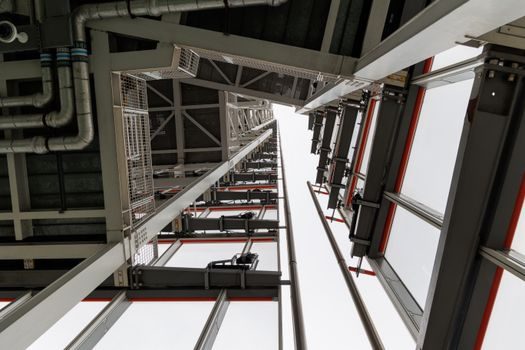
The dominant failure modes on operating bucket elevators are, in order: bucket bolt loosening (vibration + product wedging), belt splice creep (under-rated splice for the actual tension), head-shaft bearing overheating (insufficient sealing in dusty service), and boot-shaft fouling (incorrect take-up adjustment). Each is spec-able at the quotation stage: torque-locking nylon-insert bolts on every bucket, a mechanical-belt fastener or vulcanised splice rated to 1.5× the calculated steady-state tension, a head-shaft bearing life of L10 ≥ 50,000 h with regreasable labyrinth seals, and a gravity take-up with 150–200 mm of usable travel. [S2]
Chain-and-bucket units add a different failure cluster: chain-pin wear (slow-degrading bucket spacing), chain elongation (≥ 3% means re-anchor or replace), and sprocket-tooth wear (profile change, not just tooth thinning). Spare-parts stocking for a chain elevator should be sized for the next 12 months of operation, not the next PO cycle — chain is a long-lead item.
For context on long-tail protective equipment that often sits in the same procurement budget as a bucket elevator, see the protective clothing 2026 spec-cut guide — bulk-handling lines almost always co-procure PPE in the same quarter as a new elevator.
Trackable next nodes for a buyer shortlisting in 2026: (1) a Chinese OEM RFQ bundle of 3 quotations for a 200 t/h, 35 m-lift, SS316 centrifugal grain elevator — expect a 30-day response window and US$ 18,000–45,000 per piece range for that spec class [S5][S8]; (2) a separate RFQ for the head-section backstop and bearing-temperature monitor, which often shifts lead-time more than the casing itself; (3) a confirmation call to the engineering house on EN 618 / ISO 5049 compliance for the bucket-elevator standard in the destination jurisdiction before any ATEX or CE marking is committed [S7].