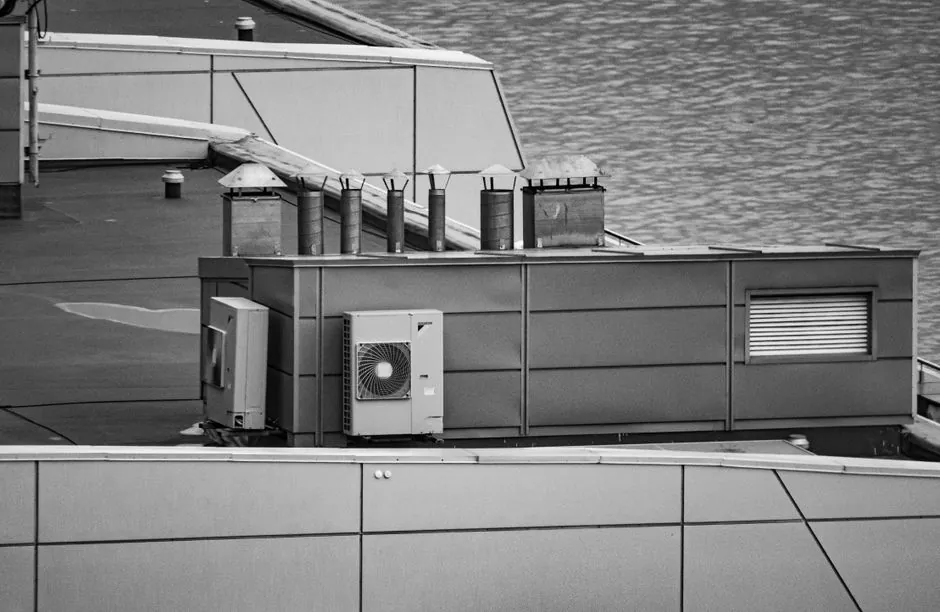
Roughly 70% of premature HVAC coating and adhesive failures on mechanical-room slabs trace back to inadequate surface preparation, not equipment defects, a pattern visible across commercial prep work in Upstate New York and St. Louis [S3][S4].
For HVAC installation, the working surface is rarely new: mechanical rooms commonly carry old mastic, tile adhesive, or epoxy that a 7-inch hand-held angle grinder cannot remove at production pace. A walk-behind floor grinder sized 18–32 inches wide, 1.5–3.0 kW single-phase, paired with a 30/40# diamond tool and HEPA dust extraction, is the conservative baseline for HVAC rigging pads, condensate drain trenches, and duct-support base plates [S2][S3].
Working Envelope and Concrete Profile Targets
Concrete Surface Profile (CSP) 2 to CSP 3 is the typical acceptance band for HVAC slab work, since most epoxy, urethane, and rubber-mastic adhesives require a textured substrate for mechanical bond [S3]. CSP 2 corresponds to a light grind that removes minor surface residue while leaving the bulk laitance intact; CSP 3 adds visible texture from 30/40# diamond tooling at moderate pass speed.
A 9-piece 30/40# diamond pad set on a medium-bond matrix is rated for both wet and dry grinding of cement and concrete, with pre-drilled holes for direct mounting to standard floor-grinder heads [S2].
Recommended working widths map to room geometry: 18-inch grinders handle condensate-pan and equipment-pad footprints under 2 m²; 25–32-inch units cover full mechanical-room slabs 50–200 m² in two passes at 1.0–1.5 m/min. Going wider below 3.0 kW single-phase risks stalling the motor on adhesive patches [S3].
Power, Voltage, and Phase Selection
Single-phase 220–240 V supply at 1.5–3.0 kW is the dominant floor-grinder rating in residential and light-commercial HVAC work, since most mechanical rooms lack three-phase service. Three-phase 380–480 V at 5.5–7.5 kW is reserved for warehouse plant rooms and large chiller decks, where continuous-duty cycles exceed 4 hours per shift [S3].
Below 1.5 kW, a walk-behind grinder loses the torque needed to keep a 30/40# diamond tool engaged on black mastic, a fault pattern where the head spins while the tool skips. Above 3.0 kW single-phase, voltage drop on long extension runs above 15 m trips the overload, a common job-site failure mode [S1].
For cutting threaded rod, sheet metal, and surface-prep edge work, an angle grinder of 4-1/2 to 7 inches remains a complementary tool, but it does not replace a walk-behind for full-slab prep [S1].
Dust Extraction and HEPA Containment
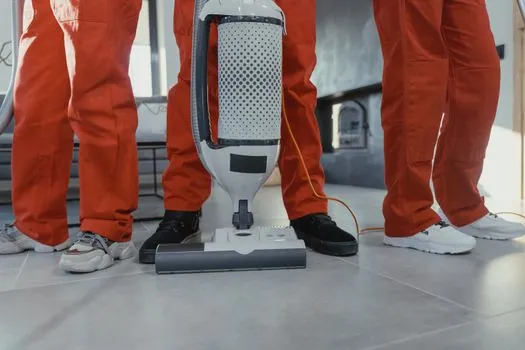
Dust-controlled grinding with industrial HEPA vacuums is the standard operating mode on occupied HVAC retrofit sites, where silica-bearing concrete dust is an OSHA-regulated respiratory hazard and a contamination risk for open ductwork [S3].
For ducted-system installations specifically, an open return or open plenum turns grinding into a forced-air dust event: fine particles travel straight into the coil and blower housing, fouling the MERV 8–13 filter bank and degrading airflow within weeks. A M-Class or H-Class extractor matched to the grinder head keeps airborne particulate below the typical 0.1 mg/m³ job-site threshold and protects downstream components.
Pre-drilled diamond tooling with optimized dust-channel geometry, as supplied on the 9-piece 30/40# pad set, supports continuous extraction without tool-side leakage [S2].
Head Type, Tooling, and Fettling-Grade Edges
Three head configurations cover nearly all HVAC prep work: single-disc rotary for open slabs, planetary for polishing and adhesive removal, and edge-focused fettling grinder heads for tight perimeters around housekeeping pads and equipment rails. Single-disc is the lowest-cost entry point; planetary is preferred when CSP 2–3 plus light polish is required in one pass [S2][S3].
30/40# diamond is the workhorse grit for mastic and thin-set removal; 60/80# steps in for profiling new slabs; 120# and above enter polish-only territory and are rarely needed for HVAC. Medium-bond matrices suit the harder concrete (4,000–6,000 psi compressive) found in commercial plant rooms; soft-bond matrices are reserved for soft, abrasive, rain-damaged slabs that glaze a hard-bond diamond prematurely [S2].
For structural pad prep on steel-supported equipment, the cross-reference spec map in Floor Grinder Specs for Steel Construction covers the wider 25–36 inch head configurations used on heavy rigging.
Site Sequencing and Trade Coordination
Grinding must occur after rough plumbing and electrical are set but before duct hangers, condensate piping, and equipment rails are welded, since metal on the floor shreds diamond tooling and creates spark hazards inside the dust stream [S3][S4].
Surface preparation is the entire job, not an afterthought, and most coating failures (peeling, bubbling, delamination) trace back to inadequate prep rather than product defects [S3].
Decision Matrix: Grinder Class vs HVAC Task
Condensate-pan and equipment-pad prep (under 2 m² per location) maps to a 1.5–2.0 kW 18-inch single-disc with 30/40# diamond and M-Class extraction. Whole mechanical-room slab prep (50–200 m²) maps to a 2.5–3.0 kW 25-inch planetary with HEPA H-Class extraction. Edge work around housekeeping pads and duct-supports maps to a dedicated fettling grinder at 4 inches, not an undersized floor machine. [S3]
Refuse the spec when the room lacks 220–240 V single-phase at 16 A minimum, or when the substrate is contaminated with deep oil penetration that diamond tooling cannot reach, a case for mechanical scarification or shot blasting instead [S3].
For larger open-plan areas and longer production runs, the 2026 spec map for road and slab maintenance carries the higher-power three-phase configurations that overlap with chiller-deck prep. Interior finishing of office-zone floors adjacent to mechanical rooms follows a different width and head-type map laid out in the interior finishing selection guide.
Track three signals over the next 6–9 months: revised OSHA silica rule enforcement on occupied HVAC retrofits, broader HEPA-extractor adoption on 1.5–3.0 kW single-phase machines, and any ICRI CSP update that shifts the prep band for high-build urethane coatings used in mechanical rooms.
