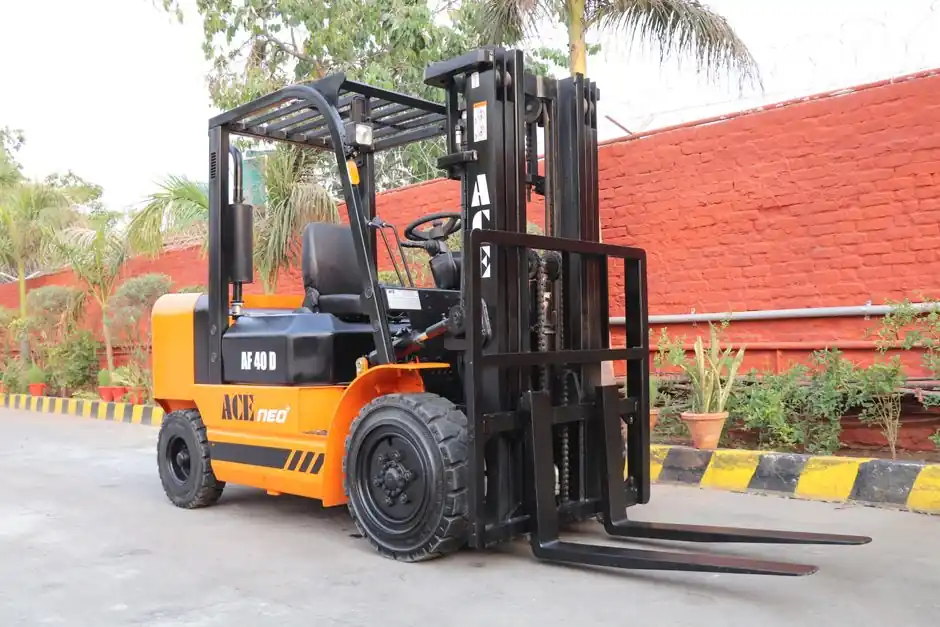
Urban infrastructure sites in 2026 are not smooth logistics halls, and a 2026-06 survey of 150 projects found 67% of site managers preferred low-profile rough terrain forklifts over standard warehouse models [S1]. The same data set shows construction accounts for 60–65% of all RT deployments, with a global market sized at $220–240 million in 2025 and projected at $260–290 million by 2030 (3.5–4.0% CAGR) [S1].
Capacity splits cleanly: compact 1.8–2.5 t units at 3.7–4.8 t operating weight cover landscaping and light utility work, mid-range 3.5–5.0 t at 5.2–8.5 t operating weight handle general construction, and 10 t heavy-duty models run 90 kW diesel for pipe and precast handling [S1]. Choosing between them hinges on three measurable numbers: ground clearance, drive configuration, and lift capacity margin.
Ground Clearance and Tire Specs That Decide the Job
Heavy-duty rough terrain forklifts carry ground clearance above 380 mm, compared with 100–150 mm on standard warehouse forklifts [S1]. On uneven urban sub-base, that delta is the difference between clearing a rebar cap and high-centering the truck. Standard tire sizes for 2.5 t models run 12.5/80-18 front and 27×10-12 rear, deep-tread pneumatic for mud, gravel, and trench spoil [S1].
Diesel power remains near-universal in this class: 43–55 kW for 2.5 t models and 90 kW for 10 t variants [S1]. The performance payoff is grade handling, with RT forklifts rated for slopes up to 50%, versus 10–15% for warehouse units [S1]. For a sewer or grade-beam site with daily access-ramp changes, that 50% envelope removes a constraint that would otherwise force a crane in for slope moves.
Switchable 4WD, Engine Tier, and the Emissions Question
Most RT forklifts offer switchable 2WD/4WD so the operator can engage all-wheel drive on soft ground and disengage it for road travel, cutting tire wear and diesel burn [S1]. Stage V turbo diesel is now the European baseline for compact truck-mounted units; PALFINGER's BM 154 ships with a 105 Nm Stage V turbo diesel and permanent all-wheel drive at 1,500 kg capacity, 2,850 mm lift, and 1,485 kg dead weight [S5].
For cities tightening low-emission zones, electric counterbalance forklifts apply to indoor and paved phases only, with a 2026-08 buyer's guide recommending buyers cross-check duty cycle, lift height, charging infrastructure, and electricity tariff before selection [S6]. A pure electric truck will not survive a muddy right-of-way job, so fleet planners typically run RT diesel for site work and electric for warehouse staging.
Truck-Mounted Forklifts for Last-Mile Urban Delivery

For municipalities running one truck across multiple stops, a truck-mounted forklift is the most flexible single asset. HIAB positions the MOFFETT specifically for traffic barriers, trench retainment, jersey barriers, signage, and event-space hardware, with all-terrain capability and a high strength-to-weight ratio aimed at city fleets [S4]. HIAB loader cranes and MULTILIFT hooklifts extend the same truck to knuckle-boom lifts and roll-off bodies, so one chassis covers seasonal jobs year-round [S4].
Compacts in this category sit in the 1,500 kg class; the BM 154 is radio-remote-controlled, which removes the operator from the line of traffic during curbside drops [S5]. When the route includes tight corners, narrow streets, and steep ramps, that remote-control head plus permanent AWD is the spec that keeps a one-truck municipal fleet viable. For deeper coverage of payload, terrain, and operating-fit trade-offs, see the rough terrain forklift spec'ing for urban infrastructure reference.
Autonomous Forklifts: Where They Fit, Where They Don't
Autonomous forklift research in 2026 highlights terminal precision of 1–2 cm lateral and sub-degree angular accuracy for pallet handling, with rear-wheel steering creating non-minimum-phase dynamics that conventional mobile robots do not face [S2]. The review notes that hybrid approaches should combine infrastructure-based precision (rails, fiducials, fixed landmarks) with forklift-mounted perception, and that LiDAR, Time-of-Flight cameras, and SLAM have reached commercial viability for warehouse-scale deployment [S2].
On a greenfield urban infrastructure site, none of that holds. Ground reference markers get buried, GNSS is jammed by high-rises, and the work envelope changes daily. Autonomous makes sense in the staging yard or precast yard that feeds the site, not on the right-of-way itself. Treat autonomy as a yard-tooling decision, and keep a human on the seat for the variable-ground phase.
Selection Criteria: Matching Truck to Phase, Not to Catalog
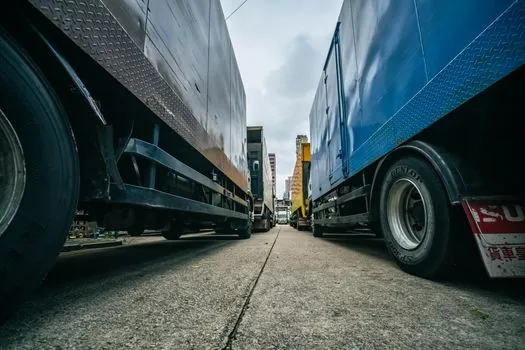
Compare the three main candidates against four decision criteria drawn from the 2026 sources:
1. Ground condition. RT forklift (380 mm clearance, 4WD, pneumatic tires) wins on mud, gravel, and ungraded sub-base; electric counterbalance loses on any unfinished surface; truck-mounted forklift with permanent AWD wins on paved curbside delivery [S1][S4][S5].
2. Capacity band. RT spans 1.8–10 t against the typical urban-infrastructure lift (pipe, precast, formwork); electric counterbalance clusters at 1.5–3.5 t for palletized goods; truck-mounted units like the BM 154 sit at 1,500 kg at 600 mm load center [S1][S5][S6].
3. Emissions and zoning. Stage V diesel covers most EU municipal sites in 2026 [S5]; electric requires verified charging infrastructure and a duty cycle that returns to a plug point [S6]; for low-emission zones, hybrid yard strategies pair electric staging with diesel site work.
4. Operating envelope. RT rated to 50% grade, 10–15% for standard forklifts [S1]; truck-mounted units rated for curbside drop on municipal routes rather than slope work [S4]; autonomous units locked to structured yards with 1–2 cm terminal precision [S2].
Safety Margin, Sizing, and What Spec Sheets Hide
The operating rule from 850 surveyed sites: size lift capacity to the heaviest anticipated load with a 20% safety margin, match drive configuration to typical ground, and pick mast height for stability on uneven surfaces [S1]. When those fundamentals slip, productivity losses of 25–40% follow from stuck equipment, tip-overs, and inability to reach required lift heights [S1].
Three figures engineers should pin on the spec sheet before signing: (a) load center distance, usually 500 or 600 mm, which derates capacity sharply as it grows; (b) grade rating in percent, not in vendor adjectives; and (c) tire size and ply rating, because under-rated pneumatics are the single most common cause of site-day downtime. For a side-by-side of forklift and aerial work platform use cases, the forklift vs aerial work platform spec-driven guide covers the height-vs-reach trade-off.
Trackable Signals Going Forward
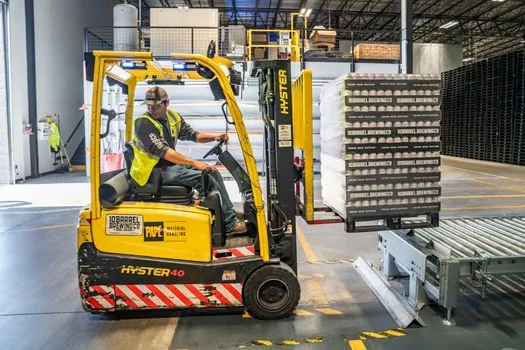
Two nodes worth watching through the rest of 2026: municipal low-emission zone rules, which are pushing more fleets toward Stage V truck-mounted units like the BM 154 [S5], and warehouse-side automation rollouts that pair 1–2 cm-precision autonomous forklifts with infrastructure-anchored SLAM [S2]. For fleets running snow removal alongside infrastructure work, the tank container and dry storage container selection for snow removal fleets reference maps the material-handling crossover.
Spec-level background on the components involved: forklift, and pressure transmitter.