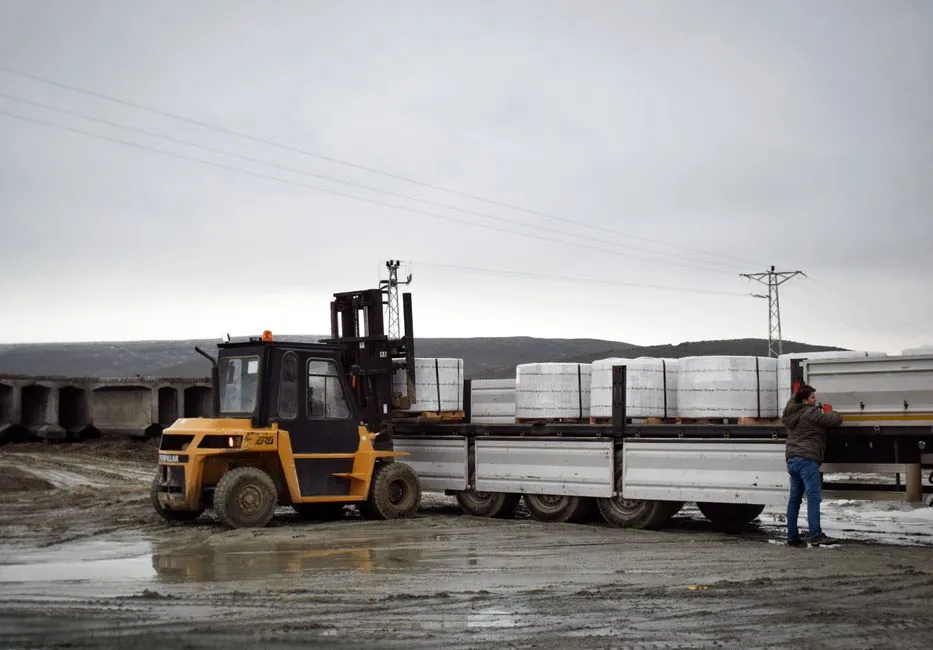
A rough terrain forklift sized for urban infrastructure work should deliver 2,000-5,000 kg rated load capacity, 3,000-6,000 mm maximum lift height, diesel power, and full-time 4x4 drive on 16/70-20 or 16/70-24 off-road pneumatic tires, with operating weight in the 4,000-8,000 kg band [S3].
Procurement teams that anchor their spec on these five parameters, then validate them against the project's worst-case ground slope and lift-height requirement, consistently avoid the 25-40% productivity loss that comes from stuck equipment, tip-overs, or insufficient reach when these fundamentals are overlooked [S1]. The category itself is expanding: the global rough terrain forklift market is valued at $3.99 billion in 2025 and is projected to reach $6.65 billion by 2034 at a 5.8% CAGR, with the construction sector holding the largest 42.5% share and Asia Pacific leading regional revenue at 38.2% [S2].
Drivetrain and Traction: 4WD, Differential Locks, Oscillating Steer Axles
Full-time or selectable 4WD is non-negotiable for professional-grade urban infrastructure work because it prevents the "digging-in" effect that strands 2WD industrial trucks in mud, gravel, or loose sand; rear-wheel-steer units without front drive simply lose tractive effort as soon as one rear wheel spins on a high-flotation surface [S4]. A limited-slip or manually lockable differential is the second pillar, because on uneven ground one wheel routinely loses contact, and the diff redirects torque to the wheels still holding grip so the machine can power through ruts that would otherwise halt a standard forklift [S4].
The third pillar is the oscillating steer axle, commonly specified at up to 10 degrees of articulation, which keeps all four tyres in contact with the ground on undulating terrain and is the single most effective mechanical guard against tip-overs when carrying a multi-tonne load across a slope [S4]. On the resulting slope capability, rough terrain forklifts can safely operate on grades up to 50%, while standard warehouse forklifts are typically limited to 10-15% grades, a roughly threefold capability gap that decides whether a machine can serve a ramped urban site at all [S1]. Engine output tracks capacity: 2.5-tonne machines typically run 43-55 kW diesels, while 10-tonne heavy-duty variants use engines around 90 kW to keep torque and continuous-duty endurance under load [S1].
Chassis Geometry: Ground Clearance, 30/30 Angles, Tire Footprint
Under-chassis clearance of 270-320 mm at the lowest chassis point is the published 2026 professional-grade benchmark, set deliberately above the 100-150 mm typical of warehouse forklifts so the machine does not high-centre on construction debris, cobbles, or temporary track plates [S4]. Heavy-duty models push that figure past 380 mm for sites with large rock or deep rutting [S1]. The 30/30 rule, meaning approximately 30° approach angle at the front and 30° departure angle at the rear, governs whether the forklift can transition between a flat yard and a steep loading ramp or natural hill without the counterweight or mast base scraping ground [S4].
Tire selection sets the ground-pressure envelope: deep-tread, high-flotation pneumatic tyres in patterns such as 12.5/80-18 front and 27x10-12 rear on 2.5-tonne models, or 16/70-20 and 16/70-24 on construction-class machines, give a larger contact patch that lowers PSI and prevents sinking into soft sub-base [S1][S3]. For aggregate yards, port-adjacent road work, and similar urban infrastructure environments, the relevant forklift baseline is that pneumatic off-road tyres, not cushion or solid rubber, are what allow continuous outdoor duty cycles.
Capacity Classes, Mast Selection, and the 20% Safety Margin

Rough terrain forklifts split into four working capacity bands: compact 1,800-2,500 kg units at 3.7-4.8 tonnes operating weight for agriculture, landscaping, and light construction; mid-range 3,500-5,000 kg units at 5.2-8.5 tonnes operating weight for general construction and timber handling; heavy 5,000-10,000 kg units for bulk materials, port work, and large infrastructure; and specialised units above 10 tonnes for mining and heavy industrial yards [S1][S3].
Capacity sizing must apply a 20% safety margin above the heaviest anticipated load, because dynamic loads on uneven ground amplify mast forces beyond the static rated figure [S1]. Lift height is the second sizing decision: 3,000-6,000 mm covers most urban infrastructure work, but telescopic-boom handlers are the right answer when the application requires reaching over obstacles, loading high-sided trucks, or placing materials on formwork, while vertical-mast units remain the lower-cost, more compact option for ground-level pallet and block handling [S7]. Mast channels should be reinforced high-tensile steel to absorb the torsional shock transferred through the hydraulic cylinders every time a loaded machine hits a bump; under-specced masts fatigue at the welds long before the powertrain wears out [S4].
Application Fit: Urban Infrastructure, Ports, and the Comparison Pass
Urban infrastructure sites, including bridge decks, metro stations, road sub-base yards, and utility trench work, share three operating conditions: mixed surfaces, frequent short-distance moves, and tight work zones. Construction as a vertical accounts for 60-65% of all rough terrain forklift deployments globally, with agriculture at 10-15% and general industrial use at 10-15% [S1]. For procurement, the practical decision matrix on the main configurations runs: vertical-mast 2.5-tonne unit (lowest cost, tightest turning, ground-level work only); vertical-mast 5-tonne unit (mid-cost, the workhorse for block, timber, and pallet handling on paving and bridge decks); telescopic handler 3-4 tonne (higher reach, able to load high-sided trucks and place loads over formwork); and 8-10 tonne heavy unit (reserved for port infrastructure, quarry-fed sites, and pipe-handling where reach and ballast dominate).
Slope rating, ground clearance, and reach are the three variables that re-rank these options site by site: a 50% slope capability and 380 mm clearance is wasted on a flat paving yard but essential on a sloped bridge abutment, while 6 m of vertical mast reach is irrelevant if the work is loading 1.2 m-high truck beds [S1][S4]. For sites that co-locate a concrete batching plant for urban infrastructure, the rough terrain forklift's role shifts to aggregate and block handling, so capacity and ground clearance dominate the spec while lift height becomes secondary. Adjacent equipment decisions on the same site, including dump truck selection for spoil haul and rotary drilling rig sizing for foundation work, should be reviewed against the same ground-clearance and slope envelope to keep the fleet coherent.
Limits, Failure Modes, and Sourcing Discipline
Rough terrain forklifts are not a universal substitute: on finished concrete slabs, indoor warehouses, or noise-restricted urban sites, the diesel drivetrain, 380 mm ground clearance, and large pneumatic tyres become liabilities, and electric counterbalance or cushion-tyre units are the correct fit [S5][S9]. The principal failure modes are under-sized capacity (mast fatigue, hydraulic overload), missing differential lock (stranding in soft ground), and inadequate approach angle (high-centring on ramp transitions), all of which are spec-able failures, meaning the procurement document is where they should be caught rather than at commissioning.
For more on the parent equipment category, the rough terrain forklift reference page consolidates the defining chassis, mast, and drivetrain features.
Trackable signals for the next procurement cycle: monitor 4WD take-rate in vendor 2026 model-year data sheets, the diffusion of hybrid and battery-electric rough terrain platforms in Tier-1 city air-quality zones, and any dealer-stock movement on telescopic handlers above 4-tonne capacity, since all three will reshape the urban-infrastructure short list before 2027.
Spec-level background on the components involved: pressure transmitter.