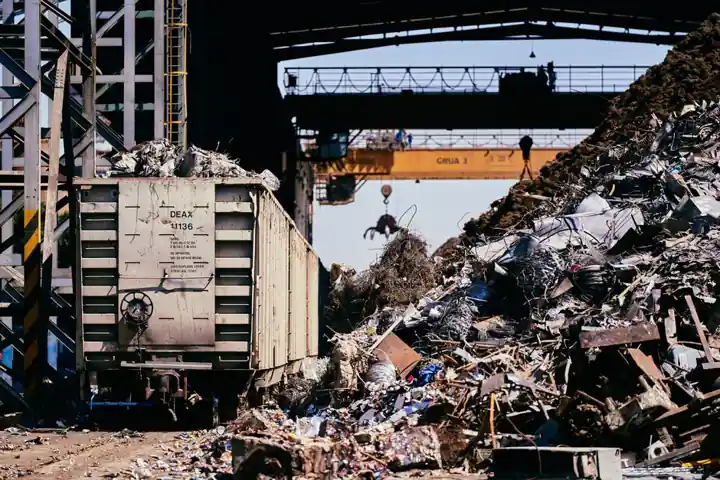
Landfill duty cycles punish under-spec'd lift trucks: operators run on compacted but uneven cover-soil, gravel access roads, and active fill faces littered with debris, so the realistic machine is a rough terrain forklift or a high-capacity pneumatic-tire forklift, not a warehouse cushion-tire unit [S1].
For most municipal solid waste (MSW) sites, the working envelope is 10,000 lb rated capacity or above, larger-diameter pneumatic or lug tires, and a diesel or LPG powertrain; electric forklifts are restricted to enclosed transfer stations where emissions and noise are controlled [S1][S2].
Landfill Working Envelope vs Standard Warehouse
Landfill floors are not floors: they are compacted soil, daily cover, and weather-affected surfaces that change grade after every rain event, which is why the standard warehouse forklift with small cushion tires is the wrong tool from day one [S1].
The original equipment guidance for MSW landfills notes that baled material is routinely handled by forklifts without supplemental compaction in the bale stack itself, a duty pattern that loads the mast and rear axle with thousands of pounds per cycle [S3]. Where this lands on a spec sheet: choose a forklift with a rated capacity at least 25% above the heaviest single bale or bin you intend to lift, and confirm the load chart at the mast tilt and lift height your operators will actually use, not at the published maximum.
Tire and Drivetrain Choices for the Active Face
Air-filled pneumatic tires remain the default on outdoor recycling and waste yards because they absorb shock on gravel and dirt and give better traction than cushion tires in loose surface material [S1].
Where ground clearance becomes the binding constraint (ruts, debris piles, trench settlements at the working face), step up to a purpose-built rough-terrain chassis with larger tires, higher ground clearance, and 4WD, the same configuration called out in the related spec guide on rough terrain forklift selection for port and terminal yards. For most landfill buyers the realistic trade is a 2WD high-capacity pneumatic for haul-road and tipping-floor work, reserving 4WD rough-terrain units for the active face and any cell working in soft cover.
Capacity, Frame, and Hydraulic Sizing
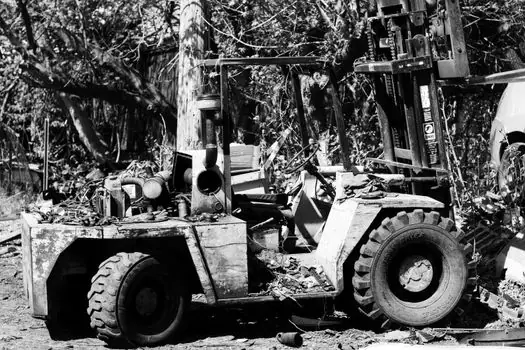
Recycling and waste duties routinely call for machines rated 10,000 lb or more, with reinforced frames, stronger hydraulic systems, and enhanced counterbalance to keep heavy, off-center loads stable [S1].
On the landfill side, the bale-and-bin handling pattern described in landfill operating procedure references pushes the same conclusion: lift trucks see repetitive high-load cycles on uneven ground, so a standard 5,000 lb warehouse chassis is structurally underbuilt for the job [S3]. When comparing candidates, score them on four criteria side by side: rated capacity at the operating load center, mast lift height, frame and counterweight mass, and tire size or ground clearance. A high-capacity pneumatic with a shorter mast typically wins on density and maneuverability inside a transfer station; a rough-terrain chassis with a taller mast wins on the active face where bales are stacked.
Power Source: Diesel, LPG, or Electric
Diesel forklifts deliver more power and speed than electric units, which matters when machines climb graded haul roads fully loaded [S2].
Electric forklifts are quieter, produce zero local emissions, and are widely chosen for enclosed warehouses and indoor sorting areas with limited ventilation, but they trade continuous run-time and torque density for those gains [S1][S2]. On an open MSW landfill that is a poor match: operators need engine braking on grades, refuel in minutes rather than hours, and a powerplant that tolerates dust ingestion. The defensible split is diesel or LPG on the open face and at outdoor transfer points, electric only inside enclosed transfer buildings where air handling and noise are regulated. Related heavy-equipment buyers weighing similar duty cycles can compare notes in the spec piece on mining dump truck selection for landfill haul routes, where chassis and ground-pressure logic overlaps with lift-truck tire choice.
Attachments, Safety, and Maintenance Reality
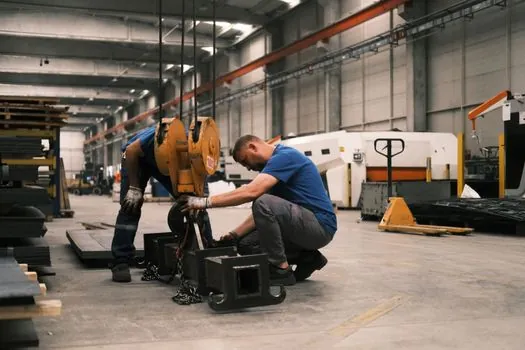
Forklift selection is not just the truck: load capacity, terrain, and the specific application (loading, unloading, stacking, unstacking, reaching high shelves) drive the attachment choice as much as the chassis [S2].
For landfill bale and bin work that typically means a side-shift carriage, a bale clamp, or a rotating handling attachment, matched to a frame rated for the combined load. Maintenance access matters: a model with readily available parts and straightforward service points reduces downtime, which on a single-shift landfill can be the difference between meeting daily tonnage targets and missing them [S2]. Operator training, random load inspection, and documented pre-shift checks are also called out as core landfill controls, not optional add-ons [S3].
Decision Matrix: Landfill Forklift Selection
Match the chassis to the surface, then size capacity to the load: the binding constraint on the active face is ground clearance and tire durability, while the binding constraint at an enclosed transfer station is emission and noise control [S1][S2].
A practical scoring matrix for a procurement engineer: (1) Surface and grade, scored by pneumatic-tire suitability vs 4WD rough-terrain necessity; (2) Rated capacity at the operating load center, scored against heaviest bale or bin with a 25% margin; (3) Power source, scored by outdoor diesel/LPG vs indoor electric; (4) Maintenance and parts availability, scored by local dealer coverage and common platform. Landfill concrete and shotcrete work adjacent to the lift-truck fleet is covered in the related guide on concrete pump truck selection for landfill operations, which complements rather than overlaps with this lift-truck spec.
Trackable signals for the next planning cycle: monitor whether the active face transitions to 4WD rough-terrain chassis as cell slopes steepen, and watch for any shift to Tier 4 final / Stage V diesel emission packages on units delivered to sites near residential buffers.
Spec-level background on the components involved: pressure transmitter.