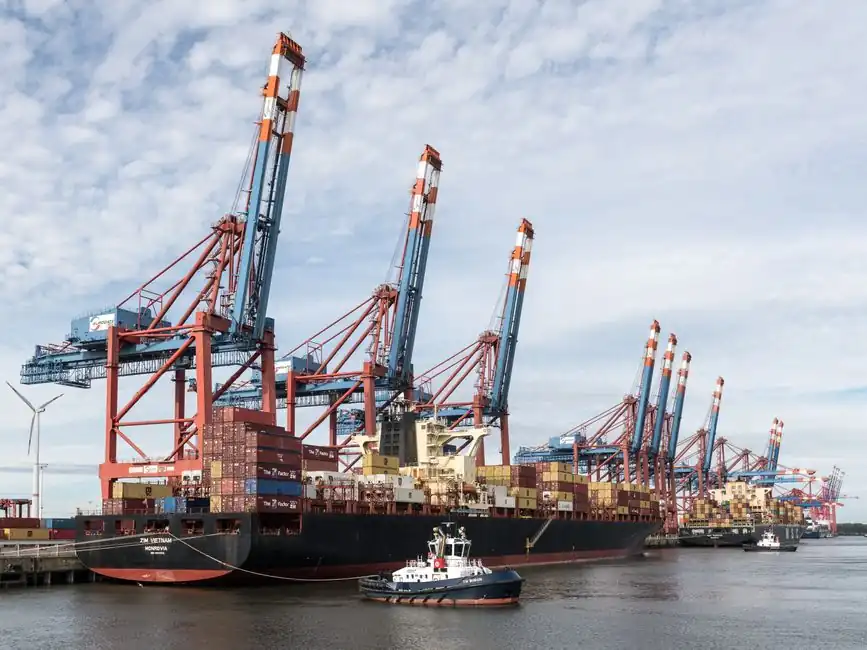
Rough terrain forklifts in the 10,000-20,000 kg (10-20 ton) class are specified for container positioning, breakbulk cargo handling, and freight-yard transfer at ports and terminals, where pneumatic tires, high ground clearance, and reinforced frames absorb the punishment of unpaved or partly paved aprons [S5][S6].
Selection is driven by three measurable variables: load weight per cycle, travel surface condition, and shift intensity. Port and terminal operators typically run three shifts with minimal downtime, so the drivetrain, hydraulics, and cooling package have to be sized for sustained duty rather than intermittent warehouse use [S1][S3].
Capacity classes and the 10-20 t port envelope
Port-focused rough terrain lifts fall into a clear three-band structure: 5-10 ton units for general freight, 14-18 ton machines for steel and bundled cargo, and 28-32 ton heavy-duty diesels for the heaviest breakbulk and container corner-cast work [S3]. The 10-20 ton middle band is where most rough terrain chassis actually live for port duty, and it covers the majority of container positioning, palletised machinery, and timber or steel bundle moves that a reach stacker would over-spec for [S5].
Lift heights in this class are typically 0-7,000 mm, which is enough for first or second-row container stacking but well below the 4-high / 5-high working envelope of a dedicated reach stacker [S3]. For terminal planners, the rule of thumb is to treat the rough terrain forklift as a yard complement to the reach stacker, not a replacement, since a rough terrain unit is generally slower than dedicated container equipment and cannot match stack density [S8].
Drivetrain, tires, and ground clearance
Rough terrain forklifts are defined by three hardware traits: large-diameter pneumatic tires, a long-travel suspension, and ground clearance typically well above a standard warehouse forklift's 100-150 mm [S1][S2]. That package is what lets the machine climb over potholed asphalt, gravel pads, and dock plates without bottoming the chassis or cracking a steer axle.
Engine choice is dominated by diesel at this capacity band. Common-rail diesel platforms from Cummins, Isuzu, and Deutz are the workhorses, with Chinese OEM engines appearing on lower-cost 5-10 t units [S3]. For terminal buyers in regulated port air-sheds, the trend is toward Stage V / EPA Tier 4 Final emissions packages or, in indoor-near-building berths, electric and hybrid conversions; electrified rough terrain lifts are still a minority of the installed base but a clearly growing share of new orders in 2025-2026 [S5].
Mast and carriage hardware on a port-rated rough terrain unit should be a heavy-duty two- or three-stage mast with a load-backrest, side-shift, and fork-positioner as standard rather than options. Hydraulic functions typically run at 200 bar class working pressure with double-acting lift and tilt cylinders, and the counterweight is sized so the rated capacity holds at full lift height with mast vertical, not just at low elevation.
Selection criteria: when a rough terrain lift fits, and when it does not
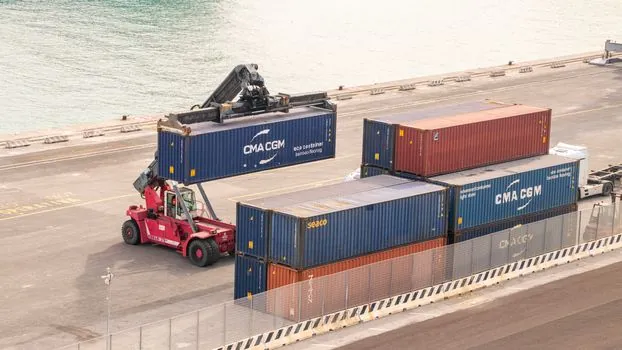
A rough terrain forklift is the right tool when the work is outdoor, the ground is uneven or unpaved in patches, lift heights stay under roughly 7 m, and cycle counts are moderate (think tens of loads per shift, not hundreds). It is the wrong tool when the job demands high-density container stacking, sustained 50+ loads per hour, or indoor warehouse aisles under 4 m ceiling height [S1][S3][S8].
Key selection numbers a port engineer should pin down before talking to a dealer:
1. Required load capacity at the lift height actually used, not the brochure maximum, because capacity falls as lift height rises and as the load centre moves forward.
2. Maximum ground slope and surface type on the duty cycle, because pneumatic-tire rough terrain chassis are typically rated for 15-20% gradient versus 5-10% for a standard sit-down counterbalance.
3. Shift pattern and ambient temperature, which set cooling-package size, hydraulic-tank capacity, and service-interval targets; three-shift port work typically halves the standard service interval.
4. Operator visibility package: raised cab, mast-tilt interlocks, reversing camera, and blue-spot pedestrian lamps are no longer optional on busy freight aprons [S1].
Comparison: rough terrain forklift vs reach stacker vs standard heavy forklift
For port buyers, the three practical options against the same job are: a rough terrain forklift (10-20 t, 0-7 m lift), a heavy-duty diesel forklift (28-32 t, 0-7 m lift), and a reach stacker (40-45 t, 4-5 high container stacks). The rough terrain unit wins on terrain tolerance and unit cost, loses on speed and stack density. The 28-32 t heavy forklift wins on raw lift capacity for single heavy lifts, loses on ground clearance and tire robustness. The reach stacker wins on container throughput and stack height, loses on unit price, yard manoeuvrability, and the ability to operate on poorly compacted surfaces [S3][S5][S8].
For container positioning in a yard with mixed pavement and tight turning radii, the 10-20 t rough terrain class remains the most cost-effective pick, while dedicated container blocks should still be served by reach stackers or terminal tractors with twist-lock trailers.
Maintenance, safety, and duty-cycle reality
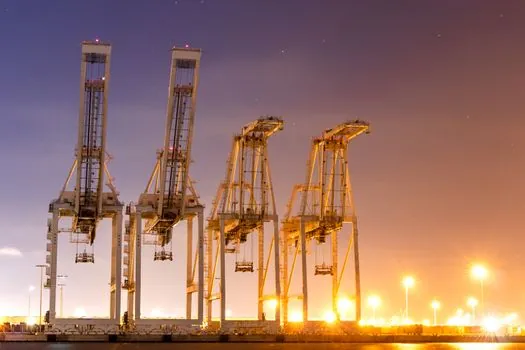
Well-maintained rough terrain and heavy-duty forklifts can handle up to 40,000 lb (about 18,000 kg) in freight-yard and terminal duty, but that ceiling assumes a disciplined preventive-maintenance programme, not just operator care [S4]. At port duty cycles, the realistic PM cadence is 250-hour engine and hydraulic checks with 500-hour powertrain service, against the 500/1,000-hour intervals typical of lighter warehouse use.
Common failure modes in port service are hydraulic-hose abrasion from grit, mast-roller wear from shock loading, and overheating of the diesel cooling package in tropical or container-stack shade conditions. Specifying a reversible fan, cyclonic air pre-cleaner, and hardened fork tips pays back fast in this environment. The construction machinery and equipment category covers the broader platform these forklifts share, while the dedicated rough terrain forklift reference drills into chassis geometry.
Standards, sourcing, and what to verify before purchase
Port-rated rough terrain lifts typically meet ISO 5053-1 for forklift terminology and stability, ANSI/ITSDF B56.1 (or the regional equivalent such as EN 1459 for rough-terrain variable-reach trucks) for safety, and the engine emissions tier applicable to the country of operation. For explosive-atmosphere terminals (fuel, chemical berths), an ATEX or IECEx-rated unit is mandatory rather than optional, and the truck must carry the appropriate temperature class for the cargo handled. [S2]
Sourcing reality in 2025-2026: Chinese OEMs (Hangcha, Heli, XCMG, Sany) dominate the 5-18 t price band with strong parts availability in Asia, Europe, and Africa; Western and Japanese brands (JCB, Manitou, Toyota, Komatsu) hold the premium heavy-duty and emissions-controlled segments [S5]. Independent market sizing puts the global rough terrain forklift market at $3.99 billion in 2025, rising toward $6.65 billion by 2034 at a 5.8% CAGR, with construction the largest end-use sector at 42.5% and Asia Pacific the largest region at 38.2% revenue share [S5].
Buyers evaluating a quote should compare: rated capacity at full lift height, mast type and lift height, engine emissions tier, tire brand and ply rating, ground clearance, turning radius, hydraulic-flow rate for attachments, and warranty terms on the powertrain versus the mast and hydraulics. For a deeper dive into the wider forklift family tree, the forklift encyclopedia page covers the counterbalance, reach, and order-picker variants that bracket the rough terrain class.
Trackable signals to watch over the next 12 months: the share of new port orders going to Stage V / Tier 4 Final diesel platforms, the rollout of factory-built electric rough terrain lifts in the 8-12 t class, and any port authority tenders that mandate ATEX zone coverage for fuel berth equipment. A related terminal-yard buying map, port and terminal forklift selection: capacity, duty cycle, and yard surface, is worth cross-reading when sizing the 28-32 t heavy diesel class that sits above the rough terrain envelope. For construction-adjacent yards, backhoe loader selection for port and terminal work: spec-first buying map covers a complementary tool class that often shares the same diesel and hydraulic platform.