For 2026 industrial spec work, FRP composites and industrial ceramics are best treated as complements rather than rivals: FRP dominates where low weight, electrical insulation, and corrosion resistance matter, while technical ceramics win where temperature, hardness, and wear resistance drive the design [S1][S2][S3].
Both material families are now mature, both have dedicated [S2][S3], and both have stabilised on a handful of dominant chemistries. A typical pultruded E-glass / polyester or vinylester FRP composite panel runs 1.7-2.0 g/cm³, against 3.85-3.95 g/cm³ for zirconia and roughly 3.9 g/cm³ for alumina, so weight is the first spec gate to settle.
Mechanical and Physical Envelope Compared
On stiffness, pultruded unidirectional E-glass FRP delivers longitudinal tensile modulus in the 20-40 GPa range with tensile strength typically 200-450 MPa, and vinylester or epoxy matrices push those numbers further with fibre volume fractions above 50% [S1][S2][S5]. Industrial ceramics occupy a different envelope: alumina (Al₂O₃, 95-99.7%) carries a Young's modulus near 300-380 GPa, flexural strength in the 280-400 MPa band, and Vickers hardness above 15 GPa for 99% grades [S3].
The trade is brittleness. FRP fails in a pseudo-ductile, fibre-pullout mode that absorbs energy and rarely fragments catastrophically, while alumina and zirconia behave linear-elastically to fracture with K_IC values typically 3-5 MPa·m^½ for alumina, rising to 5-10 MPa·m^½ for Y-TZP zirconia [S2][S3]. Specific stiffness of FRP (modulus ÷ density) is comparable to structural steel at roughly 25 GPa/(g/cm³), but ceramics are 2-4× higher in absolute stiffness for the same part, which is why ceramic armour and wear liners remain the default.
Thermal, Chemical and Electrical Behaviour
Continuous service temperature is the second spec gate. Pultruded polyester FRP is typically rated to 60-80°C, vinylester to 100-120°C, and epoxy FRP can reach 150-180°C with carefully selected resin systems [S1][S2]. Industrial ceramics are on a different curve: alumina tolerates 1600-1700°C in oxidising service, and zirconia (Y-TZP) handles 1000-1500°C depending on stabiliser content [S3].
On corrosion, both materials outperform carbon steel in acidic and chloride-rich media. FRP tanks and GRP pipework are widely used for HCl, NaCl brine, and wet chlorine handling, and FRP underground gasoline tanks have replaced steel in many retail-fuel applications [S1][S6]. The industrial ceramic reference set goes further: alumina and zirconia resist almost all acids except concentrated HF and hot concentrated caustic, and show essentially zero water absorption, which is why they dominate pump mechanical seals, valve seats, and wear rings [S3].
Electrical insulation is where FRP competes head-on with porcelain and glass-ceramic insulators. FRP rods and tubes — typically epoxy or polyester with E-glass — offer dielectric strength above 10 kV/mm combined with high axial tensile strength, which is why composite cross-arms and long-rod insulators are now mainstream in transmission lines [S2][S4]. Porcelain remains competitive at lower cost, but its brittle fracture behaviour and heavier handling weight (density around 2.3-2.5 g/cm³) push designers toward FRP for new HV builds.
Manufacturing Process and Shape Envelope
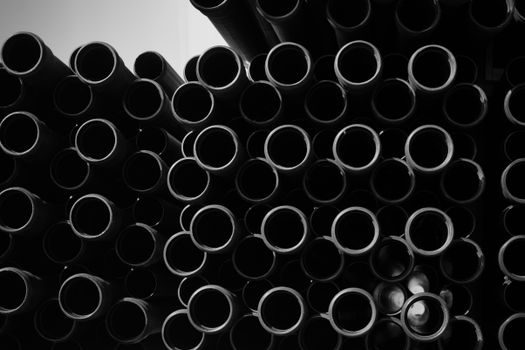
FRP manufacturing routes are low-pressure, low-temperature, and tool-light by ceramic standards: pultrusion pulls resin-impregnated rovings — bound by an industrial-adhesive matrix — through heated dies for constant-section profiles, filament winding lays wet fibres on rotating mandrels for pipes and tanks, and hand layup with vacuum bagging handles one-off structures and large enclosures [S1][S2]. Cure temperatures for FRP stay in the 80-180°C band, and tooling is usually aluminium or even wood for short runs.
Industrial ceramics require sintering at 1500-1800°C, dry pressing or isostatic pressing of green bodies, and diamond grinding of finished tolerances. Net-shape capability is improving with injection moulding of feedstocks, but the lead time and tooling cost per part are 5-10× a comparable FRP part. For complex hollow bodies, large-diameter tanks, cable ladder, and handrail, FRP wins on cost-per-metre; for precision wear parts under 200 mm and heavy wall sections, ceramics win on repeatability.
Selection Decision Frame for Engineers
Use this criteria matrix to lock the material call before geometry is finalised: [S1]
Temperature ceiling — under 150°C, FRP is in scope; 150-600°C, glass-ceramic and high-silica composites take over; above 600°C, structural alumina or zirconia are the realistic picks [S1][S3].
Mechanical loading and impact — impact-prone parts, structural cross-arms, tank shells, and walkways belong in FRP because the material yields and damages progressively rather than shattering; wear surfaces, bearings, seal faces, and cutting tools belong in ceramic [S2][S3].
Media exposure — wet chlorine, HCl, sodium hypochlorite, and many organic solvents are FRP-friendly with vinylester or furan resins; HF, hot caustic, and abrasive slurries generally point to ceramic liners, sometimes over a FRP or steel substrate for impact tolerance [S1][S3][S6].
Geometry and production volume — long constant-section profiles, cable ladder, handrail, and pultruded structural shapes are dominated by FRP at low unit cost; small precision parts above 5,000 pieces benefit from ceramic injection moulding despite higher per-part tooling [S1][S2].
Weight and electrical insulation — both FRP and ceramic insulate, but FRP typically wins on specific strength and is half the weight of porcelain, which is why composite long-rod and cross-arm insulators are now common in 110-400 kV lines [S2][S4].
Real Use Cases and Limitations
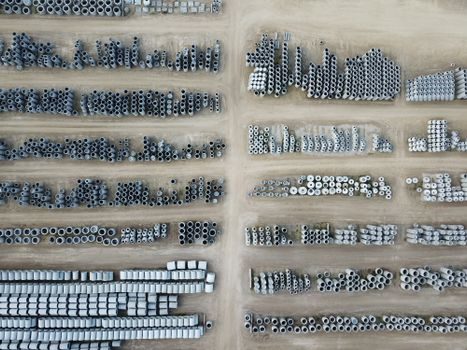
FRP is the default for cable ladder and cable tray, cooling-tower fan stacks, FRP handrail and fence, and chemical-process piping where corrosion and weight dominate the spec [S1]. Industrial ceramics are the default for pump mechanical seal faces, ball-valve seats, chute liners in mining, and high-temperature furnace furniture [S3].
Where the choice fails: FRP is wrong for any application with sustained surface temperatures above the resin heat-deflection point, for high-wear sliding interfaces without a hard facing, and for parts requiring tight machined tolerances below 0.05 mm. Industrial ceramics are wrong for thin-walled structural shapes (brittle fracture risk), for any application with significant impact or bending shock, and for low-cost large-format enclosures where pultruded FRP delivers the geometry in one piece [S1][S2][S3].
Hybrid builds are now common: a FRP structural shell with a ceramic wear liner, an FRP pipe with a ceramic flow-control insert, or an FRP cable ladder with ceramic wear pads at support points. These stacks exploit the toughness of FRP and the hardness of ceramic in one assembly [S3].
Standards, Sourcing and Verification
Specifying engineers should anchor FRP selections to ASTM D638 (tensile), ASTM D790 (flexural), and ASTM D256 (Izod impact) for coupons, plus ASTM D2992 or ASTM D5364 for pipe and tank long-term pressure ratings [S1][S2]. For industrial ceramics, ASTM C1326 covers alumina and zirconia wear tiles, ASTM C1161 covers flexural strength at elevated temperature, and ISO 6474 governs surgical-grade alumina [S3].
On supply, FRP pultrusion shops are now widely distributed with multi-week lead times on standard profiles and custom tooling amortised on volume runs [S1][S3]. Industrial ceramic blanks for alumina and zirconia are dominated by a smaller set of Asian and European refractory and technical-ceramic suppliers, with longer lead times on tight-tolerance parts and 4-6 week standard deliveries on wear liners [S3]. Trackable signals to monitor in 2026 are rising pultrusion capacity for cross-arm and cable-ladder profiles and tighter quality documentation on ceramic feedstock grain size and yttria content.
For related coverage, see Shock Absorber vs Gear Coupling: Function, Spec Gates, Misapplication Risks.