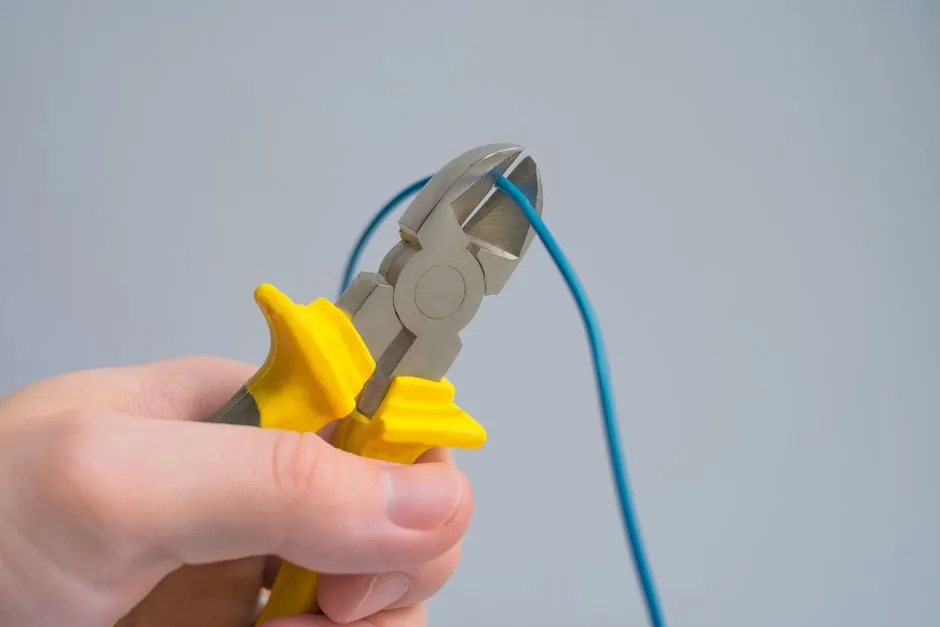
Fuse selection is a seven-parameter check, not a one-amp hunt: current, voltage, breaking capacity, time-current curve, AC/DC, temperature, and form factor, each gated by the real circuit numbers, not the label of the part being replaced [S1].
For a 230 V single-phase 2300 W heater the operating current lands at 10 A and the next standard fuse is 16 A; for a 400 V three-phase 15 kW motor at 0.85 power factor and 0.92 efficiency it lands at 28 A and the next step is 32 A; for a 1000 V DC, 100 kW battery storage string it lands at 100 A and a DC-rated PV or ESS fuse link is mandatory, not an AC cartridge [S3].
Current Rating and the 125% Continuous-Load Rule
Engineers usually rate the fuse at approximately 125% of the measured operating current for continuous duty, so a 10 A load maps to a 16 A fuse, 22 A to 25 A, 28 A to 32 A, 65 A to 80 A, and 90 A to 100 A on the standard E12/E24 ladder [S3]. Skipping that margin is the most common reason a fuse nuisance-blows on a healthy load.
Three numbers still beat one: normal running current, peak inrush, and steady-state thermal current after derating. Motors commonly draw 5 to 8 times full-load current at start, transformers draw 8 to 12 times, and capacitor banks draw even higher peaks, which is why a slow-blow (T-type) link is the right pick over a fast-acting (F-type) one for those loads [S1][S3].
Voltage Rating, AC vs DC, and Arc Extinction
Common industrial voltage classes are 125 V, 250 V, 500 V, 690 V, and 1000 V or higher for traction and PV strings, and a fuse must always be applied at or below its marked voltage, never above, because once the element melts the surrounding arc has to be quenched at the source potential [S1].
DC interruption is harder than AC interruption because the arc never sees a natural current zero, so a DC-rated fuse link (PV fuse link for solar, ESS fuse for battery storage) is the only correct choice on a 1000 V DC battery string; dropping an AC cartridge into the same holder is a common, dangerous mis-spec [S3]. On an AC motor branch a 500 V or 690 V AC class HRC or NH fuse covers the typical 400 V or 690 V industrial bus.
Breaking Capacity and Available Fault Current
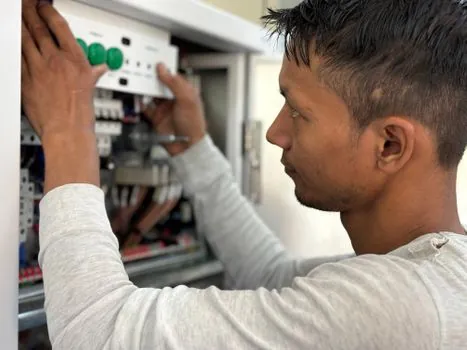
Breaking capacity, also called interrupting rating, is the maximum fault current the fuse can safely clear, and it must exceed the available short-circuit current at the point of installation, otherwise the fuse can rupture its body, vent plasma, or ignite the surrounding enclosure during a bolted fault [S1].
Standard industrial ratings sit at 10 kA, 20 kA, 50 kA, 100 kA, and 200 kA AC, with 10 kA to 100 kA typical for gG/gL NH links and 100 kA to 200 kA for HRC semiconductor and high-speed fuses; on the DC side 10 kA to 50 kA at 1000 V is the usual PV/ESS envelope [S1]. Confirm the let-through I²t against the I²t withstand of the downstream semiconductor or cable to avoid hidden coordination failures.
Glass vs Ceramic Body, Time-Current Curve, and Size
Glass-body fuses (typical 5x20 mm and 6x30 mm) give a visual blown indicator, run at lower breaking capacity, and fit low-energy signal and consumer electronics; ceramic-body fuses of the same footprint run hotter internally, sand-quench the arc, and reach higher breaking capacity, so they are the right pick for power-supply input, motor branch, and any location where fault energy can exceed the glass body's limit [S2].
Form factor still matters: 3.6x10 mm, 5x20 mm, 6x30 mm, 10x38 mm, 14x51 mm, 22x58 mm, and NH1/NH2/NH3 sizes define the holder, clip, and busbar spacing, and a 22x58 mm NH link is not a drop-in for a 10x38 mm slot, so always confirm mechanical fit before electrical rating. The time-current letter, F (fast), T (slow), TT (very slow), or M (medium), is what tells a maintenance crew whether the link will survive a transformer inrush.
Temperature Derating and Cabinet Hot Spots

Fuses carry less current as ambient temperature rises, so a fuse holder inside a 60 °C enclosure or on the roof of a control cabinet may need to be re-rated upward to avoid nuisance blowing [S1].
Three field checks prevent the temperature trap: measure ambient at the fuse clip, not at the panel door; avoid grouping fuses in a tight row where mutual heating stacks; and, when in doubt, move one standard step up the E-series ladder rather than guessing. A fuse datasheet's published derating curve is the only safe basis for that step, and ignoring it is the silent failure mode behind most summer brownouts in outdoor cabinets.
Application Match: Cartridge, NH, HRC, PV, ESS, Semiconductor
Application drives fuse family: cartridge for residential circuits, NH (knife-blade) for industrial distribution, HRC for motor protection, PV fuse link for solar PV strings, ESS fuse for battery storage, and semiconductor (aR/gR) fuse for UPS, VFD, and EV powertrain, even when the amp rating looks identical on the label [S3].
The selection logic in one line: if the load is a continuous motor, transformer, or DC string, the type matters more than the amp step. A wrong family (for example, an AC NH link on a 1000 V DC battery string, or a fast-acting glass fuse on a motor start) can pass the voltage and amp checks and still fail on the first real event. A related procurement perspective on tiered accuracy and 2026 buy decisions is laid out in this smart-meter procurement spec map, and isolation-switch sizing for industrial cabinets follows a similar envelope logic in this China isolating-switch spec map.
Who Should NOT Pick the Generic Cartridge

Skip the off-the-shelf 5x20 mm glass cartridge for any of these duties: 1000 V DC battery or PV string, VFD DC-link, motor soft-starter, large transformer primary, or any bus with available fault current above 10 kA, because the body, breaking capacity, and I²t coordination will all be wrong [S2][S3].
Skip the slow-blow T-type link on circuits that genuinely need fast disconnect, for example, semiconductor rectifier protection, where an aR high-speed fuse with a controlled I²t let-through is the only safe option. Mixing those two is the same class of error as the voltage and DC mistakes above: the part fits, the part passes a quick amp check, and the part still fails on the first real fault.
Final check before sign-off: confirm current (with 125% continuous margin), voltage class (AC or DC, plus a 25% to 50% headroom), breaking capacity above available fault current, time-current curve matched to load behaviour, ambient derating at the holder, and physical size against the holder drawing [S1][S3]. Two trackable signals to watch over the next procurement cycle: harmonised IEC 60269 gG/aR catalogue updates from major NH-link suppliers, and the next round of 1500 V DC PV fuse-link releases, both of which will shift the upper voltage and breaking-capacity envelopes for new builds.
Spec-level background on the components involved: pressure transmitter, and flow meter.