Wenzhou Kinee Electrical and Shanghai Ebasee Electric are among the most active Chinese isolating switch exporters in 2026, listing IEC 60947-3 switch-disconnectors in 1P/2P/3P/4P formats at 16, 20, 25, 32, 40, 50, 63, 80, 100, and 125 A under the EBS1G model family [S1][S4].
On the solar side, Tosun's S32D DC isolating switch line covers 16-32 A at 300-1200 V DC with utilization categories DC-PV2, DC-PV1, and DC-21B, while Ecer-listed rotary DC isolators push to 32 A at 1500 V with an IP66 enclosure under TUV and CB certification [S5][S6].
What "isolating switch" actually covers
Under IEC 60947-3, three formally distinct devices share the label: the disconnector (pure isolator, no on-load operation), the switch (on-load capable but no isolation guarantee), and the switch-disconnector or load-break switch (both functions combined) [S3]. Most catalog products branded "isolating switch" are switch-disconnectors, because they let an operator open a live circuit and then lock it out in one motion, satisfying the lock-out tag-out (LOTO) point that maintenance permits require [S3].
The defining property is the open-state guarantee: a specified isolating distance across the contacts, a rated impulse voltage withstand across that gap, and a lockable OFF position that cannot indicate open unless the main contacts truly are [S3]. This is the engineering distinction that separates an isolating switch from an ordinary cam switch or selector switch, where the OFF position may interrupt control current but not certify isolation [S3].
AC vs DC: the physics that decides which catalog page to open
An AC isolating switch cannot be cross-applied to a DC photovoltaic circuit, because a DC arc has no natural current zero and will not self-extinguish the way an AC arc does at every half cycle [S3]. DC-rated isolators use magnetic blow-out coils, longer arc chutes, and series pole doubling to stretch and cool the arc, which is why a 2-pole/4-pole in-series wiring is the standard solar topology [S3][S5].
The Tosun S32D line, for example, is offered in 2P, 4P, 4T, 4B, 4S, and 2H wiring variants, all rated to 1200 V DC with an 8.0 kV impulse withstand and 1 kA / 1 s short-time withstand [S5]. The Ecer-listed UKPD32 rotary isolator reaches 1500 V at 32 A with IP66 enclosure and IP20 switch body, mechanical life 15000 cycles and electrical life 1000 cycles, with no-polarity "+" and "-" interchangeability [S6]. Both are explicitly built to clear a DC fault current rather than just block it.
What 2026 residential code actually requires
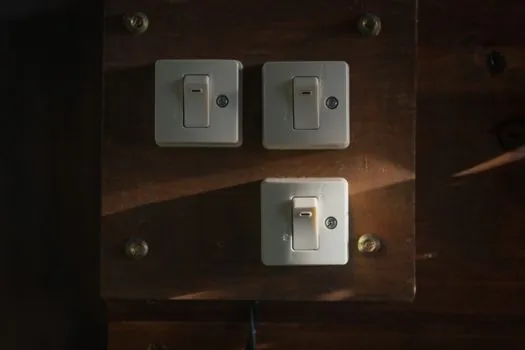
Mandatory zones for an isolator in residential wiring include HVAC outdoor condensers (must be within sight of the equipment), electric showers and wet zones (double-pole units that break both live and neutral), kitchen high-load appliances, solar PV inverters and battery storage, EV chargers, and heat pumps and water heaters [S2]. A double-pole configuration is used in wet zones specifically because a substation neutral fault could otherwise back-feed voltage onto a supposedly disconnected line [S2].
For commercial and industrial sites, the same devices double as the industrial switch used in motor control centers, photovoltaic combiner boxes, and distribution boards, where they sit beside miniature circuit breakers, residual current devices, and surge protection devices as the maintenance isolation point [S1].
Key specification parameters buyers should compare
Six numbers decide almost every isolating switch selection: rated operational current (Ie) in amperes, rated operational voltage (Ue) in volts, utilization category (AC-22, AC-23, DC-21B, DC-PV1, DC-PV2), rated impulse withstand voltage (Uimp) in kilovolts, mechanical life in cycles, and electrical life in cycles [S3][S5]. Insulation voltage (Ui), pollution degree, and suitability-for-isolation marking round out the IEC 60947-3 data plate, and the suitability-for-isolation YES is what legally allows the device to be used as the lock-out point [S5].
A short criteria comparison on the dominant options a 2026 buyer faces:
Standard AC switch-disconnector (EBS1G family, 16-125 A, 230/400 V): 1P-4P, IEC 60947-3, suitability for isolation YES, IP20 body, intended for AC distribution boards and motor isolation [S1][S4].
Residential DC-PV isolator (Tosun S32D, 16-32 A, up to 1200 V DC): 4P with 2-pole/4-pole in-series wiring, utilization category DC-PV2, IP66 UV-resistant enclosure, padlockable OFF, 18000 mechanical / 2000 electrical cycles [S5].
High-voltage string rotary isolator (UKPD32, 32 A, 1500 V DC): 2P/4P, no-polarity, TUV and CB certified, mechanical 15000 / electrical 1000, IP66 enclosure with IP20 switch body, designed for 1500 V PV strings [S6].
For a 1-20 kW residential or commercial PV system, the S32D class is the natural fit; above 20 kW or at 1500 V system voltage, the UKPD32-class rotary isolator is the more common spec [S5][S6].
Failure modes and limits buyers underestimate
Substituting an AC-rated isolator on a DC string is the most common cause of contact welding and panel-side fires in PV systems, because the DC arc never reaches a natural zero and a switch designed only for AC will not clear it [S3]. Salt-air corrosion is the second common failure in coastal HVAC and outdoor isolator installs, which is why UV-stabilized enclosures with high-purity copper contacts are specified for those zones [S2].
For enclosure and mounting choices, construction machinery and equipment applications also drive demand for high-Icw (short-time withstand) isolators, because fault levels on large machine feeders can exceed 10 kA and a residential-grade 1 kA / 1 s device will not hold [S3]. Always cross-check Icw against the site's prospective short-circuit current at the busbar, and verify the device's pollution degree rating against the actual dust or moisture exposure.
How to vet a Chinese isolating switch supplier
Three documents separate a credible IEC 60947-3 supplier from a relabeled commodity: a TUV, CB, or CCC type-test certificate showing the exact model and utilization category, a recent (within 24 months) test report covering Uimp, Icw, and mechanical/electrical life, and a declared suitability-for-isolation marking on the nameplate [S5][S6]. Both the Tosun S32D and the Ecer-listed UKPD32 publicly carry TUV and CB marks, with full IEC 60947-3 and AS 60947.3:2018 standard references on the product page [S5][S6].
Wenzhou Kinee publishes the full model family on its power-distribution catalog page with rated current options from 16 A to 125 A, matching the IEC 60947-3 frame sizes that Chinese export channels most commonly quote [S1]. Shanghai Ebasee's EBS1G line is listed on go4worldbusiness with the same 16-125 A range and 1P-4P pole options, also to IEC 60947-3 [S4]. For solar, the Tosun S32D page gives arcing time under 8 ms, which is the figure to ask any competing supplier to match or better [S5].
Sourcing context and adjacent equipment
Isolating switches rarely ship alone: a typical export package from a Chinese vendor bundles the isolator with DC MCBs, DC SPDs, NH fuses, fuse-switch disconnectors, and combiner boxes, all under one IEC 60947 family [S1]. That bundling pattern is why Chinese suppliers can hold FOB prices that are 30-50% below equivalent EU or US brands on frame sizes 16-63 A, though the spec gap is narrowing on utilization category coverage and certification depth [S1][S4].
Adjacent categories on the same catalog pages include lamps and light fittings and general lighting equipment and electric lamps, where the same suppliers package isolators into lighting control assemblies and distribution boards, so a lighting buyer often ends up sourcing the isolator from the same vendor as the luminaire [S1].
Trackable signals for the next buying cycle: any 1500 V DC rotary isolator release with mechanical life above 20000 cycles, any IEC 60947-3 update aligning utilization category DC-PV3 for higher-voltage string inverters, and any new CCC implementation for the GB/T 14048.3 equivalent standard, which would re-tier the Chinese export market in late 2026 [S5][S6].
Background reading: Dry-type transformer sizing and selection: 2026 field guide.