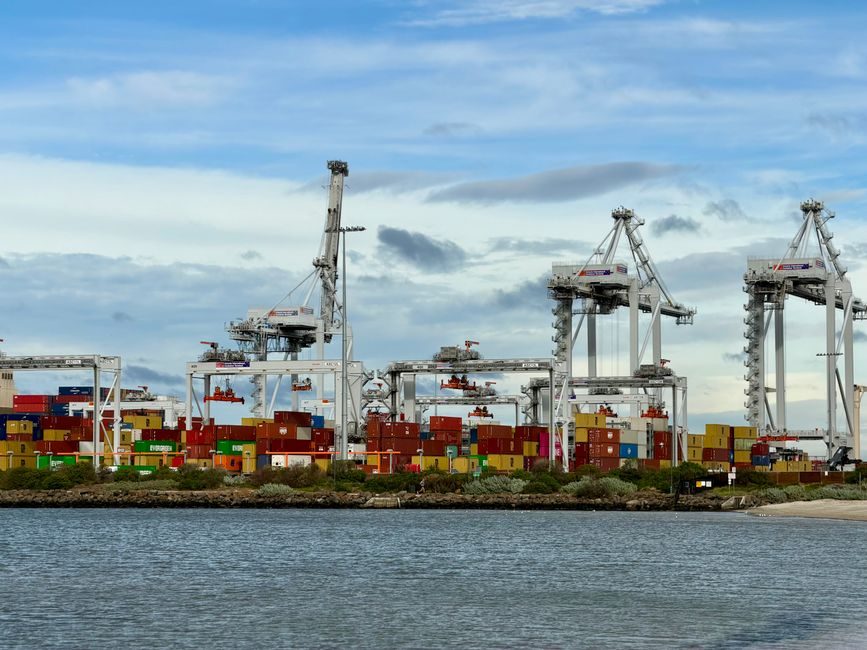
Gantry cranes and truck-mounted cranes solve overlapping lift problems but diverge sharply on mobility, lifting envelope, and infrastructure dependency — gantries run on fixed ground rails inside a defined span, truck cranes self-deploy from a roadable carrier [S1][S3].
For a typical 5–20 ton single-girder gantry, published specs sit at 3-phase 380 V 50 Hz supply, 3–20 m lift height, 5–30 ton capacity, and roughly 10,000 kg self-weight with a 1-year warranty and remote-control operation [S1]. Truck-mounted units, by contrast, prioritize outrigger span, boom telescoping length, and chassis roadability rather than a fixed span length.
Definition and Operating Envelope
A gantry crane is a bridge crane variant whose horizontal bridge rides on two ground-supported legs forming a gantry shape; it runs on rails or rubber tyres laid on the yard surface and needs no building runway structure [S3][S4]. This makes it a default pick for outdoor storage yards, container terminals, precast yards, and shipyard erecting beds where the lift path is fixed but the building cannot support an overhead runway.
A truck-mounted crane integrates a telescopic or lattice boom onto a commercial truck chassis, so it travels under its own power on public roads, deploys hydraulic outriggers, and lifts from a compact footprint. The unit can be repositioned between job sites without disassembly — the defining spec difference versus any rail-bound gantry.
Lifting Capacity and Class Boundaries
Overhead and gantry families overlap on the 1–30 ton single-girder band and the 5–550 ton double-girder band, with single-girder gantry models typically offered at 5, 10, and 20 ton ratings [S1]. Double-girder gantry builds extend well past 100 tons when the application is yard-based, because capacity scales with bridge span and leg height rather than road-transport limits.
Truck cranes cluster differently: small carrier-mounted units cover roughly 8–50 ton lifts for utility and light construction, mid-range all-terrain and rough-terrain truck cranes cover 30–120 ton, and heavy-haul truck cranes with multi-axle chassis top out in the 200–1,200 ton class but require permits and counterweight trailers. Above 120 tons on a single truck chassis, the practical envelope flattens fast because axle load limits, not boom strength, set the ceiling.
Mobility, Site Prep, and Infrastructure
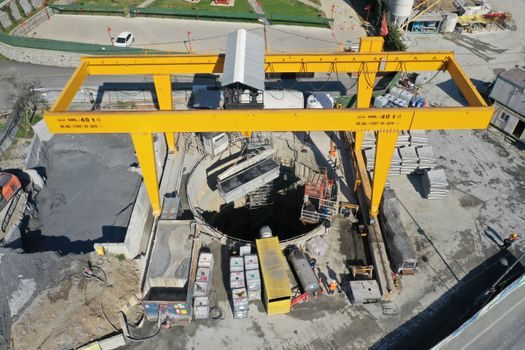
Gantries demand level ground, rail alignment (or a paved rubber-tyre run surface), and a clear span corridor; the trade is near-zero setup time per shift once the rails are down and unlimited daily duty cycles within that envelope [S1][S4]. Power is fixed 3-phase AC 380 V 50 Hz on most Chinese-built single-girder models, with electric winch or hoist and remote control as standard [S1].
Truck cranes trade site prep for travel: no rails, no runway, but every set-up cycle takes 15–45 minutes for outrigger deployment, counterweight rigging, and ground-bearing checks. Soft ground frequently demands timber mats or steel spreader plates, and outrigger pad pressure becomes a hard limit on unprepared sites — a constraint the rail-bound gantry simply does not face.
Decision Matrix: Gantry vs Truck-Mounted
Four criteria separate the two cleanly. (1) Site permanence: fixed yard with repeating lift paths → gantry; multi-site or one-off lifts → truck crane. (2) Capacity band: 1–550 ton with the heaviest units favoring gantry or crawler; 8–120 ton sweet spot favors truck chassis. (3) Power and infrastructure: 3-phase AC available and runway unwelcome → gantry; no fixed power, need to drive in and lift → truck crane. (4) Throughput: continuous shifts on a fixed span → gantry wins on cycle time; intermittent duty across scattered locations → truck crane wins on repositioning speed [S1][S3].
The same matrix rules out a truck-mounted crane for high-cycle container yards (axle and outrigger wear dominate lifecycle cost) and rules out a gantry for short-term bridge beam erection on a remote alignment (rail install cost kills the economics).
Power, Controls, and Compliance Anchors

Most Chinese-built single-girder gantries ship with electric wire-rope hoists or electric winches, 3-phase 380 V 50 Hz supply, pendant plus radio-remote control, and a 1-year warranty on core components (gearbox, motor) [S1]. Truck cranes use diesel-driven hydraulic systems with load moment indicators (LMI), outrigger position sensors, and operator cabs rated for the boom's tip-height envelope.
Factory-side compliance in this segment is anchored to ISO 9001 quality, ISO 14001 environmental, and OHSAS 18001 occupational H&S systems, as published by Chinese OEM Nucleon (Xinxiang) Crane Co., Ltd. [S6]. Design and rating work for both families traces back to FEM/CMAA duty classifications and, for higher classes, ASME B30 series crane standards — though specific revision dates should be confirmed against the latest OEM data sheet before procurement.
Failure Modes and Operating Limits
Gantry failure modes concentrate in the rail/wheel interface: rail misalignment, wheel flange wear, and span-sag under thermal load on long outdoor gantries. Sourcing preparation work on a new gantry site should include ground-bearing verification, rail gauge tolerance, and leg deflection checks at full load before the first lift [S4].
Truck crane failure modes concentrate in ground-bearing and outrigger pad crushing, hydraulic hose rupture on aged units, and LMI sensor drift causing boom-angle miscalculation. The soft-site problem is the single biggest cause of truck-crane tip-overs; the equivalent gantry risk (rail tip) is a long-term wear issue, not an acute stability event.
Use-Case Fit and Sourcing Notes
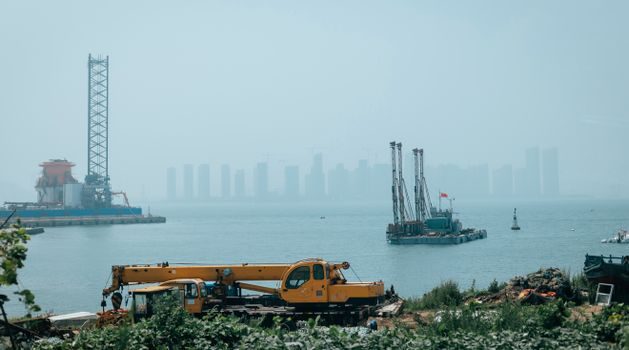
Pick a gantry when the job repeats inside a fixed span, capacity climbs past 50 tons, and 3-phase power is on site — typical buyers are precast yards, steel stockyards, port intermodal terminals, and heavy-machinery assembly halls [S1][S3]. Pick a truck crane when the lift moves, the site has no rails, and a 30–120 ton envelope covers the work — typical buyers are utility line crews, mobile tower crews, residential and light-commercial builders, and infrastructure maintenance teams.
For spec-first buyers cross-shopping crane families against other lift equipment, the crawler crane vs stacker crane selection map and the rough terrain forklift vs forklift spec map cover the adjacent fixed-yard and rough-terrain niches. The China cluster remains the dominant manufacturing source for both families, with OEMs such as Nucleon (Xinxiang) and Weihua (founded 1988, ~6,800 employees, 3.42 million m² total coverage) publishing standard product lines at the 1–550 ton band [S5][S6]. Before any purchase order, lock the spec sheet to a single duty class (FEM/CMAA), confirm the exact power supply and rail/runway tolerance, and verify the LMI or hoist braking system has a third-party type-test certificate.
Detailed specification references: dump truck.