
Rail-grade aluminum castings, including bogie brackets, coupler housings, and extruded body panels for rolling stock, are poured from gas-fired reverberatory furnaces sized for melt rates of 1,500 lbs/hr or higher, with bath temperatures held in the 1,160–1,210°F window dictated by the alloy family [S1][S4].
Specifying engineers balance three axes: melt-to-hold ratio (commonly 10:1, minimum 8:1), aluminum capacity (300 lbs crucible up to 300,000 lbs bulk holding), and refractory topology (radiant roof vs. convective sidewall burners), all of which feed directly into surface radiation losses measured at 7,147 BTU/ft²·hr at 1,250°F [S3][S5].
Melt Temperature and Alloy Window for Rail-Grade Alloys
Aluminum alloys used in rail structures (typically A356, 6061, and 6082 for structural castings) reach pouring-ready melt between 1,160 and 1,210°F depending on silicon and magnesium content, with the upper end required for high-silicon rail-casting alloys [S1]. Surface radiation loss from a molten aluminum bath at 1,250°F reaches 7,147 BTU/ft²·hr, a figure that drives roof burner positioning in radiant-top designs and dictates minimum bath area for a given melt rate [S3]. The molten bath forms an oxide layer with emissivity 0.11–0.19 (versus bare aluminum at 0.004–0.055), which is why reverberatory furnace designers favor a large bath surface versus melt rate ratio to compensate for the poor radiative coupling [S3]. Engineers comparing the aluminum alloy family for structural versus cosmetic rail parts should note that higher Mg/Si content raises melt point by 20–40°F, shifting the burner control band accordingly.
Bath-to-Melt Ratio and Throughput Sizing
Reverberatory furnace throughput is governed by the bath-to-melt ratio, where 10:1 is the proven design target and 8:1 is the absolute minimum before melt rate degradation and cold-corners appear [S3]. A 1,500 lbs/hr melting rate therefore requires roughly 15,000 lbs of bath capacity as a working minimum, which lines up with the 13,700 lbs holding, 1,500 lbs/hr melting reference build used by an outdoor-equipment OEM press, scaled up for rail casting cells [S4]. The bulk holding class spans 3,000 to 300,000 lbs, while crucible-style GS-Series gas-fired melting furnaces stop at 2,000 lbs and the GT-Series hydraulic-tilt crucibles reach 3,000 lbs, useful for alloy-change flexibility in rail job shops [S2][S5].
Refractory Topology: Radiant Roof vs. Convective Sidewall
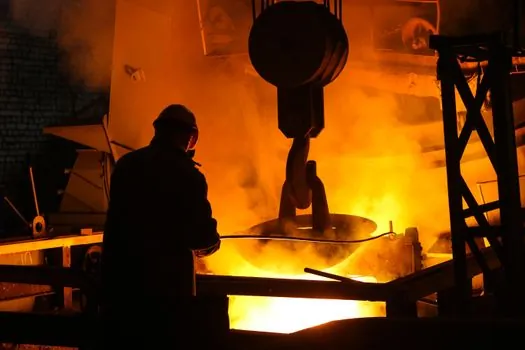
Low-headroom radiant roof burners rely on the Stefan-Boltzmann law: closer burner-to-bath distance plus higher ΔT equals faster BTU transfer, achieved with low-velocity flat-flame burners heating the burner block to 2,000°F for maximum temperature differential against the aluminum load [S3]. High-headroom convective sidewall designs move heat through larger flue gas volumes and suit larger bath footprints but require taller building envelopes, a constraint in retrofit rail-casting halls. Charging cadence is identical for both: 25% of the rated melt rate introduced every 15 minutes, with a 60% returns / 40% ingot ratio to maintain a steady thermal load and minimize dross formation [S3]. A four-component computer-designed refractory insulating system with heavy fabricated steel shell, paired with a hydraulically operated insulated lid and lip-seal geometry, is the industry-baseline construction for solid-state gas-fired units in the 300–2,000 lbs class [S2].
Safety Controls, Burner Trains, and Flux Discipline
UL-listed gas pressure switches and flame-safety control panels engineered to meet or exceed Underwriters Laboratories standards are standard on Thermtronix GS and GT-Series equipment, with IRI-type fuel trains governing the burner manifold [S2]. Modern gas-fired aluminum reverberatory control systems use butterfly valves with orifice plates on both air and gas inlet lines, driven by a programmable logic controller (PLC) with separate air-regulation and feed-door actuator branches, replacing the manual adjustment of legacy units that sacrificed accuracy and labor [S5]. The molten metal is then dispensed through one of five paths: manual tap-out block and plug into a transfer ladle, molten-metal pump, pneumatic pressurized dispensing pump well, direct-connected electric-resistance-heated gravity launder, or hydraulic furnace tilt pour [S3]. For rail component foundries running a gas aluminum melting furnace in continuous operation, the PLC-governed butterfly/orifice architecture is the minimum control upgrade over hand-valved legacy setups.
Comparison: Furnace Classes for Rail-Component Foundries
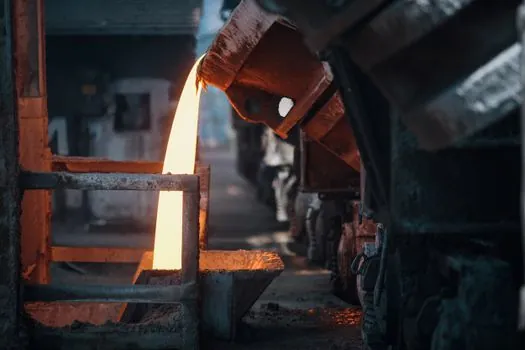
Four furnace architectures compete for rail-component melt supply. The crucible-type GS-Series (300–2,000 lbs) wins on alloy-change flexibility and rapid metal breakdown, ideal for job shops running multiple rail alloys in small batches [S2]. The GT-Series hydraulic-tilt crucible (400–3,000 lbs) adds powered pour for large master melts but inherits crucible wear cost. The GC-Series non-crucible (1,500–5,000 lbs) drops crucible consumable cost and is built for continuous melting, with a dry-hearth charging chamber on small to medium sizes that preheats returns before they hit the bath, critical for rail-grade cleanliness [S2]. Bulk reverberatory melting-and-holding (3,000–300,000 lbs capacity) dominates high-volume rail casting lines, sized at 10:1 bath-to-melt minimum and delivered as a rectangular refractory-lined steel box with submerged-arch or powered skimmer-door wet-hearth separation [S3][S5]. For melting rate alone, the 1,500 lbs/hr reference build paired with 13,700 lbs holding capacity maps to mid-volume rail-bogie production, while a 5,000–10,000 lbs/hr line covers mainline rolling-stock casting at scale.
Selection Criteria Specific to Rail Component Production
Rail casting specifications are unforgiving on inclusion content, so the dry-hearth charging chamber is a near-mandatory feature for any furnace melting returns from the rail line itself, as it preheats and partially oxidizes organic contaminants before submersion [S2][S3]. The 60% returns / 40% ingot charge mix typical of reverberatory practice is well-suited to rail operations where significant revert comes from riser pads, runners, and rejected castings. Furnace shell construction should be ruggedly reinforced for the thermal cycling inherent in 1,500+ lbs/hr melt rates, and a hydraulically operated insulated lid with refractory-lined flue extension is the standard noise and fume mitigation package on GS, GT, and GC-Series equipment [S2][S4]. For process engineers cross-referencing general melting furnace options, the fired brick refractory lining is what allows sustained 1,250°F bath operation with the four-component insulating stack that defines modern solid-state gas-fired designs.
Trackable signal to watch: bath-to-melt ratio falling below the commonly proven 10:1 design ratio, with a minimum acceptable of 8:1, in reverberatory aluminum melting furnaces [S3], with gas-feeding branch control systems such as the one disclosed in patent application CN201510557646.4 [S5].
For related coverage, see How to Choose a Portable Gas Detector: Spec-First Selection Guide.