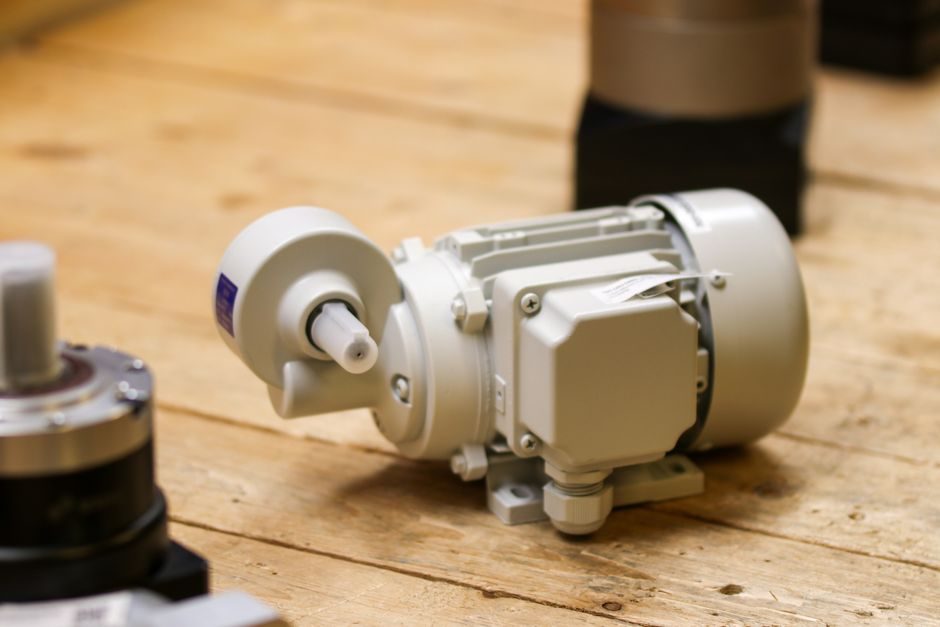
A gear pump that passes a nameplate check on flow and pressure can still self-destruct on the first dead-head event if its duty envelope, fluid viscosity, and over-pressure protection are not aligned with the application profile. The three compatibility gates that decide fit are mechanical (mounting, shaft, coupling), hydraulic (viscosity window, inlet pressure, head limit), and electrical/protocol (motor voltage, control signal, ATEX class), with the S2 intermittent-duty rating as the first hard filter.
Industry-side, the gear pump category on Made-in-China's catalog grid lists 11+ active SKU bands as of 2026-07-16, with price points from US$ 430 (single clamped centrifugal) up to US$ 12,999 (high-flow electric impeller) and US$ 888–1,499 for sanitary stainless gear/lobe pumps [S2]. GPM-US, the Mississippi-based distribution arm of Gear Pump Manufacturing, stocks SAE-mounted cast-iron bearing and bushing gear pumps plus PTO and flow-divider variants, with same-day US shipping [S3].
S2 Intermittent vs. S1 Continuous Duty: The First Hard Gate
The S2 short-time duty rating on the nameplate is non-negotiable: a pump marked S2 30 min must not be specified where the process demands more than 30 minutes of continuous run per cycle, or the bearing housing and gear-mesh temperature will exceed the lubricant's film-strength window within hours [S1]. Pompes Japy's HC-series DC gear pump publishes an explicit "Intermittent use: max. duration of 30 min" with an On/Off switch, two voltage taps (12 V and 24 V DC), and current draws of 35 A (HC3) and 18 A (HC4) at 0.3 kW, with a maximum head of 30 m (98 ft 5 in) and flow band of 0.66–0.69 m³/h [S1]. Specifying that pump on a 24/7 lubrication loop is a warranty-voiding decision; the part is designed for discrete oil-transfer events, not continuous circulation.
For continuous processes, an engineer should cross over to a bearing-type gear pump in the SAE-mount format (GPM-US, Parker/GPM hydraulic families) or a helical-tooth reducer-fed industrial unit where the industrial gear set is sized for S1 thermal class. The helical gear reducer page in the spec encyclopedia documents the thermal-rise and service-factor gates that a continuous-duty pump drivetrain must clear before a nameplate match is accepted.
Viscosity Window and Inlet Conditions
The second gate is fluid viscosity, expressed in mm²/s (cSt): the HC-series envelope of 50–600 mm²/s [S1] is the operating band within which volumetric efficiency and gear-mesh film strength are both valid, and excursions in either direction destroy the pump by different mechanisms. Below 50 mm²/s, the gear mesh loses hydrodynamic film, increasing wear on the steel rotor and Delrin vane interface; above 600 mm²/s, suction-side cavitation risk rises sharply because the inlet pipework cannot replenish the meshing volume at low NPSH, and the pump starts to make a characteristic high-pitched whine before failing the bearing.
For low-viscosity and clean-fluids service, gear pumps lose out to centrifugal pump topologies — the stainless sanitary close-impeller BS-series centrifugal at US$ 500–1,500 [S2] handles CIP (clean-in-place) flow regimes that a gear pump cannot. Conversely, for high-viscosity polymer, bitumen, or chocolate service, the heat-jacketed stainless gear/lobe rotor pump at US$ 1,500–10,000 [S2] is the correct topology because the gear coupling between drive and pump must tolerate the higher breakaway torque.
Relief-Valve Sizing: The Dead-Head Protection Gate
A pressure-relief valve (PRV) is mandatory on every gear-pump installation, and the rule is: when the gear pump is dead-headed — discharge valve closed, bypass blocked, or downstream filter blinded — the PRV must open at or below the pump's continuous-duty pressure rating, and the bypass line must return fluid to the suction tank, not the pump inlet [S4]. Returning PRV bypass to the suction side instead of the tank causes the pump to re-circulate hot fluid through itself, accelerating seal and gear wear; the published engineering guidance is explicit on this point [S4].
Belt-driven gear pumps get a second protection layer: if dead-headed without a PRV, the belt will slip on the pulley, providing mechanical fuse behaviour that direct-coupled pumps lack, so a directly coupled VFD duty motor-driven gear pump must always have an active PRV and a high-temperature cut-out on the casing [S4]. The Pompes Japy HC3 / HC4 DC unit specifies "ATEX: No" and a cast-iron body with steel rotor and Delrin vanes [S1], which means it cannot be specified in Zone 1 or Zone 2 hazardous-area service without an external purge or enclosure strategy, regardless of how well the duty cycle matches.
Selection Matrix: Topology vs. Duty Profile
Matching topology to duty is a four-row decision: (1) Intermittent oil transfer under 30 min/cycle and 50–600 mm²/s → external DC gear pump (HC series) at 12/24 V, 0.3 kW, with PRV to tank [S1]; (2) Continuous hydraulic service, SAE mount, mid-pressure → bearing gear pump (GPM-US) with S1-rated motor, S2 derate only for cold-start [S3]; (3) High-viscosity, sanitary, or CIP service → stainless lobe or heat-jacketed gear rotor at US$ 1,500–10,000 [S2]; (4) Clean, low-viscosity water or solvent duty → centrifugal (BS-series at US$ 500–1,500) or sealed CIP centrifugal (US$ 430–5,600), not a gear pump [S2]. The decision pivots on duty cycle first, then viscosity, then over-pressure protection, then materials.
ATEX, Materials, and Protocol Gates

The HC series publishes "ATEX: No" with cast-iron body, steel rotor, and Delrin vanes [S1], which excludes it from any Zone 1/2 European hazardous-area build without an engineered enclosure. For hazardous-area hydraulic service, an engineer steps up to ATEX/IECEx-certified bearing gear pumps, with the certification marking on the nameplate matched to the gas group (IIA/IIB/IIC) and temperature class (T1–T6) of the installed location. The materials-contact compatibility check is separate from the duty-cycle check: Delrin (POM) vanes in the HC series are incompatible with strong acids, bases, and several synthetic hydraulic fluids, even when the viscosity and duty ratings are otherwise correct [S1].
Control-side compatibility, when the pump is paired with a VFD-driven motor for variable-flow demand, must be verified at the protocol layer: many DC gear pumps including the HC family are bare-pump designs intended for fixed-speed DC bus operation, not for variable-frequency drive output, and the drive must be programmed with the correct V/Hz curve and current limit to avoid demagnetising the DC motor at low speed. The VFD duty motor page in the spec encyclopedia documents the inverter-duty insulation and bearing-isolation requirements that gate whether a VFD-driven gear-pump package is valid or invalid.
Failure Modes and Field Watch-Outs
The three most common field failures on gear pumps that passed the nameplate check are: (1) dead-head run without PRV, or with PRV bypassed to suction — gear-mesh seizure within minutes [S4]; (2) cold-start at sub-zero viscosity above the 600 mm²/s ceiling — suction-side cavitation stripping the Delrin vane tips within hours [S1]; (3) direct-coupled install with no alignment — coupling wear and shaft-seal leakage within weeks. The published engineering practice is to add a high-temperature cut-out and a low-NPSH cut-out, in addition to the PRV, on every continuous-duty install [S4].
Process-side, the hydraulic actuator and gear backlash compatibility piece documents the four backlash and torsional-stiffness gates that govern whether a gear pump and its driven actuator are mechanically compatible — a fit that passes a flow-and-pressure datasheet check but fails on backlash burns out the actuator seal within months. On the welding-and-fabrication side, welding robot 2026 price compression tracks how the same duty-cycle and service-factor discipline is being applied to robotic actuator selection in 2026 builds.
Trackable signals for the next quarter: a watch on whether major hydraulic OEMs publish revised S2 30 min → S1 derate curves for DC gear pumps in the 0.3 kW class, and whether the next price-list refresh on Made-in-China's gear-pump catalog grid (currently US$ 430–12,999 across 11+ SKU bands as of 2026-07-16 [S2]) introduces explicit S1/S2 markings in the spec table rather than burying duty in product descriptions.