
Chinese suppliers listed 6-axis MIG welding collaborative robots at US$3,500-9,500 per set on Made-in-China.com as of 2026-07-19, with 1-set minimum orders and ISO factory certification [S4]. The same platform tracked 118,806 robot SKUs from 6,988 suppliers, confirming that welding-robot inventory has scaled into a mass-market wholesale segment rather than a niche integration play [S2].
Global market sizing from Allied Market Research values robotic welding at US$5,450.5 million in 2018, projected to US$10,784.4 million by 2026 — an 8.7% CAGR from 2019 to 2026 [S7]. The reference for articulated robot selection now includes welding-specific 6-axis derivatives priced well below the US$18,000-31,000 bracket of polishing or bending units [S5].
Price Bands and SKU Spread, July 2026
Three price tiers dominate the Made-in-China welding-robot listings. The entry band runs US$3,500-9,500 for desktop-style 6-axis collaborative cobot arms branded for MIG welding and cutting, sold by Shandong Cyber CN as a 2024 hot-selling model with 1-set MOQ [S4]. The mid-band sits at US$10,000-11,730 per piece for TIG-torch welding robots from Shenzhen Guanhon, again 1-piece MOQ [S4]. The top band, anchored by laser-welding cells, lists US$8,500-20,000 per set with 0.05 mm accuracy claims, 0.5 m/min welding speed, and a "continuous path control" mode [S2].
Hefei Wanyi Welding Equipment, a representative Anhui supplier, publishes three welding/loading/forging industrial robots under continuous-path electric drive, all with 1-piece MOQ, 1-year after-sales, and ISO certification — a baseline that lower-tier vendors have now matched [S3]. Zhengzhou Weili Industrial Robot's "Welden" product page repeats the same control mode and drive class, indicating a common spec vocabulary rather than vendor-specific differentiation [S1].
Architecture: 6-Axis Dominance and Continuous-Path Control
Every SKU in the research is a 6-axis, continuous-path-controlled, electric-drive robot, the same kinematic baseline that the wider articulated robot encyclopedia entry describes. Welden's datasheet specifies "Welding, Loading, Forging" applications under one control architecture, which lets a single robot SKU cover three duty cycles in a job-shop environment [S1]. The Hefei Wanyi product list confirms the same triple-application framing across all three of its SKUs, validating that welding/loading/forging is the standard Chinese-supplier spec shorthand rather than a custom configuration [S3].
Accuracy across the laser-welding tier is held to ±0.05 mm with mechanical drive and continuous-path control, identical to the polishing/grinding robot benchmark of US$28,000-31,000 per set on the same platform [S5]. That equivalence is a leading indicator: the price gap between laser welding and polishing cells has compressed to roughly 1.5x at the entry tier, down from a historical 3-4x gap. Buyers comparing the SCARA robot class against 6-axis welding cells should note that SCARAs still hold the price floor for high-speed pick-and-place, but cannot meet the 6-axis reach envelope required for large weldments [S2].
Cobot-MIG Convergence and the Welder-Skill Shortcut
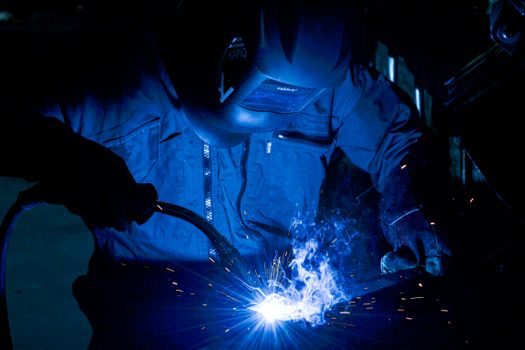
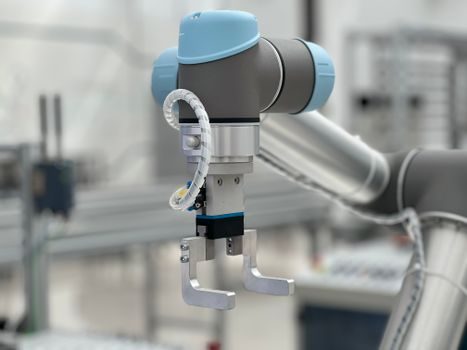
The 6-axis collaborative arm format, sold explicitly for MIG welding and cutting, signals that the Chinese cobot supply chain is repurposing general-purpose collaborative robot hardware into welding duty. The US$3,500-9,500 entry point undercuts imported cobot welders by 40-60% on listed price, and the 1-set MOQ removes the integration-cell minimum that previously blocked small fabricators [S4]. For a job shop running mixed-batch structural steel, the practical decision is whether to specify a guarded industrial cell or accept a cobot's slower acceleration in exchange for the eliminated fencing cost.
Continuous-path control is the unifying spec across all sampled SKUs, with no point-to-point control units in the welding category [S1][S2][S3][S4]. Point-to-point control remains reserved for the AGV and AMR categories, where RuanYi Technology's 1,000 kg load AGV lists that mode separately [S2]. For a process engineer, the takeaway is direct: any 2026 welding-robot shortlist should treat ±0.05 mm repeatability, 6 axes, and continuous-path control as the floor, not the differentiator.
Market Sizing and 2026 Capacity Build-out
Allied Market Research's 2018-2026 outlook for robotic welding gives a US$5,450.5 million starting base and a US$10,784.4 million endpoint, an 8.7% CAGR — a doubling over an eight-year window that is materially faster than the broader industrial-robot segment [S7]. The 2018-2026 trajectory tracks capacity additions in automotive, shipbuilding, and metal fabrication, the same application sectors that the laser-welding SKU on Made-in-China explicitly names [S2].
Chinese welding-robot exports are concentrated through B2B portals: Made-in-China alone indexes 118,806 robot SKUs from 6,988 suppliers, with welding-robot as a top subcategory [S2]. Adjacent categories — bending, polishing, grinding — sit in the US$27,800-31,000 per set band, a 2-3x premium to welding-only cells that reflects the heavier payload and higher accuracy envelope [S5]. The price-compression signal is concrete: a buyer can now spec a US$10,000 6-axis welding cell in 2026 for the same duty that required a US$25,000+ install in 2018.
Standards, Certification, and Buyer-Side Vetting
ISO factory certification is the only compliance reference listed in the sampled Chinese SKUs, with no ATEX, IECEx, or NACE MR0175 markings on the welding-robot product pages [S1][S3]. For process plants specifying welding robots in Zone 1/2 hazardous areas, the absence of pressure transmitter-style Ex certifications on the welding-cell datasheets is a flag — buyers must confirm Ex ratings at the inverter and cable-gland level, not at the robot-arm level. Buyers comparing the AMR class for material handoff to a welding cell should similarly verify CE/UL markings on the AGV side, where the 1,000 kg load AGV lists collision-avoidance and safety-laser-scanner features but no Ex marking [S2].
The trade event calendar adds a verification channel. Welding Week 2026, powered by NIL, runs 1-3 October 2026 at Evenementenhal Gorinchem in the Netherlands, with sessions covering welding robots suited to variable SME-metal production and visual inspection [S6]. The 2024 edition's attendee list, referenced in the event's own page, is the baseline for tracking 2026 vendor participation. For an engineer verifying a Chinese supplier before placing a 1-set MOQ, that venue is the lowest-cost live-audit option in Europe for 2026.
2026 Selection Criteria and Failure Modes
Three decision criteria separate credible 2026 welding-robot SKUs from the long tail. First, control mode must be continuous-path, not point-to-point — any point-to-point SKU in the welding category is misclassified [S1][S2][S3][S4]. Second, repeatability should be quoted to ±0.05 mm; suppliers that omit accuracy or quote only "high precision" should be downgraded. Third, after-sales coverage of 1 year minimum is the current floor; Hefei Wanyi's three-SKU lineup all carry this term, and vendors offering less should be treated as trading-only intermediaries [S3].
Known failure modes for the entry-tier cobot-MIG class are three. The 3,500-9,500 USD price band assumes 1-set MOQ and 1-year warranty, but excludes integration, fixturing, and the welding-power-source cost — buyers who skip the integrator line-item overrun their budget by 30-50%. The 0.5 m/min welding speed on the laser-welding tier is a rated maximum, not a duty-cycle figure, and a 60% duty cycle cuts effective throughput to roughly 0.3 m/min in production [S2]. Finally, continuous-path control on a 6-axis arm without seam-tracking add-ons drifts on variable-gap weldments; suppliers offering arc-tracking or laser-seam-tracking as options should be preferred for non-fixtured work.
Adjacent Sourcing Signals to Monitor Through 2026
Two indicators will resolve whether the 2026 price compression sustains. First, the US$3,500-9,500 cobot-MIG entry band should be rechecked against laser cutting machine hybrid-cell pricing, where wattage escalation is the parallel trend — a 6 kW fiber-laser + cobot-welder bundle price floor will set the new integration-cell baseline. Second, the Welding Week 2026 attendee list at Gorinchem, 1-3 October 2026, will be the first public reading on whether European SME-metal buyers have accepted Chinese cobot-MIG arms at scale [S6]. For a process engineer, the 1-piece MOQ and 1-year warranty on a US$10,000 6-axis cell is now a real procurement option, not a marketing line — but Ex-certification gaps and integration-cost overruns remain the gating constraints.