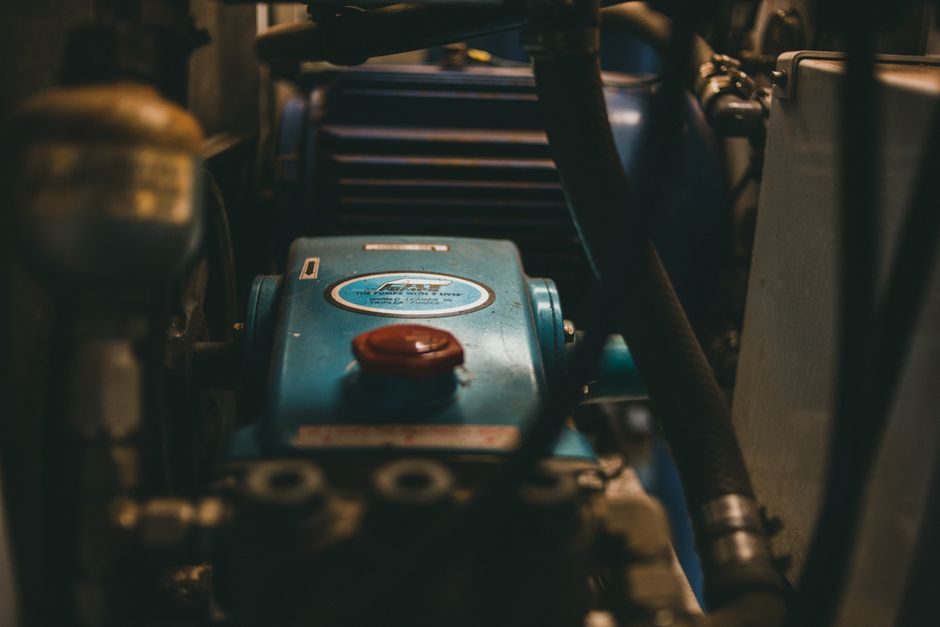
For thin, clean, hazardous, or low-viscosity fluids a magnetic drive centrifugal pump is the default sealless choice, while for viscous, lubricating, high-pressure dosing service (5-1500 cSt, up to 6.90 bar on the Pulsafeeder GMC1 platform) a positive-displacement gear pump still wins on flow precision [S4][S6].
Both architectures appear inside the same factory portfolio at Cangzhou-based Botou Kemai, where the catalog lists gear pumps, multistage centrifugal pumps, and magnetic drive pumps as parallel main-product lines rather than substitutes [S2][S3]. That co-listing alone tells you the selection is fluid-driven, not brand-driven.
Where Each Architecture Actually Wins
A gear pump is a fixed-displacement PD machine: two meshing idler-and-drive gears move a constant volume per revolution, so flow is linear with speed and essentially pulse-free. The KCB magnetic-driven gear variant covers viscosities from 5 to 1500 cSt and is rated for fuel oil, lube oil, and other toxic, volatile, or flammable media that you do not want to leak past a mechanical seal [S6]. Isochem gear pumps on the GMC1 frame cap at 6.90 bar differential and 3.41 L/min, marketed for continuous-duty industrial service across wide temperature, viscosity, and pressure variations [S4].
A magnetic drive pump replaces the dynamic seal with a torque-transmitting magnet coupling, so the wetted envelope is fully enclosed. Vendor catalogs on the same Made-in-China platform show magnetic drive units spanning ANSI, sub-ANSI, API 685, side-channel, regenerative turbine, sliding-vane, and small gear configurations, with Magnatex MPL ratings of 340 GPM, 400 ft head, 20 hp, 150# or 300# RF flanges, SiC bearings, neodymium or SmCo magnets, and a working envelope of -112°F to 660°F [S7]. That range is two orders of magnitude wider in flow and head than any PD gear pump in the same supplier set.
Decision Matrix: Gear Pump vs Magnetic Drive Centrifugal
Run the selection on four criteria, in this order, before looking at price.
1. Viscosity window. Gear pumps keep NPSH margin and volumetric efficiency up to 1500 cSt; magnetic drive centrifugals lose head rapidly above ~400 cSt unless re-trimmed [S6]. 2. Differential pressure and flow target. The GMC1 ceiling is 6.90 bar at 3.41 L/min; the MPL sealless centrifugal is 400 ft (≈12 bar) at 340 GPM — different jobs entirely [S4][S7]. 3. Solids and cleanliness. Magnetically coupled gear pumps from Suzhou Macxi are explicitly sold for organic solvents with suspended particles, while a magnetic drive centrifugal tolerates clean, particle-free fluids only [S8]. 4. Leak tolerance. For toxic, flammable, or hot fluids (660°F service on Magnatex units), the sealless architecture removes the single most common failure mode (mechanical seal face wear) and is the reason magnetic drive pumps are dominating new chemical-plant retrofits.
Use the table below as a quick selector.
Parameter | Gear pump (KCB/GMC1 family) | Magnetic drive centrifugal (MPL family) — Typical viscosity: 5-1500 cSt [S6] | -112 to 660°F liquid temperature [S7] — Max differential: 6.90 bar (GMC1) [S4] | 400 ft / ≈12 bar (MPL) [S7] — Flow range: 3.41 L/min class (GMC1) [S4] | up to 340 GPM (MPL) [S7] — Solids tolerance: tolerates suspended particles (Macxi MD gear) [S8] | clean fluid only — Seal: dynamic lip on standard, magnetic optional | fully sealless — Bearing: component self-lubricating [S4] | SiC standard, SiC-X optional [S7] — Magnet: n/a on standard gear | NdFeB or SmCo [S7].
Use-Case Mapping Across Industrial Plants
For lube-oil, bitumen, hot-oil, and resin transfer lines the gear pump is the right tool: the KCB magnetic-driven gear variant is specified for petroleum, paint, paper, and resin plants, with viscosity 5-1500 cSt and an explicit exclusion on solid particles and long fibres [S6]. The same KCB frame handles heavy fuel, diesel, and mechanical oils where a leaking mechanical seal would be a fire or contamination event.
For chemical, petrochemical, pharma, food, refinery, gas, power, water-treatment, and tank-farm service the magnetic drive pump catalog is broader: ANSI, sub-ANSI, API 685, fluoropolymer-lined, side-channel, regenerative turbine, sliding-vane, hollow-disc, and small gear configurations are all listed, with thousands of installed units in chemical, petrochemical, pharmaceutical, food-and-beverage, refinery, gas, power, water-treatment, tank-farm, and OEM systems [S7].
For metering and micro-dosing the gear pump still owns the application: the 3.0 mL/rev stainless-steel micro magnetic drive gear pump with stepper motor from Suzhou Macxi, and a 1-piece MOQ starting at US$1,033.70, is a textbook metering architecture where ±1% linearity against a calibration curve matters more than raw flow [S8].
Limits, Failure Modes, and Standards Watch
Two failure modes kill gear pumps regardless of brand: dry running (gears depend on the pumped fluid for cooling and boundary lubrication, so Isochem explicitly relies on the fluid itself for cooling) and solids ingress (the KCB family excludes long-fibre and particulate media) [S4][S6]. Specify a flushed seal reservoir, an inlet strainer matched to gear-tooth clearance, and a thermal cut-out if duty approaches the upper viscosity limit.
Two failure modes dominate magnetic drive pumps: magnet-coupling slip at overload (SmCo retains magnetism above 300°C, NdFeB does not — pick the magnet material against the actual process temperature, not the datasheet headline) and dry-running of the inner bearing, since the SiC/SiC-X bearing is also fluid-lubricated [S7]. For hazardous-area service the sealless design is the path of least resistance to ATEX/IECEx compliance, but it is not a free pass: the containment shell is a single pressure boundary and the magnet envelope can attract ferrous debris in dirty services.
For a broader look at how PD and centrifugal selections interact with system hydraulics, the Centrifugal Pump Sizing and Selection: A 2026 Field Engineer's Walk-Through walk-through is a useful companion read on head, NPSH, and affinity-law corrections. For alternative PD technologies covering slurry, viscous, and hygienic duties, the Diaphragm Pump Suppliers and Manufacturers: 2026 Spec and Sourcing Map and AODD Diaphragm Pump Spec Map for Pulp and Paper: 2026 Selection Guide notes show where AODD units overlap with — and replace — gear pumps in paper and chemical stock service.
Selection Checklist for a Working Engineer
Step 1: name the fluid, viscosity at the lowest expected operating temperature, and the maximum particle size — this single block rules out roughly half of either catalog. Step 2: state the duty point (L/min, bar) and the required turndown; a 10:1 turndown on a magnetic drive centrifugal means a VFD, on a gear pump it is free. Step 3: confirm the hazardous-area classification, the allowable leak rate, and whether the line can be flushed before a dry start; this picks between sealed gear, magnetic-driven gear (KCB), and sealless magnetic drive centrifugal. Step 4: pick the bearing and magnet material against the actual process temperature (SiC-X and SmCo for >300°C hydrocarbon service) and the flange class against the piping stress (150# RF standard, 300# RF optional on MPL-class units) [S7]. Step 5: price the spare-gear kit, the inner-magnet assembly, and the bearing cartridge separately — the magnet coupling is the line item that decides a 5-year vs 10-year maintenance interval on a magnetic drive magnetic drive pump.
What the 2026 Catalog Tells Us About Sourcing
Catalog evidence from Made-in-China and GlobalSpec in 2026 shows gear-pump vendors clustering around Cangzhou, Hebei (Botou Kemai on two distinct showroom pages, both registered in the Manufacturing & Processing Machinery range) and a separate cluster of Suzhou and Houston-based magnetic drive specialists [S2][S3][S7][S8]. That geographic split matches the technology split: gear-pump capacity is concentrated in Northern China, magnetic drive capacity is split between US-headquartered API 685 specialists and Chinese process-pump OEMs.
For a procurement manager the practical move is to shortlist one PD gear vendor (look for KCB-class or GMC1-class frames with magnetic-coupling options for hazardous fluids) and one sealless magnetic drive vendor (look for MPL-class flow/head and the magnet material you need) [S4][S6][S7]. A BOM that includes both means the same engineering team can swap one for the other when the fluid envelope changes — which it will, in most process plants. A useful second-pass read on adjacent instrumentation stacks and seal-pot design is the MEMS Sensor OEM vs ODM Manufacturing: Spec-Driven Decision Map note, less for the sensor content than for the discipline of writing a BOM against spec rather than brand.
Track the next two signals: any 2026 vendor update that pairs a magnetic drive centrifugal with a permanent-magnet motor (changing the magnet-coupling economics), and any update to a gear-pump line that adds a containment-shell magnetic option to a frame currently sold only with a packed-gland seal.
Component reference pages worth checking: magnetic material, and magnetic sensor.