
Glass fiber installation covers five product families — moulded FRP grating, GFRC architectural panels, FRP underground pipe, E-glass chopped strand mat laminates, and GF-reinforced 3D printer filament — each with its own governing standard and acceptance test rather than a single universal spec [S1][S2][S3][S4][S5].
The shared logic is the same: match the resin/fiber system to the chemical/thermal environment, hold dimensional tolerance during lay-up or burial, and verify slip or fire class after install rather than trusting the data sheet alone [S1][S2][S4].
FRP Grating Panels: Mesh, Resin, and Slip Class
Moulded FRP gratings from suppliers such as GEI are produced in mesh openings of 38 x 38 mm, 26 x 26 mm, 50 x 50 mm, and 19 x 19 mm security bar patterns, with standard panel sizes of 1000 x 2026 mm, 1000 x 3055 mm, and 1220 x 3055 mm at thicknesses 30/7, 38/7, and 50/7 mm — load-bearing in both directions [S1].
Slip resistance is graded R13 (concave or siliceous surface) to BGR 181 and DIN 51130, fire performance is M1/F1 per NFP 92-501 and NFF 16-101, and flame-spread is held to ASTM E84 FSI < 25 [S1]. Stair treads ship at 800 x 275 mm, 1000 x 275 mm, and 1000 x 350 mm with a gritted front edge for nosing definition [S1].
On-site, the failure mode is almost always a missing clip or a panel cut without re-sealing the cut edge — the resin-rich moulded skin is what carries the corrosion and slip rating, and a field-sawn edge exposes raw glass; in chemical or wet service, replace the panel rather than re-coat [S1].
GFRC Architectural Panels: Lightweight Cladding Logic
Glass Fiber Reinforced Concrete (GFRC) is a composite of cement, glass fibers, aggregates, and polymers; it is specified where weight, fire rating, and pre-fabrication speed dominate over raw compressive strength [S2]. Stromberg's GFRC ceiling panels for the Fulton and Dey Street NYC subway stations (installed 2011 and 2013) were pre-fabricated off-site so the concourse install could be completed inside a political deadline — GFRC's light weight meant existing structural support was adequate [S2].
For a GFRC install, the acceptance criteria are panel-to-panel alignment at the reveals, mechanical fixing through the hollow body rather than adhesive-only, and seal joint width held to the architect's joint tape spec — the panel itself is non-toxic, earth-friendly, and gains strength with age, but the joint is the leak path [S2].
Where GFRC is NOT the right pick: any application needing raw compressive load-bearing (use steel-reinforced precast), or aggressive chemical splash where the cement matrix will carbonate — FRP grating or vinyl ester linings take that service [S1][S2].
FRP Underground Pipe: ASTM D3839 Burial Logic
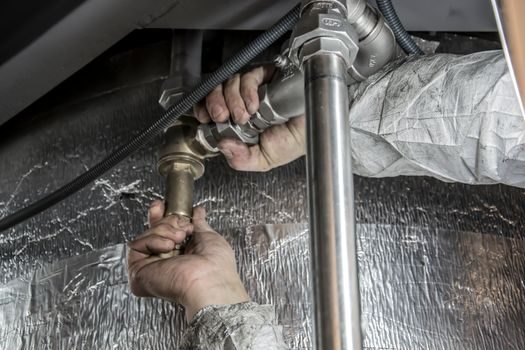
ASTM D3839-08 is the Standard Guide for Underground Installation of "Fiberglass" (Glass-Fiber-Reinforced Thermosetting-Resin) Pipe, and it is the governing document when an engineer specs an FRP gravity or pressure line rather than a steel or HDPE alternative [S4].
The standard sets the soil-stiffness, compaction, and bedding logic that determines whether the pipe will see the assumed long-term deflection or a buckle 18 months after burial [S4]. Pipe installation in this family always reads as: trench width, embedment material gradation, compaction level (typically 90% Standard Proctor around the haunches), and deflection limit after backfill (commonly 5% of nominal diameter) [S4].
For related material context, glass fiber properties drive both the FRP pipe and the grating families above — fiber diameter, resin compatibility, and the E-glass vs C-glass split that reappears in mat products [S3][S4].
Chopped Strand Mat Laminates: Lay-Up and Areal Weight
E-glass stitch chopped strand mat is supplied in areal weights of 300, 380, and 450 g/m² (codes EMK300/380/450) at widths 50–2400 mm, with a C-glass equivalent (CMK300/380/450) for chemical-resistant skins [S3]. The construction is roving cut to length, evenly dispersed, then stitched with polyester yarn — giving uniform thickness, drapability over complex moulds, and fast wet-out under hand lay-up or closed-mould injection [S3].
The installation-level checks are areal weight per ply (to hit designed glass fraction), uniform stitch pattern (no roving clumps), and wet-out time — a mat that resists resin within the planned cycle is the wrong mat for that resin system [S3]. Minimum order 2,000 kg at reference $1.00–3.00/kg FOB Shanghai gives a useful cost baseline for an FRP shop running a job [S3].
Mat-based laminates overlap with optical glass only in name — the E-glass fibers here are a textile reinforcement, not an optical element, and any confusion between the two at the PO stage has cost a fabricator a year of warranty claims.
GF-Reinforced 3D Printing Filament: Machine-Locked Specs

Raise3D's Glass Fiber (GF) Reinforced Filament is an industrial-grade composite for large-format FFF printers; the abrasiveness of chopped glass means a hardened steel nozzle (typically ≥ 0.4 mm) is the install prerequisite, and a heated bed matched to the matrix polymer is mandatory to avoid warping [S5].
For engineering context on the underlying motion-system tolerances that hold GF print quality steady, see linear guide installation: torque, flatness, and parallelism specs — gantry flatness directly drives first-layer adhesion on a glass-reinforced build [S5].
Where GF filament is NOT the answer: any job that needs isotropic strength (use continuous-fiber lay-up instead), cosmetic-visible parts (glass fibers telegraph through surface finish), or any printer without a hardened extruder path [S5].
Standards and Codes Cross-Reference
Across these five product families the binding documents are: ASTM E84 (FSI < 25) for grating flame spread, NFP 92-501 and NFF 16-101 (M1/F1) for European rail/transit grating, BGR 181 and DIN 51130 (R13) for grating slip, ASTM D3839-08 for FRP pipe burial, and ASTM D5319-2017 for glass-fiber reinforced polyester wall and ceiling panels [S1][S2][S6].
Side-by-side, the families sort as: FRP grating = floor/walkway with slip + fire code; GFRC = architectural cladding with weight + finish code; FRP pipe = buried pipe with soil/compaction code; chopped strand mat = shop laminate with areal weight + wet-out code; GF filament = additive build with hardened-nozzle code [S1][S2][S3][S4][S5][S6].
For deeper material context linking these families to the wider composites taxonomy, see the glass fiber types and classifications spec-first map and the optical glass types spec-first map — together they cover the structural and the optical ends of the same base material [S1][S3].
On-Site Failure Modes and When NOT to Repair

Three recurring failure modes drive callbacks in glass fiber installs: (1) field-cut FRP grating with unsealed edges exposed to chemical splash — replace the panel, do not re-coat, because the rating lives in the moulded skin [S1]; (2) GFRC cladding installed with adhesive-only fixings on a high-rise — pull and mechanically re-fix, because the polymer skin creeps under sustained shear [S2]; (3) FRP pipe installed without meeting ASTM D3839 compaction targets — the deflection will exceed 5% and the joint will leak at the next surge [S4].
Replace, do not repair, when: the panel shows fibre bloom across more than 10% of the surface, the GFRC reveal has shifted more than the joint tape can absorb, the FRP pipe has a buckle or a weeping joint, or the chopped strand mat has clumped roving that the resin cannot wet out in cycle [S1][S2][S3][S4].
Escalate to the resin supplier (not the installer) when the failure is a chemical compatibility miss rather than a mechanical one — the spec was wrong, and the next install will fail the same way [S1][S3].
Spec-level background on the components involved: linear guide.