
Globe valves specified for high-pressure gas service are overwhelmingly forged-body, bolted-bonnet or pressure-seal designs in the PN160 to PN630 / ASME Class 900 to 4500 envelope, with butt-weld or socket-weld ends and stem packing rated for the process gas [S5].
Selection is driven by five interlocking criteria: pressure-temperature rating, body and trim material, seat leakage class, end connection style, and actuation interface — and most failed gas-line globe valve specifications can be traced to one of these being undersized [S3][S5].
Pressure-Temperature Rating and Body Construction
Forged carbon-steel and forged stainless-steel bodies dominate the high-pressure gas envelope because cast equivalents suffer porosity risks at wall thicknesses above Class 600; a typical high-pressure product line covers DN15–DN50 (½"–2") in PN160–PN630 / ASME 900–4500 with butt-weld or socket-weld ends [S5].
Pressure-seal bonnets become economically attractive above Class 900 because the bonnet load no longer scales with pressure, and the bonnet-less design shown in current high-pressure globe product literature is a direct response to that envelope [S5]. For sub-Class 600 gas service, cast bodies in ASTM A216 WCB or A217 WC9 remain a lower-cost option when the process is clean and non-corrosive [S4].
Body, Trim and Seat Material Selection
Stainless steel 410 / 420 hard-facing on the disc and seat is the default trim for natural gas and refinery gas at temperatures up to ~425 °C; Stellite 6 overlay is added when H₂S partial pressure or CO₂ partial pressure pushes the service into NACE MR0175 sour-service territory [S3].
For high-temperature service — superheated steam, ethylene cracker feed gas, hydrogen reformer loops — a dedicated heat-sink bonnet extension keeps the packing area below the recommended maximum continuous stem-packing temperature, which is the most common cause of gland leakage on high-temperature globe valves [S3]. A parallel pressure sensor mounted on the bonnet cavity gives an early warning of packing degradation before it becomes a fugitive-emission event.
Seat Leakage Class and Shutoff Duty

ANSI/FCI 70-2 Class IV is the minimum shutoff that should be accepted for high-pressure gas block valves; Class V is specified when the downstream side feeds a flare header or a relief-valve inlet where seat leakage is a safety issue, and Class VI (soft seat, PTFE or PEEK) is reserved for clean, non-abrasive gas at temperatures below the polymer limit [S5].
For modulating / throttling duty — a frequent use case on gas pressure-control skids — a contoured plug (equal-percentage or linear) with hardened trim is mandatory; a standard flat-disc globe will erode within weeks at high pressure drop [S2]. The ZIMMER DSV-series pressure-control valve, for example, is built around a pneumatically-actuated globe body specifically because the geometry gives stable control at varying ΔP [S2].
End Connections and Piping Integration
Butt-weld ends are the default for ASME Class 900 and above because flanged joints introduce a leak path and add a stress concentration at the gasket seating face; socket-weld is permitted up to Class 600 in non-cyclic service and is the dominant choice in compact skid packages [S5].
Flanged ends (RTJ for Class 900+, RF for Class 600 and below) are kept for terminal connections and for tie-ins to existing headers; the flange standard must match the pipe schedule, and any mismatch between ASME B16.5 flange rating and the valve body rating should be flagged at the datasheet review stage. Engineers integrating the valve into a pressure transmitter loop should confirm that the upstream and downstream tap locations are outside the bonnet body cavity, where flow disturbance can corrupt the differential-pressure measurement.
Actuation, Diagnostics and Smart-Valve Interfaces
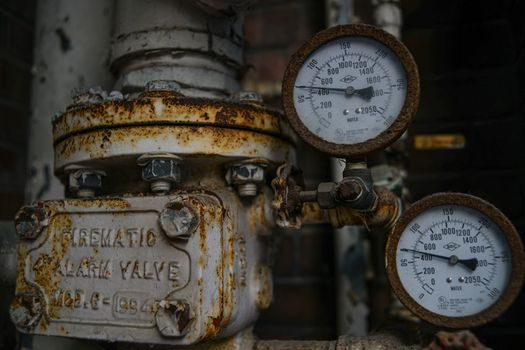
Pneumatically-actuated globe valves dominate pressure-control skids because the pneumatic actuator output force scales with supply pressure and gives fast, repeatable stroking for modulating duty [S2]. Hydraulically-operated globe valves with float pilots remain the standard for level-control and pressure-sustaining duty on separator and scrubber vessels, where the valve must hold a setpoint against varying flow [S1].
Electric actuation appears where the valve is part of a PLC-controlled ESD or where a smart positioner is required for asset-management data; in those cases the positioner must be rated for the hazardous area classification of the line, and the pneumatic tubing to a flow meter upstream must be protected against frost in cryogenic gas service. Diagnostic outputs (travel, seat-load, cycle count) are now expected on any new high-pressure gas globe valve feeding a downstream servo motor-driven compressor, because the operating data is consumed by the plant's machinery-health system.
Failure Modes, Limitations and Sourcing Signals
The four most common failure modes on high-pressure gas globe valves are: (1) packing leakage from thermal cycling, mitigated by a heat-sink bonnet [S3]; (2) seat erosion from throttling at high ΔP, mitigated by a contoured plug and hardened trim [S2]; (3) stem galling on sour service, mitigated by NACE MR0175 trim and a hard-chrome stem; and (4) bonnet joint leak on cast bodies above Class 600, mitigated by switching to forged body / pressure-seal bonnet [S5].
Beyond the standard industrial valve selection logic, the high-pressure gas envelope has a sourcing reality that matters: India-based manufacturers (Controtek, Giflon) are now active on global trade platforms with Class 800 and above offerings, and Chinese mills are quoting PN160–PN630 forged globe valves in 304/316 at lead times materially below Western suppliers [S4][S6]. Verified signals to track over the next procurement cycle: (a) whether the mill holds valid ISO 15848-1 fugitive-emission certification for the bonnet packing, and (b) whether the published pressure-temperature curve covers the full ASME B16.34 cold-work pressure rating, not just the Class 150/300 datapoints that often appear in catalog cut sheets [S5][S6].