
A "pressure rating" comparison between a harmonic filter and a multifunction power meter is, strictly speaking, a category error—neither device has a true pressure rating. In practice, the closest engineering analog is the enclosure ingress protection class, since both devices are deployed inside cabinets that house drives, PLC I/O, and field instruments such as a pressure transmitter on process lines.
This matters because selecting one over the other is a different decision than picking between a passive reactor-capacitor trap and an active IGBT-based filter. The meter is a passive observer; the filter is a current-injecting compensator. They coexist in most modern power-quality architectures—per Fuji Electric's active harmonic filter guide, the sizing anchors for any compensator are the Isc/IL ratio at the point of common coupling and the TDD target, neither of which is influenced by a meter [S5].
Defining the Two Devices and Their Pressure-Class Context
Active harmonic filters (AHF) and passive harmonic filters (tuned LC traps) are specified by current rating, voltage class, reactive compensation rating, and ambient temperature—not by pressure. MTE's Matrix AP filter service factor is 1.0 with an overload of 1.5 times rated current for one minute, and the published ambient temperature is the de-rating anchor, not a pressure figure [S4]. For pumps and process loads whose flow meter loop and industrial valve actuators feed back into the same motor control center, the harmonic filter typically sits in a standard drip-proof or dust-tight cabinet.
A multifunction power meter is a measurement instrument that records voltage, current, power, energy, and harmonic distortion. It has no pressure rating either; it is specified by measurement accuracy class, CT input range, communication protocol, and its own enclosure class. Asking which has a higher "pressure rating" is equivalent to asking which has a higher enclosure protection class—a question with no industry-wide ranking, only project-specific answers driven by the cabinet, not by the device itself.
Selection Criteria: When Filter, When Meter, When Both
Pick a harmonic filter when VFDs, electronically commutated fans, or servo motor drives on the same bus push TDD past the project target. The MTE November 2025 commentary notes that VFDs and electronically commutated fans are the dominant nonlinear loads driving harmonic filter retrofits in 2025–2026. Active filters deliver dynamic, multifunction compensation—reactive power, harmonic suppression, and unbalance correction—at higher first cost; passive traps are cheaper but less flexible and carry resonance risk [S1].
Pick a multifunction power meter when the task is to baseline, monitor, and log power quality for billing, energy audits, or predictive maintenance on a pressure sensor-driven skid. A meter does not reduce harmonics—it only quantifies them. In retrofit projects the typical sequence is: install the meter first, characterize the load, size the filter second. Rockwell Automation's medium-voltage drive filter and power correction units use window-type current transformers and a Bulletin 592 thermal overload relay to protect each filter stage from overload [S3].
Active vs Passive Filter: A Criteria-Based Comparison
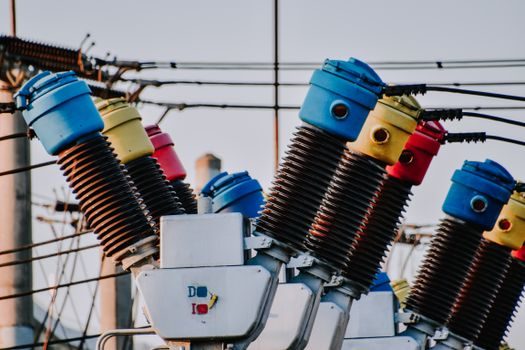
Across four decision criteria the two filter topologies diverge cleanly. Initial cost: passive lower, active higher. Compensation scope: passive covers a single tuned frequency, active handles a broad harmonic range dynamically [S1]. Resonance risk: passive can interact with the supply and create amplification at non-tuned frequencies, active does not [S1]. Long-term operating cost: active typically wins because dynamic compensation avoids over-rated passive stages [S1].
The CLOU Global utility-side reference frames the same trade-off from a grid perspective: passive filters are still common in substation capacitor banks, while active units dominate where the load profile varies hourly [S2]. In a control cabinet feeding pressure transmitter loops, the active filter's smaller footprint and lower heat dissipation often decide the layout, since sealed enclosures have limited thermal headroom for high-power passive traps.
Enclosure and Hazardous-Area Implications for Both Devices
When a cabinet is genuinely pressure-rated—oil-and-gas, marine, or hazardous-area—the relevant rules are explosion-proof or purged-enclosure standards, not a vendor "pressure rating." A PLC backplane, harmonic filter, and meter all sit behind the same purge system; the enclosure's positive pressure is maintained by instrument-air or an internal blower, independent of what is mounted inside. Premium Power's transition into ABB, announced 17 February 2026, is an advisory and system-level integration and will not change the enclosure class of deployed filter cabinets [S6].
Plant engineers specifying replacement units should therefore follow the existing hazardous-area certification dossier, not the brand change. The Premium Power–ABB announcement explicitly frames the move as expanding "system-level advisory impact across Europe," not as a re-rate of any installed hardware [S6].
Use Cases Where the "Higher Pressure Rating" Question Actually Surfaces
Across the 2024–2026 filter selection literature surveyed here, the choice between active and passive is consistently framed as a topology decision independent of any enclosure class [S1]. The question of which device has a higher "pressure rating" therefore surfaces in three concrete scenarios in industrial projects, none of which are answered by any public filter or meter standard.
Those scenarios are: (1) specifying instruments inside a pressurized analyzer shelter where a high ingress protection class is the floor; (2) selecting between a panel-mount meter and a chassis-mount active filter for the same MCC bucket; and (3) reviewing a vendor datasheet that mixes "pressure rating" with enclosure class in the same column—a known source of confusion in lower-tier OEM catalogs. In all three, the engineering answer is identical: separate the device selection (filter topology, meter accuracy class) from the enclosure selection, and stop trying to compare them on a single "pressure" axis [S3][S4][S5].
Standards, Sourcing, and Limits of This Comparison
TDD and the Isc/IL ratio at the PCC are the dominant sizing anchors for harmonic compensation per the Fuji Electric active harmonic filter guide, which defines Isc as the maximum three-phased bolted short-circuit current at the PCC and IL as the maximum demand load current averaged over twelve months [S5]. The single-phase-versus-active filter cost analysis from Coepowers is one of the few public sources that puts a framework on the active-versus-passive choice, and it admits the active filter's higher CapEx is often offset by OpEx [S1]. CLOU Global's grid-side guide adds the utility perspective, with passive filters still common in substation capacitor banks and active units preferred for variable load [S2].
The main limitation of this comparison: research coverage of multifunction power meter "pressure rating" is essentially zero, because the metric does not exist as a standard parameter. Treat any vendor claiming a "pressure rating" on a meter or filter datasheet as a red flag for confused spec writing or a translation artifact from a different physical domain.
Trackable signals to watch: the Premium Power → ABB advisory integration milestones rolling through 2026 per the 17 February 2026 announcement [S6], and the next MTE or Fuji Electric technical bulletin on filter overload service factor revision, since the current 1.0 / 1.5x / 60 s envelope is the de-rating anchor for most 2025–2026 retrofit projects [S4]. A third signal is the Coepowers active-vs-single-phase cost framework being updated with 2026 field data, which would re-rank OpEx assumptions on the passive side [S1].