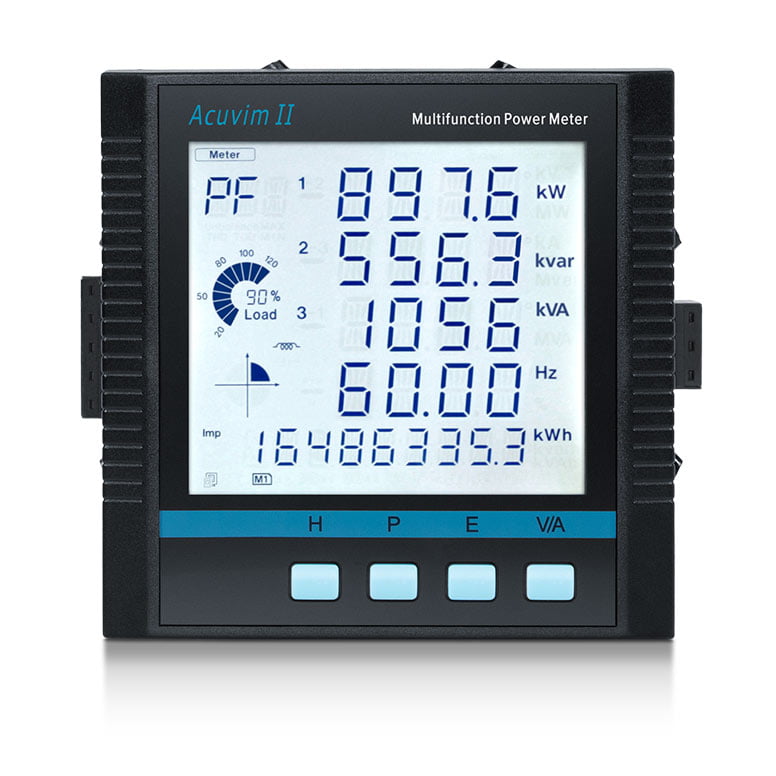
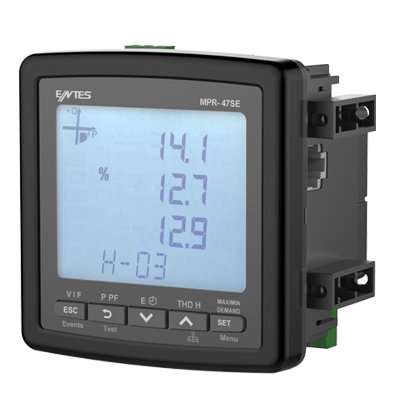
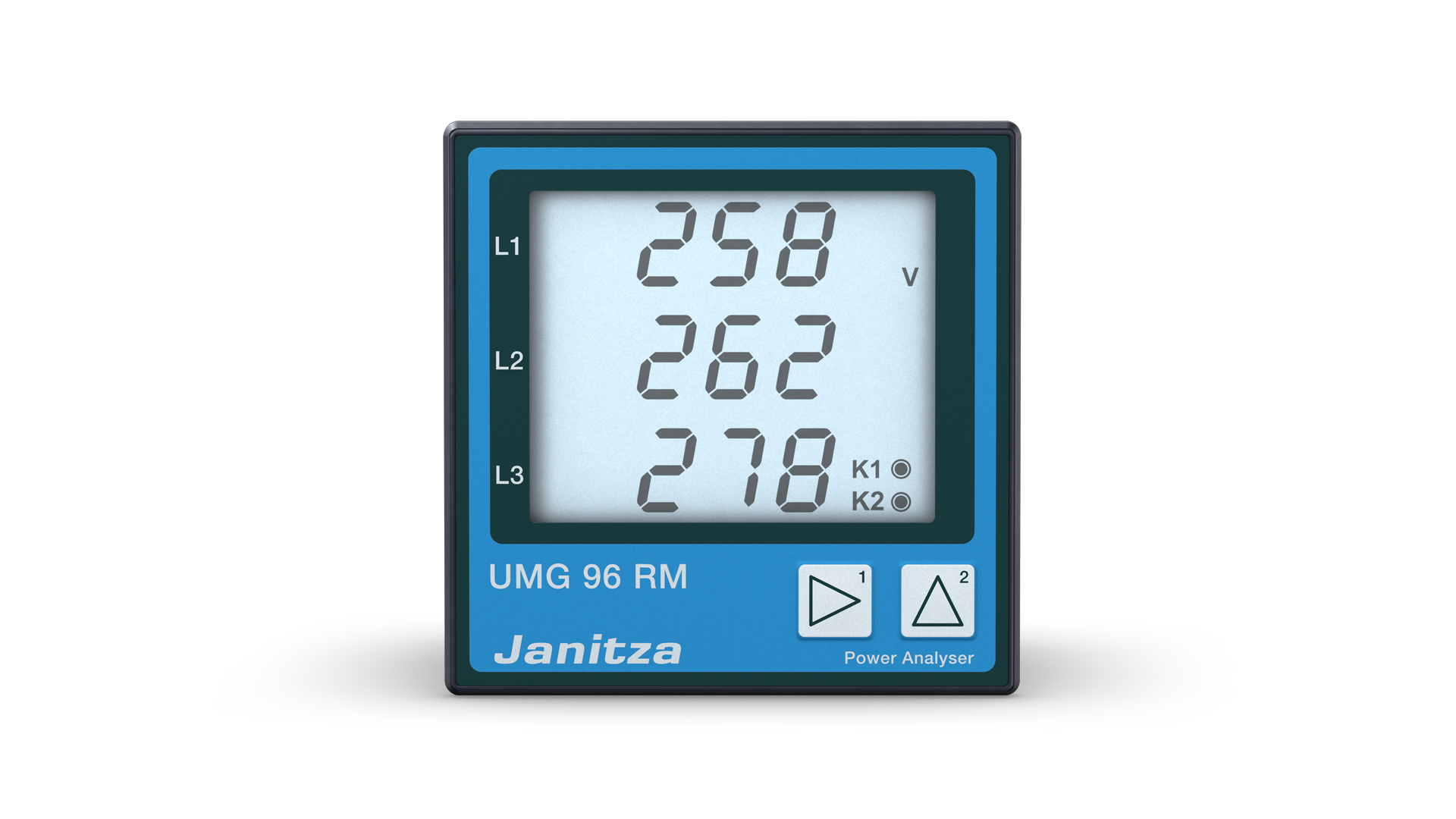
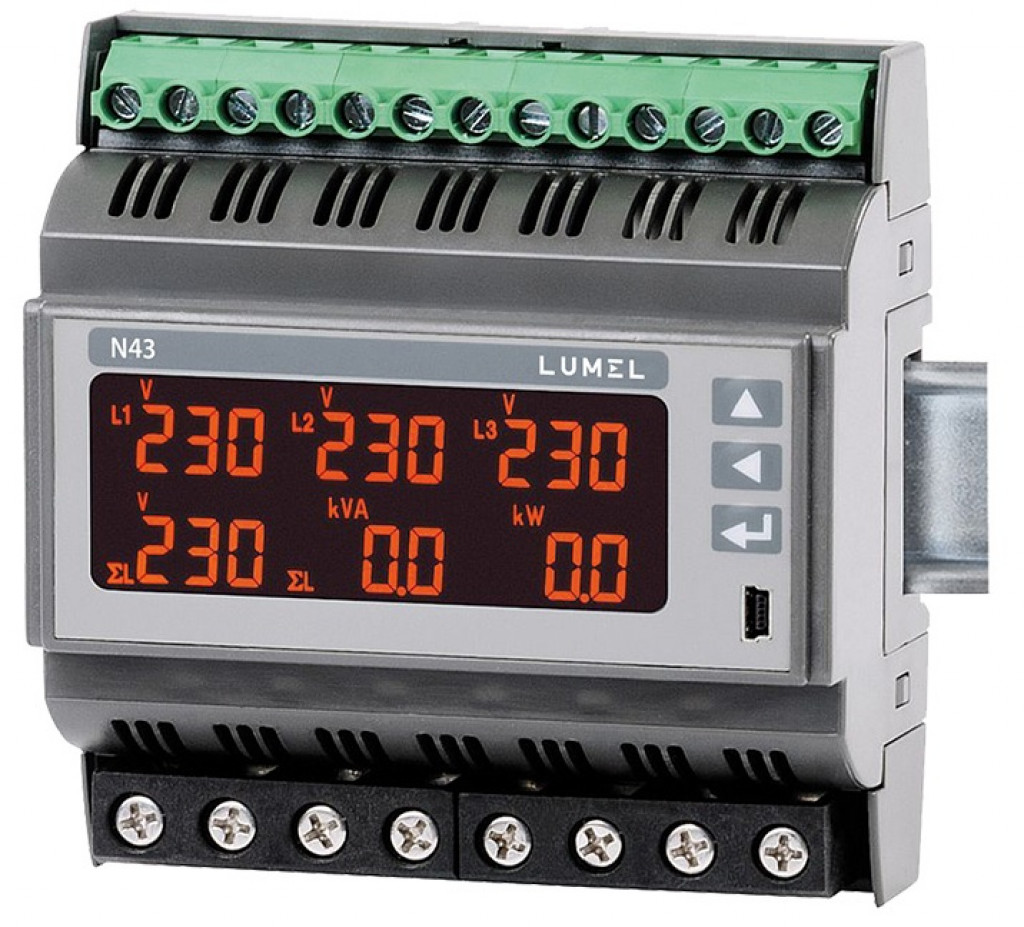
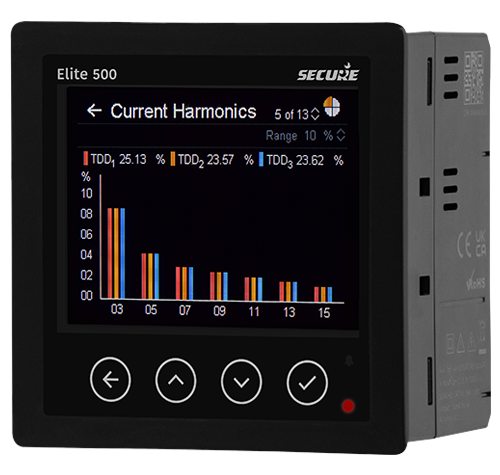
A multifunction power meter is a panel or DIN-rail instrument that measures, displays and communicates the complete electrical picture of a three-phase circuit: per-phase voltage and current, active, reactive and apparent power, power factor, frequency, four-quadrant energy, and harmonic distortion. International standards group these devices under the term power metering and monitoring device (PMD), defined by IEC 61557-12, while their energy-accuracy classes derive from the IEC 62053 family used for revenue meters.
Unlike a billing-only kWh meter, the multifunction meter is the eyes of an energy-management or building-management system. It replaces a wall of separate analog gauges with one networked device, and it is the data source that lets a facility allocate cost by tenant or feeder, hold suppliers to a power-quality contract, and detect a failing load before it trips a breaker.
Photo: Denis PI, CC BY-SA 3.0, via Wikimedia Commons
This guide is written for industrial purchasing engineers and electrical design engineers. It covers 6 chapters spanning what a power meter is and where it sits in the metering hierarchy, meter types by mounting and channel count, accuracy classes and standards, voltage and current inputs and how they are wired, the spec sheet parameters that actually drive selection, and a step-by-step selection sequence. All parameters reference the public standards IEC 61557-12 (PMD), IEC 62053-22 and IEC 62053-24 (active and reactive energy classes), IEC 61000-4-30 (power-quality methods), and ANSI C12.20.
Chapter 1 / 06
What is a Multifunction Power Meter
A multifunction power meter is an electronic measuring instrument that samples the instantaneous voltage and current waveforms of a single-phase or three-phase electrical circuit, then computes from those samples the full set of electrical quantities an engineer needs to operate and bill a network. From one device you read per-phase and total true-RMS voltage and current, active power in kilowatts, reactive power in kilovar, apparent power in kVA, power factor, frequency, and the four-quadrant active and reactive energy registers, alongside demand values and harmonic distortion. The international standards community calls this device class a power metering and monitoring device, or PMD, under IEC 61557-12; the same product is sold commercially as a power meter, power monitor, network analyzer or multifunction meter.
The decisive difference from a plain energy meter is scope. A revenue kWh meter exists to totalize active energy for billing and exposes little more than a register and a pulse output. A multifunction meter computes dozens of live and integrated quantities simultaneously and publishes them over a digital communication bus, so it functions as a sensor node in an energy-management system rather than as a billing endpoint. In a modern switchboard it replaces the historical cluster of separate analog voltmeter, ammeter, wattmeter, power-factor meter and frequency meter, collapsing five or more panel cutouts into one networked device behind a single 96 by 96 millimeter window.
Functionally the instrument has four blocks. The input section conditions the voltage taps and current-transformer secondaries down to levels the electronics can sample safely. The acquisition section digitizes both at a fixed number of samples per cycle, with mainstream meters running from 64 up to 256 samples per cycle, the higher rate giving better harmonic resolution. The compute section performs the true-RMS, power, energy and FFT harmonic calculations in firmware. The interface section drives the local display and one or more communication ports plus digital and analog I/O. A meter holding accuracy across this whole chain, at low load and non-unity power factor, is what separates a true class 0.2S or 0.5S instrument from a low-cost indicator.
Historically these functions lived in separate devices. Electromechanical induction-disc kWh meters dominated billing for most of the twentieth century, while panel switchboards carried discrete moving-iron meters for each quantity. The transition to fully electronic static metering through the 1980s and 1990s, combined with cheap microprocessors and the spread of the RS-485 Modbus bus, made it economic to fold every measurement into one programmable instrument. The IEC 61557-12 standard, whose second edition formalized the PMD device class and its performance grading, gave the market a common way to compare meters that had previously each claimed accuracy on their own terms.
The application scale is broad. The same product family meters a single motor feeder drawing a few amps, a 4,000 A main incomer in a data-center switchboard, a tenant submeter in a commercial tower, and a tie point exporting solar energy back to the utility. What changes across these duties is not the physics but the configuration: the current-transformer ratio, whether voltage transformers are needed, the accuracy class, whether four-quadrant and power-quality functions are required, and which communication protocol the head-end system speaks. The rest of this guide maps those requirements to concrete specifications.
Chapter 2 / 06
Meter Types and Form Factors
Multifunction power meters are classified first by mechanical form factor and second by channel count, because those two choices determine where the meter physically goes and how many circuits it watches. The table below summarizes the four dominant form factors found in industrial and commercial switchboards.
Form factor
Typical cutout / width
Where it is used
Trade-off
Panel mount (flush)
96 x 96 mm or 72 x 72 mm
Switchgear front doors, MCC sections
Visible local display, one circuit each
DIN-rail mount
2 to 7 modules (18 mm each)
Distribution boards, submetering rows
Compact, often no or small display
Multi-circuit submeter
DIN or chassis, 6 to 90 circuits
Tenant billing, branch-circuit monitoring
Lowest cost per circuit, shared display
Transducer / no display
DIN or surface, blind
Embedded OEM, SCADA-only points
Data over bus only, lowest unit cost
Panel-mount flush meters are the traditional switchboard instrument, fitting the standard 96 by 96 millimeter or 72 by 72 millimeter DIN cutout that previously held an analog meter. They carry a bright local display, front-panel keys for configuration, and watch one three-phase circuit. The Schneider Electric PowerLogic PM5000 series is a representative example, supplied in the 96 by 96 millimeter case with a 72 millimeter depth behind the panel. This form factor suits the main incomer and major feeders where an operator wants a glance-readable display at the panel door.
DIN-rail meters snap onto the 35 millimeter rail inside a distribution board next to the breakers, occupying a few 18 millimeter modules. They trade a large display for density and low cost, and they dominate submetering, where many small circuits each need a meter. The Eastron SDM630 family, a CT-operated three-phase multifunction meter with RS-485 Modbus RTU, is a widely deployed example of this class. SATEC's EM132 and EM133 sit at the higher-accuracy end of the DIN-rail category, offering 1 A or 5 A current inputs and direct voltage measurement.
Multi-circuit submeters concentrate metering for many feeders into one chassis, sharing the voltage reference across a busbar and accepting compact split-core or Rogowski current sensors per branch. They drive the cost per metered point to its lowest, which is why they dominate tenant billing in commercial real estate and branch-circuit monitoring in data centers. Accuenergy's AcuRev 2000 multi-circuit meter is a representative product in this category, designed to meter many tenant or branch circuits from a single networked device.
The second axis is single-phase versus three-phase. Three-phase meters configure for several wiring modes: three-phase four-wire (3P+N, the common wye distribution system), three-phase three-wire (delta, no neutral), and single-phase. The selected wiring mode tells the firmware how to combine the channels, and a mismatch between the programmed mode and the actual connection is, along with a wrong CT ratio, one of the two most common commissioning errors. The next chapter turns to the accuracy classes that separate a billing-grade instrument from an indicating one.
Chapter 3 / 06
Accuracy Classes and Standards
The single most misunderstood line on a power-meter datasheet is the accuracy class, because it is governed by several standards that grade different quantities separately. A meter does not have one accuracy number; it has an active-energy class, a reactive-energy class, and often a separate display-accuracy figure for instantaneous quantities. The table below maps the principal standards and the classes they define.
Standard
What it grades
Classes defined
Typical meter claim
IEC 62053-22
Static active energy (kWh)
0.1S, 0.2S, 0.5S
0.5S or 0.2S
IEC 62053-24
Fundamental reactive energy (kvarh)
0.5S, 1S, 1, 2, 3
2S or 1S
IEC 61557-12
PMD overall performance
0.05 to 5 (PMD class)
PMD/SD or PMD/Sx
ANSI C12.20
US revenue accuracy
0.1, 0.2, 0.5
Class 0.2
IEC 61000-4-30
Power-quality method
Class A, Class S
Class S
Active energy under IEC 62053-22. This is the headline class on most datasheets. The current edition lists classes 0.1S, 0.2S and 0.5S, where the number is the maximum permissible percentage error for active energy at unity power factor and rated current. Class 0.5S permits roughly plus-or-minus 0.5 percent, class 0.2S roughly plus-or-minus 0.2 percent. The S suffix is the important part: it certifies that the meter keeps within class limits down to very low load currents, typically from 1 percent of rated CT current, and at power factors below unity. An ordinary class 1 meter is only held to its limit over a much narrower load band, which is why class 1 and class S meters at the same nominal percentage are not equivalent.
Concrete examples make the tiers clear. In the Schneider PowerLogic PM5000 family, the PM5100 and PM5300 models are class 0.5S for active energy per IEC 62053-22, while the higher PM5500 models reach class 0.2S; correspondingly their reactive-energy grades are class 2S and class 1S under IEC 62053-24. The PM5100 and PM5300 sample at 64 points per cycle and the PM5500 at 128 points per cycle, the faster acquisition supporting both the tighter class and harmonic measurement to the 63rd order.
Reactive energy under IEC 62053-24. Reactive energy is graded by its own standard, which defines classes 0.5S, 1S, 1, 2 and 3 and computes reactive power from the fundamental-frequency components of voltage and current only. A meter that is class 0.2S for active energy is commonly only class 1S or 2S for reactive energy, so reading the active-energy class alone overstates the meter where reactive billing or power-factor penalties matter. Always read both numbers.
PMD performance under IEC 61557-12. This standard wraps the whole device. Its second edition created PMD types and recognizes that a meter with directly connected sensors (designated PMD/DD or PMD/SD) performs differently from one paired with an external current sensor (PMD/Sx). When an external CT is used, the standard combines the CT accuracy class with the meter performance class so the declared system class reflects the real measuring chain, not just the electronics. This is why a 0.2S meter on a class 1 CT is, as a system, no better than the CT allows.
ANSI C12.20 is the North American revenue standard, with class 0.1, 0.2 and 0.5 tiers analogous to the IEC S classes; many global meters such as the Accuenergy Acuvim II declare both IEC 62053-22 and ANSI C12.20 conformity. IEC 61000-4-30 is separate again: it grades the power-quality measurement method, not energy, into Class A (advanced, contractual-grade) and Class S (survey-grade). Advanced multifunction meters often declare Class S; true contractual dispute resolution needs a Class A instrument, a distinction Chapter 5 returns to.
Chapter 4 / 06
Voltage and Current Inputs
Getting the inputs right is where most commissioning effort goes, because a multifunction meter rarely connects to the line directly at full scale. It reads scaled-down representations of the line voltage and current through instrument transformers, and the meter must be told the exact ratios so it can reconstruct primary values. This chapter covers the voltage tap, the current-transformer secondary, the auxiliary power supply, and the wiring modes.
Voltage inputs. On low-voltage systems the meter usually wires directly to the phase conductors. Typical direct measurement ranges run up to 415 V, 480 V or 600 V phase-to-phase, with high-end meters such as the SATEC EM132 rated for direct measurement to 690 V AC and many panel meters specifying nominal inputs around 100 V to 480 V line-to-line. Above that, on medium and high-voltage networks, voltage transformers (VTs, also called PTs) step the line down to a standard 100 V, 110 V or 120 V secondary, and the programmed PT ratio, for example 11000 over 110, restores the reading to primary volts. A meter wired directly on LV simply uses a PT ratio of 1 to 1.
Current inputs. Except on the smallest direct-connected meters, line current is read from the secondary of a current transformer. The two standard CT secondaries are 5 A and 1 A; a meter ordered for one will not read correctly on the other unless it is a selectable-input model. The CT primary rating and the meter CT ratio setting (for example 800 over 5) scale the secondary current back to primary amps. Beyond conventional iron-core CTs, modern meters accept low-output sensors: 333 millivolt voltage-output CTs, Rogowski coils for very large or retrofit conductors, and milliamp sensors. The Accuenergy Acuvim II, for instance, accepts 5 A or 1 A, 333 millivolt, Rogowski and 80 to 200 milliamp inputs.
Input type
Typical rating
Best for
Note
5 A CT secondary
5 A nominal, 6x continuous
Short runs inside one panel
Default; higher lead loss
1 A CT secondary
1 A nominal
Long secondary leads, substations
25x lower lead loss at same VA
333 mV output CT
0 to 333 mV
Safe, hot-swappable submetering
No open-circuit hazard
Rogowski coil
mV/A output, flexible
Large busbars, retrofit
Wide range, lower low-end accuracy
The choice between 5 A and 1 A is governed by lead burden. Because the secondary lead resistance dissipates power proportional to current squared, a 1 A secondary loses 25 times less in the wiring than a 5 A secondary at the same VA, so 1 A is the norm in large substations where the meter sits far from the CT. The accompanying caution applies to every wound iron-core CT: never open-circuit the secondary of a live conventional CT, because the core drives a dangerous high voltage across the break. The 333 millivolt and Rogowski sensors avoid this hazard, which is one reason they dominate hot-work submetering retrofits.
Auxiliary supply and burden. The meter itself needs control power, commonly a wide-range input such as 100 to 415 V AC or 100 to 300 V DC, drawing only a few VA. The CT, however, sees the meter as a burden, and the CT must be rated for at least the meter input burden plus the lead burden; manufacturers recommend a CT accuracy of 0.5 or better with a rating above 3 VA so the transformer, not the meter, does not become the limiting error. Finally the wiring mode (3P+N wye, 3P delta, or single-phase) must be programmed to match the physical connection, or the firmware combines the channels incorrectly and every power figure is wrong.
Chapter 5 / 06
Key Specification Parameters
A multifunction meter datasheet can list forty parameters, but only a handful change the selection. Below are the parameters that matter, grouped by what they govern: measured quantities, accuracy and sampling, power quality, communication, and I/O.
Measured quantities and four-quadrant energy. Confirm the meter reports per-phase and total true-RMS voltage and current, active (kW), reactive (kvar) and apparent (kVA) power, power factor, frequency, and energy. The energy section is where four-quadrant capability lives: a four-quadrant meter independently registers import and export active energy and tracks reactive energy by quadrant, so it correctly handles sites with solar PV, batteries or capacitor banks that can reverse power flow or swing power factor into the leading region. A single-quadrant meter on a back-feeding site silently mis-bills, so four-quadrant is essential wherever generation or over-compensation is possible.
Accuracy and sampling. As Chapter 3 established, read both the IEC 62053-22 active class and the IEC 62053-24 reactive class, and check the load and power-factor range over which they apply. Sampling rate, quoted in samples per cycle (for example 64, 128 or 256), sets the harmonic ceiling: a meter cannot faithfully resolve a harmonic order above roughly half its samples per cycle. A meter claiming harmonics to the 63rd order therefore needs at least 128 samples per cycle to be credible.
Power-quality functions. Advanced meters report voltage and current total harmonic distortion and individual harmonics, commonly to the 31st, 63rd or 127th order, plus voltage unbalance, frequency deviation, and sometimes sag and swell logging. Many declare IEC 61000-4-30 Class S compliance, the survey-grade method, as the Accuenergy Acuvim II does. Class S suits trend analysis and internal investigation. For contractual disputes, flicker per IEC 61000-4-15, rapid voltage change events, and tightly synchronized event timestamps, the duty calls for a dedicated Class A power-quality analyzer; the multifunction meter is a continuous monitor, not a forensic recorder.
Communication. The protocol is often the deciding spec, because the meter must talk to the existing head-end. The mainstream options are listed below:
Modbus RTU over RS-485: the default; cheap, multi-drop up to 32 devices on one twisted pair, supported by nearly every PLC and SCADA system. The Eastron SDM630 and most DIN-rail meters use this.
Modbus TCP / Ethernet: one IP address per meter on the building LAN, faster polling, web access; meters such as the Schneider PM5560 carry dual Ethernet ports.
BACnet MS/TP or BACnet IP: the building-management-system protocol, common in HVAC and commercial real estate.
Fieldbus and utility protocols: PROFIBUS DP, PROFINET, DNP3, IEC 60870-5-101/104, and IEC 61850 in substations; the SATEC EM132 and EM133, for example, add DNP3.0 and IEC 60870 alongside Modbus.
Digital and analog I/O. Most meters offer a few digital inputs (status, tariff switching, external pulse counting) and digital outputs or relays (energy pulse, alarm, control), and some add analog outputs. The Schneider PM5560, for instance, provides four digital inputs and two digital outputs with dozens of configurable alarms. Confirm the I/O count and whether outputs are solid-state pulse or mechanical relay, since alarm and demand-control logic depends on it. Finally, check the display type and whether the meter logs to onboard memory for demand and event history, which determines whether you can audit data after a disturbance.
Chapter 6 / 06
Selection Decision Factors
To turn the preceding five chapters into a specific model, follow the decision sequence below. Most selection mistakes come not from a single wrong parameter but from deciding accuracy or communication before the application class is settled. These eight steps work as a fixed RFQ template.
Application and metering point: Decide whether the meter is a main-incomer monitor, a feeder meter, a tenant submeter, or a utility-tie revenue point. This sets every downstream choice. A tie point that exports needs four-quadrant and a higher class; a motor-feeder monitor does not.
Accuracy class: Match to purpose: indication and trending (class 1 or class 0.5S is ample), internal cost allocation (class 0.5S), and revenue or utility settlement (class 0.2S or ANSI 0.2, with class 1S or better reactive). Read both the IEC 62053-22 and IEC 62053-24 classes, not just the active number.
Form factor and channel count: Panel 96 by 96 mm for switchboard doors, DIN-rail for distribution boards, multi-circuit submeter for many tenant or branch circuits. Decide single-phase versus three-phase and the wiring mode (3P+N, 3P delta, single-phase).
Voltage and current inputs: Direct LV connection up to 415 to 690 V, or PT input for MV/HV with a programmed PT ratio. Choose 5 A or 1 A CT secondary by lead distance, or a 333 mV / Rogowski sensor for safe retrofit, and confirm the CT class is 0.5 or better above 3 VA.
Power-quality requirement: THD and individual harmonics to the order you need, unbalance, and sag/swell logging. If contractual power-quality matters, specify a Class A analyzer per IEC 61000-4-30 rather than a Class S multifunction meter.
Communication protocol: Match the head-end. Modbus RTU over RS-485 by default; Modbus TCP or a meter with native Ethernet for LAN integration; BACnet for BMS; PROFIBUS, DNP3, IEC 60870 or IEC 61850 for substations and process plants. Avoid protocol gateways where a native-protocol meter exists.
I/O, display and logging: Count the digital inputs, relay or pulse outputs, and analog outputs the application needs, choose a display or blind transducer, and confirm onboard logging for demand and event history if you must audit after a disturbance.
Environment and standards: Operating temperature range, panel ingress protection (commonly IP54 on the front, IP20 at the terminals), surge category, and the PMD performance declaration under IEC 61557-12, which combines the external CT class with the meter class for the true system accuracy.
One last dimension that buyers often overlook is serviceability and lifecycle support: firmware upgradability, availability of the Modbus or BACnet register map and DD files for the head-end, local calibration and spare-part support, and the maker's commitment to the product line over a switchboard's twenty-year life. Established suppliers including Schneider Electric (PowerLogic PM5000), Accuenergy (Acuvim II and Acuvim-L), SATEC (EM132, EM133), and Eastron (SDM630) all publish full register maps and maintain regional support, which makes them low-risk choices for projects where the meter must outlast several control-system upgrades.
FAQ
What is the difference between a multifunction power meter and a basic energy meter?
A basic energy meter (kWh meter) totalizes active energy only and outputs a register or pulse for billing. A multifunction power meter measures the full set of instantaneous and integrated quantities on a three-phase circuit at once: per-phase and total true-RMS voltage and current, active, reactive and apparent power, power factor, frequency, active and reactive energy in four quadrants, voltage and current THD, and often individual harmonics and demand. It typically exposes all of this over a digital bus such as Modbus RTU, Modbus TCP, BACnet or a fieldbus, plus digital and analog I/O. Same revenue-grade sensing core, far wider measurement and communication scope.
What does accuracy class 0.5S or 0.2S mean on a power meter?
The S classes come from IEC 62053-22, the standard for static active-energy meters, which now lists classes 0.1S, 0.2S and 0.5S. The number is the maximum permissible percentage error for active energy at unity power factor and rated conditions: class 0.5S allows about plus-or-minus 0.5 percent, class 0.2S about plus-or-minus 0.2 percent. The S suffix means special, indicating the meter holds accuracy down to very low load currents (from 1 percent of rated current with a CT) and at power factors below unity, which ordinary class 1 or class 2 meters do not. Reactive energy is graded separately under IEC 62053-24 (classes 0.5S, 1S, 1, 2, 3).
What is the difference between 5 A and 1 A CT inputs?
Most panel power meters do not measure line current directly; they read the secondary of an external current transformer. The two standard CT secondaries are 5 A and 1 A. 5 A is the long-standing default for short cable runs inside a switchgear panel. 1 A is preferred when the meter sits far from the CT, because at the same VA burden the I-squared-R loss in the wiring is 25 times lower, so 1 A is common in large substations with long secondary leads. The meter must be ordered or configured for the matching secondary, and the CT ratio (for example 800/5) is programmed so the meter scales back to primary amps. CT accuracy class should be 0.5 or better, with rated burden above 3 VA, or it becomes the limiting error of the whole chain.
Can a multifunction power meter measure power quality?
To a degree. Advanced multifunction meters report voltage and current total harmonic distortion and individual harmonics, commonly to the 31st, 63rd or 127th order, plus unbalance, frequency deviation and sometimes voltage sag and swell logging. Many advanced models, such as the Accuenergy Acuvim II, declare compliance with IEC 61000-4-30 Class S, the survey-grade power-quality method. For contractual disputes, flicker, rapid voltage change and high-accuracy event timestamping you need a dedicated Class A power-quality analyzer per IEC 61000-4-30. A power meter is a continuous monitoring instrument; a power-quality analyzer is a forensic instrument. They overlap but do not replace each other.
What is four-quadrant metering and when do I need it?
Four-quadrant metering tracks both the direction of active power (import or export) and the sign of reactive power (inductive or capacitive) independently, giving four combinations. A simple load that only consumes energy needs one quadrant. You need four-quadrant metering whenever power can flow both ways or reactive power can change sign: sites with solar PV, wind, batteries or any back-feed to the grid, plants with power-factor correction capacitor banks that can over-compensate into leading PF, and any tie point where export is billed separately from import. Four-quadrant meters register import kWh, export kWh, and reactive energy per quadrant so net metering and power-factor penalties can be settled correctly.
Which communication protocol should I choose for a power meter?
Modbus RTU over RS-485 is the default: simple, cheap, multi-drop up to 32 devices on one twisted pair, supported by virtually every meter and PLC or SCADA. Choose Modbus TCP or a meter with a built-in Ethernet port when you want each meter on the building LAN, faster polling or web access. BACnet MS/TP or BACnet IP suits building management systems. Use a fieldbus such as PROFIBUS DP or PROFINET, or IEC 61850 with MMS and GOOSE, in utility substations and large process plants where those are the site standard. DNP3 and IEC 60870-5 appear in utility SCADA. Match the meter protocol to the existing head-end system rather than the other way around; protocol gateways add cost and a failure point.
How do I size and configure the CT ratio and PT ratio?
Pick a CT primary rating about 1.2 to 1.5 times the maximum expected load current so the normal operating current sits in the upper part of the CT range where accuracy is best, but never below it, for example a 250 A feeder with a 300/5 or 400/5 CT. Program the exact CT primary and secondary into the meter so it scales secondary amps back to primary. On low-voltage systems up to 690 V the meter usually connects directly to the phases with no PT, so PT ratio is 1:1. On medium and high voltage, voltage transformers step the line down to 100 V, 110 V or 120 V secondary, and you program the PT ratio, for example 11000/110. Getting either ratio wrong scales every power and energy reading by the same factor, which is the single most common commissioning error.
Multifunction Power Meter Manufacturers
Source-backed product routes. Open a company dossier for procurement scope and cited evidence.