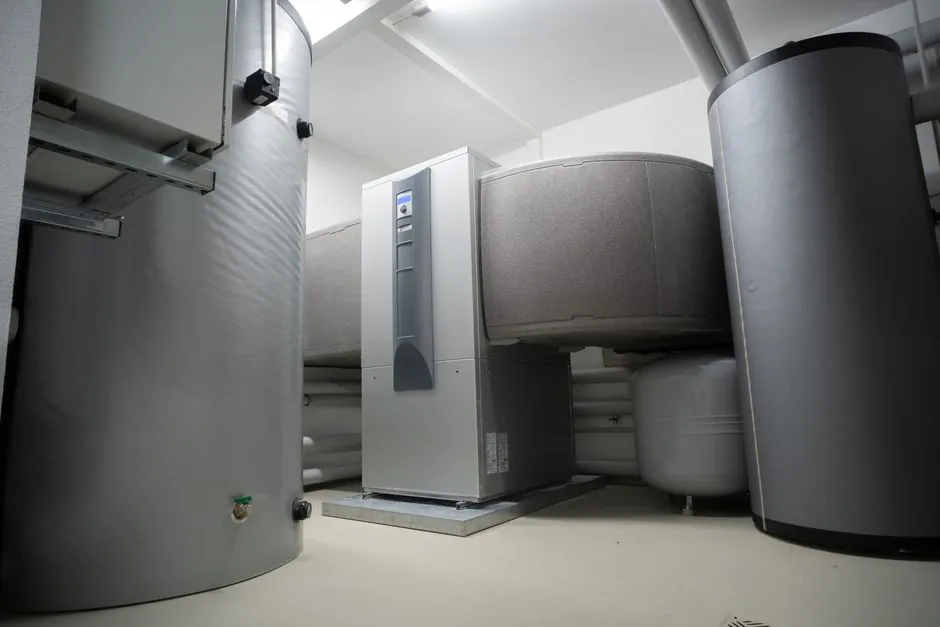
Guangdong-hosted factories dominate the air-source heat pump OEM/ODM supply base, with SPRSUN (founded 1999) listing EVI, swimming pool, hot water, and water heater variants under a single OEM/ODM service flag [S3][S5].
PHNIX operates 4 production bases with 24 production lines (2 automatic) and a 2000+ units/day capability, monitored by an MES system, and explicitly states cooperation on an OEM/ODM basis [S6].
ODM Definition and Where It Stops at the Spec Sheet
An ODM designs and manufactures to a buyer's specification envelope, owning the industrial design, internal part selection (CPU-class equivalents like inverter drives, heat exchangers, expansion valves), and back-end choices, while the buyer controls the brand, target specs, and form factor [S9].
Under ODM the brand owner fixes the user-visible spec (screen size, I/O, enclosure colour, fan curve) and leaves the BOM-level detail (transistor part number, switching frequency of any back-end converter) to the factory [S9]. In OEM, the factory builds to a fully-frozen spec handed over by the buyer, with the factory contributing almost no design opinion [S9]. PHNIX, SPRSUN, and Shanghai Venttech all list R&D capacity as OEM/ODM service on their factory profiles, meaning the same line can flip between full-build OEM and partial-design ODM depending on what the buyer brings to the table [S2][S3][S5][S6].
Guangdong vs Shanghai: Capacity, Capability, Product Mix
Guangdong-based SPRSUN lists Main Products: Heat Pump, Air Source Heat Pump, Air to Water Heat Pump, Swimming Pool Heat Pump, Hot Water Heat Pump, Water Heater, Water Tank, with sample service available [S3].
PHNIX (Guangdong) layers on house heating and swimming pool variants and runs 2 automatic lines inside the 24-line footprint, giving a step-change in repeatability for ODM runs that demand tight COP variance [S6]. Shanghai Venttech, by contrast, couples heat pumps with air conditioning, refrigeration units, chiller, condenser units, and plate heat exchangers, with main markets in North America, South America, and Eastern Europe [S2]. A buyer choosing Shanghai gets a wider HVAC portfolio under one roof; a buyer choosing Guangdong (PHNIX/SPRSUN) gets higher pure-play heat pump throughput.
Module Heat Pump Pricing and MOQ Bands, 2026

Module heat pump factories on Made-in-China.com list a 12 kW COP 4.5 all-in-one air-to-water heat pump (DC inverter optional) at US$1000-3000 per piece on 1 piece minimum order, with a 12 kW DC inverter all-in-one heating/cooling/hot water variant at 1 piece MOQ from a Foshan, Guangdong OEM/ODM factory [S8].
The 1-piece MOQ is the structural lever for ODM trials, since most European and Australian heat pump brands require only 1 unit of a custom SKU before locking a tooling or labelling run [S8]. For pure OEM, the price floor drops to US$60-1000 per set on 1-set MOQ for water-side boosting pump bodies used inside heat pump hydraulic loops, API610 Vs6 casing geometry offered alongside standard configurations [S1]. The spread between the US$60-1000 booster pump and the US$1000-3000 module heat pump is roughly 17-50x, which sets the BOM cost ratio between hydronic components and the refrigerant-side module.
Selection Criteria: When OEM Beats ODM and Vice Versa
OEM is the right call when the buyer already owns a fixed design and a certification (CE, MCS, KEYMARK, Eurovent) tied to a specific heat exchanger geometry, refrigerant charge, and inverter firmware; the factory builds to the print, the buyer's NRE amortises across volume, and the unit cost floor is lowest [S3][S6][S9].
ODM is the right call when the buyer wants a private-label unit without carrying an in-house mechanical/electrical team, accepts the factory's reference platform (inverter drive, expansion valve, fan motor) and customises only the cabinet, controls UI, and branding [S3][S6][S9]. For a brand launching its first air-to-water line, ODM collapses the 18-24 month development cycle into a 3-6 month sample-to-ship window, at the cost of being locked to the ODM's component roadmap. Smart WiFi/Zigbee thermostat OEM/ODM providers like E-TOP Controls ship OpenTherm, Zigbee, RF, and Bluetooth TRV variants, so the controls side of a heat pump can be bought as a separate ODM module rather than specified inside the heat pump contract [S4].
Comparison Matrix: OEM, ODM, and Hybrid Sourcing for Heat Pumps

OEM scores lowest on unit cost (US$60-1000 for hydraulic booster pumps at 1-set MOQ, similar low-end for refrigerant modules at higher capacity) and highest on buyer design control; ODM scores lowest on time-to-market (sample-to-ship in single-digit months) and highest on shared platform risk; hybrid ODM-plus-separate-controls (heat pump body from PHNIX/SPRSUN, thermostat and TRV from E-TOP) scores highest on integration flexibility and lowest on cross-vendor warranty exposure [S1][S3][S4][S6][S8].
The decision turns on three numbers: NRE budget, time-to-market window, and required certification ownership. Buyers with NRE under US$50k and a 6-month launch window pick ODM; buyers with NRE above US$200k, a 24-month window, and a need to own CE technical file pick OEM; buyers who need MCS or Eurovent certification in the brand's name and a fast UI iteration pick hybrid [S2][S3][S4][S6][S8]. For process engineers specifying centrifugal pumps inside the hydronic loop, the OEM route keeps pump selection under the brand's spec; for heat treatment furnace integrations that reuse the heat pump's waste heat, ODM keeps the heat exchanger side flexible.
Limits, Failure Modes, and Where the Sourcing Model Breaks
The ODM model breaks when the buyer's required refrigerant (R290, R744, low-GWP blends) sits outside the factory's reference platform, because the heat exchanger, compressor, and safety chain all change together and the ODM's NRE amortisation collapses [S3][S6].
The OEM model breaks when the buyer's volume is below the factory's economic run (PHNIX's 24 lines are tuned for hundreds of units per SKU per month, not dozens), since per-unit tooling amortisation can push the factory's quote above the ODM retail price [S6]. A common failure mode is the brand that signs an OEM contract, realises after 6 months that the inverter firmware and UI need continuous iteration, and is then contractually locked out of the controls codebase that the ODM retains. Specifying the controls layer separately, as E-TOP does with its Zigbee/OpenTherm/RF thermostat catalogue, removes that lock-in for the UI half of the system [S4].
Track the next data point: a published PHNIX or SPRSUN 2026 catalog update that pins a per-SKU MOQ, certification file list, and refrigerant option table, and a Made-in-China.com refresh of the 12 kW DC inverter module band below US$1000/piece, which would re-set the ODM price floor for residential monobloc units. For a deeper dive on the production-line side, see Heat pump manufacturing equipment: a spec-driven line selection guide, and for the hydronic pump pairings inside the loop, Hydraulic pump suppliers 2026: Chinese OEM landscape and spec bands mapped.
For the relevant spec sheets and selection criteria, see additive manufacturing material.