Heat treatment furnace installation starts with three hard numbers: chamber volume, maximum continuous operating temperature, and atmosphere class (air, inert gas, vacuum). The Carbolite Gero CWF bench-mounted chamber line lists five capacities — 5 L, 13 L, 23 L, 36 L, 65 L — and four maximum-temperature tiers at 1000 °C, 1100 °C, 1200 °C, and 1300 °C, with overall widths spanning 375-780 mm, heights 800-1245 mm, and depths 485-945 mm [S1].
On the industrial end, Made-in-China lists 198,318 heat treatment furnace SKUs across 8,263 suppliers in March 2026, with vacuum sintering models ranging US$22,266-US$200,393 per piece and induction melting furnaces reaching US$1,000,000 per set, while entry-level LPG gas-cylinder heat treatment lines sit at US$28,000-US$72,000 per piece [S3]. Sizing the utility drops (gas pressure, kW, exhaust CFM) to the chosen class is what separates a clean first-fire from a six-week rework.
Spec-First Selection: Match Workpiece, Atmosphere, and Temperature Class
Lab-scale chamber furnaces use free-radiating wire-wound elements on alumina carriers, with low thermal-mass insulation and a vertical-lift door that keeps the hot face away from the operator [S1]. That geometry suits analytical work — thermogravimetric analysis, loss-on-ignition on cement, lime, calcined bauxite — where sample mass must be read during the ramp, so the CWF-BAL ships with an integral balance that runs independently of the furnace controller [S1].
Industrial atmosphere or vacuum furnaces cover a different envelope. SECO/WARWICK's 2026 product tree groups them into Vacuum Furnaces, Atmosphere Furnaces, Aluminum Furnaces, Controlled Atmosphere Brazing of aluminum, and Vacuum Metallurgy, with separate service lines for Insulation Replacement, Upgrade of Furnace Heating Chamber, Modernization of Heating Systems, and Heat Recovery [S2]. Picking a furnace type without naming the atmosphere target is the most common spec error; a vacuum metallurgy line cannot be downgraded to an air-atmosphere annealing cell without re-engineering the hot face, the seal package, and the exhaust train. For foundational definitions of furnace classes, see the heat treatment furnace reference page.
Site Readiness: Clearances, Floor Load, and Utility Drops
Bench-mounted chamber units only need a stable lab bench with 100-150 mm rear clearance for the chimney exhaust and at least 750 mm front clearance for full door travel; the tallest CWF configuration at 1245 mm height plus chimney still fits through a standard 900 mm laboratory door [S1]. Hard-wearing alumina element carriers and easy-access element panels mean a single technician can swap heating elements without disturbing the refractory brick, which shortens planned maintenance windows from days to hours [S1].
Industrial cells demand heavier site work. The Chinese LPG gas-cylinder heat treatment furnace listed for US$28,000-US$72,000 ships with a 4 kW / 5.5 kW motor option, 75 PCS/hour productivity, and a horizontal steel-cylinder hearth, so the foundation must be sized for the loaded weight plus the quench-tank surge volume at full throughput [S3]. Vacuum sintering models from the same supplier pool need a dedicated roughing pump location, a leak-rate acceptance test, and a water-cooled heat exchanger loop rated for the maximum kW draw across the heating element bundle [S3].
Atmosphere and Exhaust: Combustion Air, Fume Chimneys, and Inert Gas Purging
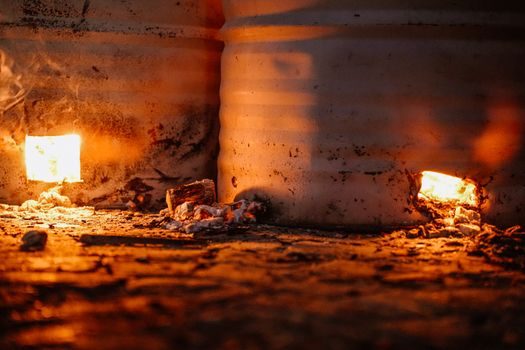
Combustion-air management starts at the door. The CWF-B variant adds air inlet holes in the door plus a tall chimney to accelerate fume removal — relevant for ashing applications where organic matter must be fully oxidized before the weighing step [S1]. For inert or reducing atmosphere work, the same bench footprint still applies, but the gas train (rotameter, pressure regulator, oxygen probe) becomes the critical path, and a delayed-start / process-timer function is a standard feature on the Carbolite Gero 301 controller to coordinate the purge cycle with the heating ramp [S1].
On vacuum or partial-pressure lines, graphite-heater vacuum heat treatment furnaces ship with stainless-steel hot faces and require a separate inert-gas manifold for backfill cycles [S3]. A typical acceptance test is a 24-hour hold at the maximum continuous operating temperature while monitoring element resistance drift; if resistance shifts more than a few percent the heater bundle is suspect and should be replaced under the 1-year warranty window that dominates this category [S3]. For a side-by-side look at crucible-style and continuous-belt configurations, the crucible furnace entry covers melt-deck geometry.
Controls, Safety, and First-Fire Acceptance
Every laboratory chamber unit in this class uses a single-ramp-to-set-point controller with a process timer and delayed start, which is the minimum useful feature set for repeatable heat treatment cycles [S1]. The CWF controller integrates with an external balance via RS-style comms so weight-change curves can be logged against the temperature program, useful for LOI and TGA compliance work [S1].
First-fire acceptance on industrial furnaces should follow a documented three-step gate: cold insulation resistance check on every heating element, vacuum leak-rate test below the OEM-specified mbar·L/s threshold for vacuum units, and a loaded burn-in at maximum temperature with production representative fixtures. The induction melting furnace category lists CE and ISO certification, a vertical placement style, and an electric fuel class on the supplier's data card, which together define the documentation pack the installer must hand over [S3]. For continuous-melt shops, the cupola furnace page lays out the comparative refractory wear profile.
Cost Stack and Sourcing Signals (2026 Baseline)
The 2026 Chinese export price band for heat treatment furnaces clusters into three tiers: entry-level industrial ovens and small chamber units at US$1,200-US$3,000 per set with electric or LPG fuel, mid-tier gas-cylinder lines at US$28,000-US$72,000 per piece, and high-end vacuum or induction systems at US$22,266-US$1,000,000 per piece depending on hot-face material, vacuum class, and heater type (resistance, graphite, induction) [S3]. After-sales service ranges from online-only support on the smallest units to free-lifetime and 24-hour on-line coverage on the larger vacuum and induction systems, and warranty is consistently 1 year across the surveyed supplier set [S3].
SECO/WARWICK's service catalogue in 2026 lists ECO-MODE, Insulation Replacement, Upgrade of Furnace Heating Chamber, Modernization of Heating Systems, Heat Recovery, Cold Production, and Special Production as separate line items, which means an existing furnace owner can usually buy a modernization path instead of a full replacement — a useful signal when the capital budget is tighter than the energy-savings target [S2]. The supplier pool on Made-in-China for push-board ceramic kilns lists CE and ISO certification, 1-year warranty, and a horizontal structure at US$4,000 per piece, useful as a sanity-check baseline for small-batch advanced-ceramics work [S3].
Limitations and When to Replace Rather Than Repair
Repair makes sense when the failure is on a consumable element bundle, the controller, or the door seal — all of which Carbolite Gero designs for in-house access on chamber units, and which SECO/WARWICK lists as standalone service line items for industrial cells [S1][S2]. Replace the furnace when the hot-face refractory is cracked through, when the vacuum vessel fails a helium leak test repeatedly, or when the heater bundle drifts more than the OEM tolerance on a loaded burn-in [S1][S3].
A practical installer checklist before first-fire: confirm floor load rating for the heaviest configuration, verify gas train pressure and rotameter calibration, validate the chimney draft against the furnace's CFM rating, log the cold insulation resistance of every element, and capture a baseline thermography map of the shell at setpoint. The combined chamber and atmosphere guidance on the heat treatment furnace page complements the heat detector entry for over-temperature interlocks. Tracking signals: 2026 supplier price index on Made-in-China for vacuum sintering models, and any 2026 ECO-MODE retrofit announcements from SECO/WARWICK's service catalogue [S2][S3].
For related coverage, see Optical Glass Types and Classifications: A Spec-First Map for Engineers.