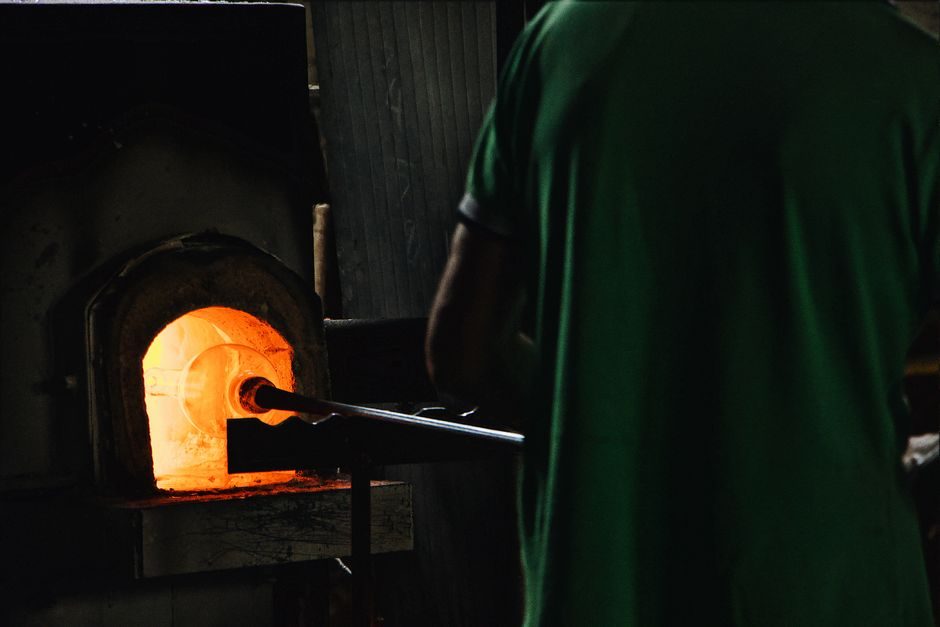
A 2026 selection decision on an industrial heat treatment furnace is governed less by brand than by six binding engineering parameters — atmosphere class, peak temperature, quench integration, workload geometry, utility/footprint, and the control/standards envelope — and these are typically locked before vendor RFQs are issued [S1][S2].
SECO/WARWICK positions itself as a single-source supplier spanning atmosphere, vacuum and aluminium process lines, while Beacon Machinery sells matched work-handling accessories (retorts, baskets, fixtures) as the supplier's scope widens beyond the furnace shell [S1][S2]. Heat-treatmentfurnace.com lists the repair, retrofit and thermal-consultancy layer that most buyers need once an asset reaches 8-15 years of service [S4].
Spec Gate 1: Atmosphere Class and Workload Chemistry
Atmosphere is the first filter: air-fired box furnaces suit non-critical annealing of carbon steel; endothermic-gas (endo) generated atmospheres, typically ~20% CO / 40% H₂ / 40% N₂ balance, are the baseline for gas carburising and neutral hardening; nitrogen-methanol or pure-nitrogen/methanol blends dominate greenfield European plants because methanol cracking in situ avoids stored endo gas [S1].
For tool steels, die steels and stainless parts requiring oxide-free surfaces, vacuum furnaces running at 10⁻³ mbar-class partial pressures of N₂ or Ar are the dominant choice, with hot-zone graphite or molybdenum reflecting the 1100-1300 °C envelope [S1]. Salt-bath furnaces remain a niche option for tool-steel hardening where rapid, uniform heating of complex geometries is required, but the salt-disposal burden excludes them from most EU greenfield sites [S1].
Spec Gate 2: Peak Temperature, ΔT and Heating Element Class
Peak temperature is non-negotiable.
Workload ΔT (the temperature uniformity envelope across the working zone) is the contractual number: ±5 °C at 850 °C is typical for sealed-quench batch furnaces meeting AMS 2750 Rev. E class 1 or 2 requirements on aerospace work; ±10 °C is the common commodity-furnace baseline; ±15 °C is the threshold above which metallurgical consistency on thin case-depth carburised gears becomes a scrap risk [S1].
Spec Gate 3: Quench Integration and Media
Quench is where most line stoppages originate. The three structural options are: (a) separate chamber furnace with manual transfer, the cheapest first cost and the longest cool delay, usually 8-30 s; (b) integral-quench sealed furnace with internal elevator or drawer quench, transfer ≤5 s, the industry default for alloy-steel aerospace and gear work; (c) continuous mesh-belt or roller-hearth with integrated oil or polymer quench tank, the throughput default for high-volume carbon-steel case hardening [S1].
Quench media is a separate decision: fast-quench oil (10-15 s to reach martensite start on 4140), water for plain-carbon low-hardenability steels, and polyalkylene-glycol (PAG) polymer at 5-20% concentration for distortion-sensitive parts where cooling rate sits between oil and water [S1]. Vacuum furnaces almost always pair with high-pressure gas quench (N₂ or He at 6-20 bar) rather than liquid quench, which is why holding furnace and crucible furnace lines cannot substitute for vacuum hardening on M2 or D2 tool steels [S1].
Spec Gate 4: Workload Geometry, Throughput and Heat-Mass Index
Workload geometry is the line-design driver. A pit furnace handles shafts, rolls and long cylinders; a top-loading bell furnace suits coils and large ring gears; a sealed-quench batch furnace handles discrete gears and tool-steel dies up to ~600 kg per load; a mesh-belt line processes washers, small pins and fasteners at 200-500 kg/h; a roller-hearth or pusher line serves plates, rings and large case-hardened shafts at 1-5 t/h; a rotary-hearth serves heavy forgings and large ring gears where footprint economy matters [S1][S2].
The first sizing question to lock is the Heat-Mass Index — work mass (kg) divided by effective working-zone volume (m³) — and a useful 2026 rule of thumb is that this index should sit between 200 and 600 kg/m³ for sealed-quench batch furnaces, dropping to 100-200 kg/m³ for low-density continuous-belt loads and exceeding 700 kg/m³ only on purpose-built pusher or rotary-hearth lines [S1]. Mismatching workload to chamber size is the most common reason for ±20 °C-plus uniformity failures on retrofit installations [S1].
Spec Gate 5: Controls, Instrumentation and the Standards Envelope
The 2026 controls baseline on any new heat treatment furnace above 100 kW is PLC + HMI with recipe management, USB/Ethernet recipe transfer, paperless chart recording, and at minimum over-temperature protection per IEC 60519-1 and IEC 60519-2 safety series for thermal electro-processing equipment [S1].
Sensor and instrumentation choices matter as much as the chamber itself: type-K and type-N thermocouples cover the bulk of the 0-1200 °C envelope; type-S and type-R platinum-rhodium serve 1200-1600 °C; type-B serves above 1600 °C; oxygen probes (zirconia-cell) are the standard add-on for endo-gas and nitrogen-methanol carbon-potential control, typically held at 1.0-1.2% C in boost carburising and 0.8-0.9% C in diffuse [S1]. Buyers specifying aerospace work should call out AMS 2750 Rev. E (the controlling pyrometry standard for US aerospace heat treatment) and CQI-9 (the AIAG heat-treat system assessment) as contractual documents on the RFQ, with the furnace supplier providing a SAT and a TUS (temperature uniformity survey) at nine points per zone before acceptance [S1].
Spec Gate 6: Utility, Footprint, Emissions and Cross-Reference to Adjacent Assets
Utility envelope is the gate most often missed on greenfield layouts. A 1 t/h sealed-quench carburising line typically pulls 800-1200 kW of electric heating plus 300-600 kW of cooling-tower and quench-oil-cooler load, requires ~80-120 Nm³/h of endo carrier gas or nitrogen, and occupies 18-25 m × 6-8 m of floor area including the loader and washer — buyers pairing a new induction furnace for melting upstream should plan the upstream power-quality budget (harmonic filters, capacitor banks) at the same time [S1].
Emissions and end-of-pipe treatment: endo-gas generators emit CO, NOₓ and unburnt hydrocarbon at the stack and almost always require a thermal oxidiser sized at ≥760 °C with 0.5-0.8 s residence time; oil-quench tanks need a mist eliminator and an after-cooler; salt-bath furnaces fall under the EU Waste Framework Directive for spent neutral salt disposal and are increasingly excluded from EU permit reviews [S1]. ATEX zoning applies inside any atmosphere furnace where endo gas or ammonia-based nitrocarburising atmospheres can leak; IEC 60079-10-1 area classification typically puts the loading vestibule and the endo-room in Zone 1, the furnace vestibule in Zone 2 [S1].
Decision Matrix: Batch vs Continuous, Atmosphere vs Vacuum, Fuel-Fired vs Electric
Buyers who have locked specs 1-4 typically score the remaining three structural options against a Pugh matrix on these criteria — first cost, throughput per m² of floor, atmosphere flexibility, scrap risk on distortion, and utility availability — and the same matrix logic used in the broader industrial buying guides for capital equipment applies: list the criteria, weight them 1-5, score each option 1-5, multiply and sum [S6].
A representative 2026 scoring against first cost, throughput/m², atmosphere flexibility, distortion control, and utility simplicity puts the integral-quench batch furnace ahead for alloy-steel aerospace and gear work under 600 kg/load, the mesh-belt continuous line ahead for carbon-steel fasteners and small parts above 200 kg/h, and the vacuum furnace ahead on tool-steel and stainless work where oxidation-free surface and tight ±3 °C uniformity are contractual — buyers specifying capital-equipment selection gates in parallel categories such as plasma cutters or sanders will recognise the same spec-gate logic applied to the heat-treat scope [S1][S6].
Failure Modes, Retrofit Triggers and 2026 Market Signals
Recurrent failure modes tracked by retrofit suppliers fall into five buckets: (1) ±15 °C-plus uniformity drift caused by degraded element resistance and refractories past 12-15 years of service; (2) atmosphere control failure from oxygen-probe drift or endo-generator catalyst poisoning; (3) quench distortion from contaminated oil with water ingress above 0.5% by mass; (4) door-seal and fan-shaft leakage on sealed-quench units causing decarburisation; (5) PLC obsolescence — any Allen-Bradley SLC 500, Siemens S5 or older S7-300 retrofit typically triggers a full controls upgrade [S1][S4].
The heat-treatmentfurnace.com service offering — repair, retrofit, thermal consultancy and re-commissioning — exists specifically because the average service life of a sealed-quench batch furnace is 15-20 years and a controls-only retrofit at year 10 typically recovers ±3-5 °C of uniformity and extends asset life by 8-10 years at 25-35% of the cost of a new line [S4]. Beacon Machinery's matched retort, basket and fixture scope illustrates the second-tier spec gate: a furnace is only as repeatable as the work-fixturing that loads it, and buyers who omit the fixture specification from the RFQ typically lose more parts to distortion than to furnace control drift [S2].
Buyers tracking the 2026 segment should monitor two verifiable signals: (1) EU endo-gas generator replacement with nitrogen-methanol on greenfield sites, an unmistakable shift driven by carbon-footprint accounting under CSRD reporting; (2) the rising retrofit share of supplier order books, which both Beacon Machinery and heat-treatmentfurnace.com explicitly target, indicating that the European installed base is now in a replace-or-retrofit decision window through 2030 [S1][S2][S4].