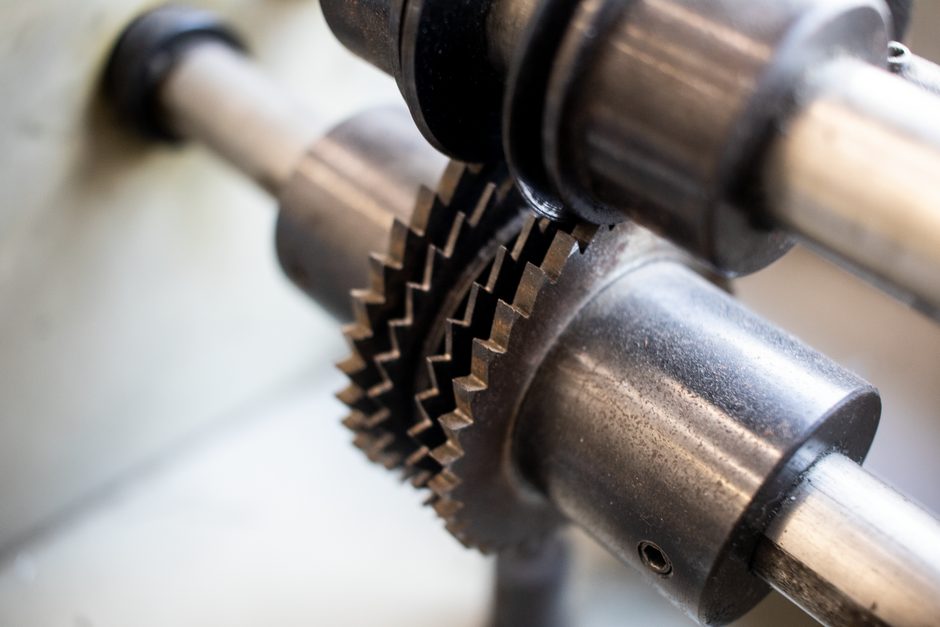
Specifying a helical gear reducer in 2026 means choosing first by torque class — 0.5-1 kNm light-duty, 2-5 kNm mid-duty, and >10 kNm heavy-duty — and only then by ratio, mounting, and ATEX status, because the gearbox's structural size and shaft diameter are set by torque before anything else [S1][S2][S3].
The catalog spread in mid-2026 is wide: MOTOVARIO's H series covers single-, two- and three-stage units above 10 kNm with parallel-shaft or hollow-shaft output and ATEX variants [S1]; Renold's SMX is a shaft-mounted parallel-shaft unit rated above 10 kNm with 0.36-287 kW input and 10-400 rpm output [S2]; FIMET's PE-A serves the 2-5 kNm range as an aluminium shaft-mounted unit coupled to 33 kW class motors [S3]; Galbiati Group's cement-mill drives run above 10 kNm at 750 rpm with 3.3 kW input [S4]; and BEZARES' 603799 is a high-power reversible solid-shaft parallel-shaft unit rated 500-1000 Nm, 97 kW max, ratio 1.11-2.92 [S5]. A helical gear reducer is, in engineering terms, a parallel-axis speed-reduction gearbox with inclined-tooth gearing; the inclined teeth give smoother meshing and higher torque density than spur gears of the same pitch.
Torque Class and Mechanical Footprint
Three torque bands dominate the 2026 industrial catalog, and each maps to a distinct housing and bearing envelope: the 500-1000 Nm band (BEZARES 603799, solid-shaft, 97 kW max, ratio 1.11-2.92) suits conveyor and agitator duties [S5]; the 2-5 kNm band (FIMET PE-A, aluminium housing, shaft-mounted, 33 kW motor coupling) targets mid-range packaged drives where mass matters [S3]; the >10 kNm band (MOTOVARIO H, Renold SMX, Galbiati cement-mill units) covers heavy process machinery and mill drives [S1][S2][S4].
Rated input power and output speed must be checked together, not separately, because they define the service factor envelope: Renold's SMX accepts 0.36 kW at the low end and 287 kW at the top while holding output between 10 rpm and 400 rpm [S2], which gives a 0.86-2740 kNm apparent torque range and tells the buyer the real working point is governed by thermal limit and bearing life, not by the catalog headline. Galbiati's 3.3 kW / 750 rpm cement-mill drive sits at the other end of the speed spectrum, where low ratio and high torque are normal [S4].
Configuration: Parallel-Shaft, Hollow-Shaft, Solid-Shaft, Shaft-Mounted
Four shaft configurations appear across the 2026 catalog, and the choice is mechanical, not commercial. Parallel-shaft with hollow-shaft output (MOTOVARIO H, >10 kNm, single/two/three-stage, flange or compact mount, ATEX option) is the standard pick for direct mounting onto a driven shaft via shrink disc or key, which saves a coupling and a foundation [S1]. Parallel-shaft with solid-shaft output (BEZARES 603799) is preferred when the gearbox must drive through a flexible coupling, a chain, or a pinion, and the 1.11-2.92 ratio window suits low-reduction auxiliary drives [S5].
Shaft-mounted units — Renold SMX for heavy loads and FIMET PE-A for shaft applications — bolt directly to the driven machine's input shaft, eliminating pillow blocks and alignment work; SMX is rated above 10 kNm for heavy-duty applications, while PE-A covers 2-5 kNm in aluminium [S2][S3]. For a deeper look at the parallel-shaft family itself, the helical gear reducer reference page lays out the inclined-tooth geometry and load-sharing behavior that these four configurations all rely on.
Stages, Ratios and Input Power Envelope
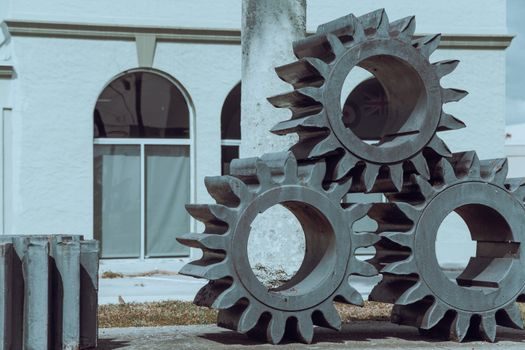
Stage count sets the ratio window and the efficiency curve. MOTOVARIO's H series ships in single-, two- and three-stage builds, which moves the ratio from low single digits into the hundreds depending on stage count, with power reaching 45 kW (61.18 hp) and a minimum gear ratio of 1.23:1 in the single-stage catalogue line [S1]. BEZARES' 603799 holds to 1.11-2.92 in a single reduction, deliberately narrow because it is sold as a high-power auxiliary multiplier/reducer [S5].
When a ratio outside the helical window is needed — typically above 60:1 or below 1.5:1 with very high torque — buyers move to a helical-bevel (right-angle) build, a worm unit for self-locking, or a cyclo (planetary) head for shock-load service. The 2026 China customs tariff index still treats "helical bevel gear reducer" as a separate HS heading from the parallel-shaft unit [S8], which matters for import duty budgeting on cross-border orders.
ATEX, Service Factor and Duty Environment
Explosive-atmosphere certification is a binary gate, not a feature toggle. MOTOVARIO lists ATEX as an available option on the H series, meaning the same mechanical platform ships in a certified variant with modified sealing, brass breather plugs, and a nameplate that matches the EU ATEX equipment directive for group II category 2 or 3 zones [S1]. Plants with combustible dust (grain, flour, wood, aluminium, sugar) or gas/vapour (paint booths, refineries, solvent handling) need the certified variant; conveyor, water-treatment and general factory drives do not.
Duty environment also drives the housing material choice. FIMET's PE-A uses aluminium to keep mass down for packaged unit builds, but aluminium casings are uncommon above 5 kNm because the casting wall grows faster than the torque rating [S3]. The Galbiati cement-mill units use cast-iron housings sized for continuous 750 rpm low-ratio service in dusty, high-vibration environments [S4]. For buyers matching the reducer to an upstream drive, the electric motor manufacturing process map is useful background: motor frame size, B5 flange and IEC input dimensions must match the gearbox input boss before ratio and torque are even discussed.
China Sourcing Landscape and 2026 Price Bands

The Chinese supply base is the price-setter for sub-10 kNm units in 2026. Foshan Xingguang Transmission Machinery, a Guangdong-based manufacturer, lists helical gear reducers, worm gear motors, cam index drives and cyclo speed reducers in its core catalog with a 1-set minimum order and T/T or L/C terms [S6]. On Made-in-China.com, Fenghua Transmission Technology (Jiangsu) Co. offers a "Durable Helical Gear Reducer for Automated Guided Carts" at US$ 312.00-447.00 with a 2-piece MOQ and RoHS contact-issuer status, while Cimo Transmission lists a Wpa/Wpo/Wps worm/helical 40-300 frame at US$ 10.00-100.00 with a 10-piece MOQ [S9].
Alibaba's supplier index for helical gear reducers lists a top mainland supplier with domestic-market channels at 60.0%, North America and Eastern Europe each at 10.0% as the leading export regions, and a 68.6% response rate tag [S7]. Against that spread, a >10 kNm European-built helical unit (MOTOVARIO H, Renold SMX, Galbiati) typically prices several multiples higher than the China-sourced equivalent once freight, duty and certification are added; the buyer's trade-off is lead time and ATEX/IECEx documentation depth against unit cost.
Selection Criteria Comparison Across the Four Main Builds
For a buyer's shortlist, the four catalog templates sort cleanly on four criteria. On torque: BEZARES 603799 at 500-1000 Nm is the lightest, FIMET PE-A at 2-5 kNm is mid, and MOTOVARIO H / Renold SMX / Galbiati cement units at >10 kNm are the heavy class [S1][S2][S3][S4][S5]. On shaft configuration: BEZARES is solid-shaft, MOTOVARIO H is hollow-shaft, Renold SMX and FIMET PE-A are shaft-mounted, and Galbiati's mill drive is a dedicated parallel-shaft drive output [S1][S2][S3][S4][S5]. On input power: Renold SMX spans the widest window at 0.36-287 kW, MOTOVARIO H hits 45 kW, BEZARES 603799 reaches 97 kW, FIMET PE-A pairs to a 33 kW motor, and Galbiati's cement drive sits at 3.3 kW / 750 rpm [S1][S2][S3][S4][S5]. On ratio window: BEZARES is narrow at 1.11-2.92, MOTOVARIO H goes down to 1.23:1 in its single-stage line and much higher in three-stage, and Renold SMX covers 10-400 rpm output, implying ratios across two orders of magnitude depending on motor speed [S1][S2][S5].
The economic crossover sits near 5 kNm: below that, Chinese OEM catalogs (Fenghua, Cimo, Foshan Xingguang) typically win on price for non-ATEX duties, with Made-in-China 2026 FOB bands around US$ 10-447 per unit depending on size and MOQ [S6][S9]; above that, European and Indian (Renold) suppliers tend to win on documentation, ATEX/IECEx coverage, and aftermarket bearing availability [S1][S2][S4].
Failure Modes, Limits and Buyer Pitfalls
Three failure modes dominate warranty returns on helical units, and each is set at the buying stage, not the operating stage. First, undersized service factor: a gearbox rated 10 kNm on a 16-hour-per-day, 6-start-per-hour agitator needs to be de-rated for both start/stop thermal cycling and for the peak load of the driven machine; the Renold 0.36-287 kW span on SMX exists because a single frame can be oil-bath or forced-lubrication configured for different duty cycles [S2]. Second, radial/axial load miscalculation on the output shaft: hollow-shaft shrink-disc mounting (MOTOVARIO H) imposes different bending and torque-transmission limits than solid-shaft flexible-coupling mounting (BEZARES 603799), and the driven machine's overhung load must be checked against the gearbox catalog, not the coupling catalog [S1][S5].
Third, lubrication and breather mismatching: aluminium housings (FIMET PE-A) and cast-iron housings (Galbiati) cool and breathe differently, and a reducer ordered for a clean-room conveyor then installed in a cement-mill environment will ingest dust through an inappropriate breather [S3][S4]. For ATEX units, the breather, oil plug, and nameplate are part of the certification, not accessories; substituting a non-certified breather voids the build [S1]. Buyers pairing the gearbox to downstream equipment should also confirm the output coupling or pinion is correctly matched; the gear coupling and industrial gear reference pages cover the sleeve, pinion and coupling alignment side of that checklist.
Standards, Documentation and Cross-Border Logistics
Documentation gates the import step. EU-sourced helical reducers ship with a CE declaration under the Machinery Directive, an ATEX EU type-examination certificate where applicable, and a nameplate that ties serial number to the certificate batch [S1]. China-sourced units ship with a CCC certificate path for the Chinese domestic market and typically with a CE/RoHS package on request, with RoHS status flagged as "contact issuer" on Made-in-China listings rather than guaranteed [S9]. The HS heading for a helical bevel gear reducer is treated separately from the parallel-shaft unit in the China customs index, so the buyer's import declaration must use the right 8-digit code to avoid duty misclassification [S8].
For buyers also specifying linear motion components on the same line, the linear guide and crossed-roller guide encyclopedia pages cover the rail-and-block side of the bill of materials, and the gear pump page covers the lube-oil circulation hardware often specified on forced-lubrication helical units above 100 kW input. Adjacent category references such as the harmonic reducer 2026 guide are useful only when backlash below 1 arc-minute is needed, which is outside the helical envelope; for compact low-backlash planetary units in robot joints the harmonic path is the right comparator.
The 2026 buyer's verification loop is short: confirm torque class against driven-machine peak load, confirm shaft configuration against mounting method, confirm ATEX/IECEx scope against zone classification, confirm input power and ratio against motor nameplate, and confirm HS code, MOQ and shipping terms before the PO is cut. Watch the Made-in-China 2026 price band for the 40-300 frame worm/helical hybrid at US$ 10-100 per unit with a 10-piece MOQ [S9] as the floor for low-end sourcing, and treat the MOTOVARIO / Renold / Galbiati >10 kNm ATEX-capable European lines as the documented ceiling for heavy process duty [S1][S2][S4].