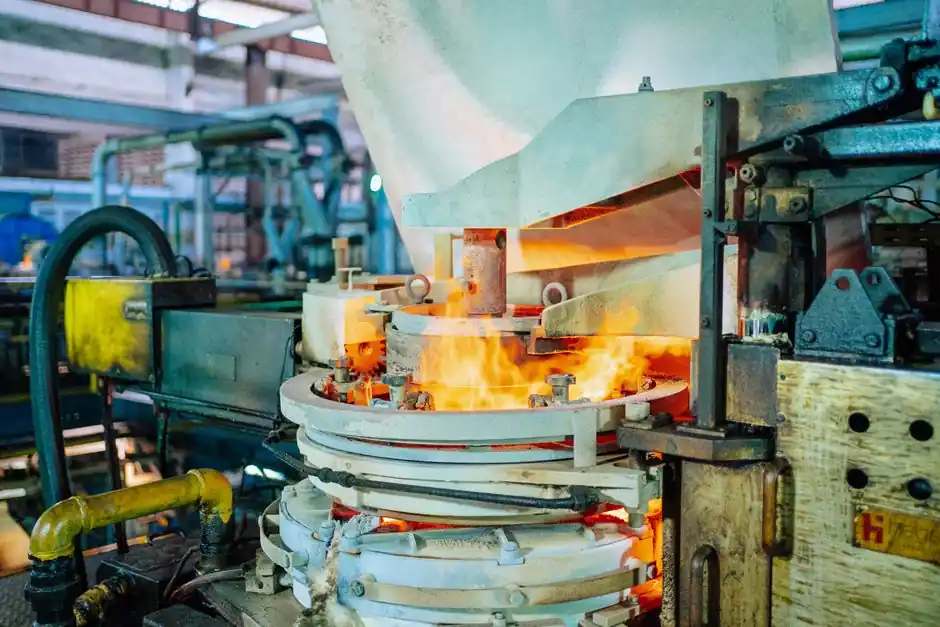
Aerospace foundries specify holding furnaces as a buffer between primary melting and precision pouring or die-casting, and the 2026 supplier market in Guangdong lists stationary melting+holding units at US$113,000 for 3+ sets and US$118,000 for 1–2 sets, FOB Foshan, with a quoted production capacity of 5 sets per month [S1].
Holding differs from primary melting in a measurable way: the bath is already at target chemistry, so the furnace's job is temperature stability, dross control, and minimal hydrogen pickup, not melt rate. The term "holding furnace" is rendered as 保温炉 in Chinese technical glossaries and is described as a fixed vessel paired with a melting shaft furnace in continuous copper-rod cast-rolling lines [S2][S4].
Alloy Class Drives the Holding Architecture
Aluminum and magnesium aerospace castings are typically processed in electric-resistance holding furnaces, where the bath is held at 660–720 °C for Al and 580–650 °C for Mg, with K-type or N-type thermocouples logging the bath and a PID loop on a silicon-carbide or MoSi2 heater bank. Aluminum-alloy electric holding furnaces are described by Guangdong suppliers as primarily applied to non-ferrous metal melting and holding, with explicit framing as a support unit for die-casting [S3].
For titanium, Inconel, and other nickel-superalloy billet or investment-cast work, the holding chamber must be vacuum or argon-purged, because oxygen and nitrogen pickup above 1–2 wt-ppm destroys fatigue life in rotating parts. These vacuum holding units sit downstream of vacuum induction melting and add US$200,000–500,000 to a turnkey aerospace melt shop, depending on charge size. Engineers comparing a holding furnace against a melting furnace should remember that holding units typically run at lower kW (15–80 kW for 250–2000 kg Al baths) because the goal is not to remelt but to offset radiation and lid-opening losses.
Selection Criteria Beyond Temperature Setpoint
Five criteria separate a qualified aerospace holding furnace from a generic foundry unit: bath temperature uniformity within ±5 °C across the full hearth, refractory-grade selection (high-alumina or fused silica for non-ferrous; graphite or zirconia for reactive metals), atmosphere control (air, inert gas, or vacuum to 10⁻³ mbar), dross or slag removal access, and a control package with redundant thermocouples and a chart recorder for AS9100 traceability. Aerospace heat-treatment specifications such as AMS 2770 (for aluminum) and AMS 2750 (for pyrometric equipment) are the documents engineers cite for thermal uniformity surveys, though they govern heat-treat ovens more than holding vessels directly. [S3]
Refractory compatibility is non-trivial: molten magnesium attacks silica-based refractories, so steel-crucible or low-silica alumina linings are specified. For aluminum, fused-cast AZS (alumina-zirconia-silica) or high-alumina (80–90% Al₂O₃) brick is standard, and bath life of 12–36 months between cold repairs is typical at 700 °C. Crucible furnaces (crucible furnace) for smaller aerospace investment shops give easier alloy changeover than large bath holding units, but at the cost of thermal mass and therefore temperature stability. A clear comparison line: a 500 kg bath holding furnace with 30 kW connected load holds ±3 °C at 680 °C, while a 50 kg tilting crucible holding furnace holds ±8 °C on the same control loop.
Who Needs a Holding Furnace, and Who Does Not
Holding furnaces are essential when melt-to-pour time exceeds 30 minutes, when chemistry is sensitive to long melt cycles (high-Mg Al, Al-Si hypereutectic, Al-Li), or when a single melt feeds multiple downstream stations (low-pressure die casting, squeeze casting, sand casting). They are not needed for small job shops that melt and pour a single charge in under 20 minutes, where a crucible furnace with bottom-pour suffices and saves capital. [S3]
Aerospace tier-1 foundries running 24/7 typically split the line into a primary melter (gas-fired reverberatory or induction furnace) and a separate holding furnace sized to feed 2–6 casting cells. Standalone holding, without a dedicated melter upstream, is uncommon in aerospace because the holding vessel's heating budget assumes an incoming molten charge at near-target temperature. The earlier industry baseline for Chinese-supplied stationary melting+holding lines shows a 5-set-per-month production run [S1], so lead time for custom aerospace-rated units (vacuum, special refractory, AMS-traceable instrumentation) typically extends 16–24 weeks from PO.
Comparison: Common Holding Furnace Types for Aerospace
Three configurations cover 90% of aerospace holding duty. (1) Electric-resistance bath holding, Al/Mg, 15–80 kW, ±3–5 °C, low capex (US$50,000–200,000), no vacuum. (2) Gas-fired radiant or immersed-tube bath holding, Al only, 100–500 kW, ±5–8 °C, lower operating cost where natural gas is cheap, but introduces water-vapor pickup that needs degassing downstream. (3) Vacuum or inert-atmosphere holding, Ti/Ni-superalloy, 30–150 kW, ±5 °C at 1500–1700 °C, capex US$300,000–800,000, required for reactive alloys. Within aluminum specifically, the gas-fired melting-and-holding pair discussed in our aluminum melting furnace field data is the common die-casting-shop configuration, while aerospace investment casters tend toward electric or vacuum holding. [S3]
Selection on cost alone misleads: a gas-fired unit at US$80,000 looks cheap against a US$400,000 vacuum unit, but aerospace specification usually locks the answer to vacuum or inert for Ti/Ni and to electric-resistance for Al/Mg, with gas-fired permitted only where the casting allows it and a downstream degasser is in the line.
Limitations and Failure Modes Engineers Watch
The dominant holding-furnace failure mode is refractory wear at the metal line, which causes iron or silicon pickup into the bath and disqualifies a heat from aerospace chemistry limits (typically Fe ≤0.15–0.25 wt% in Al-Si aerospace alloys). Secondary failures are thermocouple drift (a 10 °C drift over 6 months is common with unprotected K-type probes in magnesium-bearing melts), heater-element burnout in silicon-carbide rods at the bath-line hot zone, and lid-seal leakage in vacuum units that pulls the chamber from 10⁻³ mbar toward 10⁻¹ mbar and lets oxygen back in. A documented aerospace lesson: holding time above 4 hours at 720 °C in Al-Cu alloys like A201 drives copper-rich intermetallic settling and grain coarsening, so holding is not a substitute for casting promptly. [S2]
A 2026-07 buyer referencing the Guangdong stationary melting line should also note that the listed US$113,000–118,000 price is for combined melting+holding, not holding alone, and does not include vacuum options, AMS-traceable instrumentation, or export crating [S1]. Real aerospace holding furnaces from the same supplier tier with vacuum, special refractory, and AS9100 documentation land closer to US$250,000–600,000 installed. Comparable to the prestressing strand spec gates discussion, the spec sheet price is the floor, not the ceiling.
Sourcing, Standards, and What to Verify on a Quote
Engineers sourcing from Chinese OEM catalogs should treat list prices as FOB entry points and verify: refractory composition certificate (Al₂O₃ wt% or fused-silica equivalent), thermocouple type and sheath material, atmosphere-control spec (vacuum level in mbar, or oxygen ppm in inert purge), heating element kW and replacement part number, control system make/model, and CE/UL/ASME-stamp on the pressure boundary where applicable. A fixed holding furnace is described in the Chinese-English technical glossary as "designed to provide easy operation" [S2][S4], which is a translation of a real design intent (operator-side access for dross skimming and sampling) that should be checked on a drawing, not on a brochure.
Two trackable signals for the next procurement cycle: the post-2026 tightening of Chinese export controls on graphite and certain refractory raw materials, and the slow migration of aerospace tier-1 suppliers from 4-wire PID control to digital SCADA with per-heat data logging to satisfy AS9100D clause 8.5.1. A third reference point is the PA nylon spec gates discussion, which applies a similar evidence-density lens to a different material and confirms the same engineering pattern: list price is the floor, traceability documentation is the deciding factor. Watch for the next quarterly Made-in-China catalog refresh in the boiler-and-furnace category to see if 2026 Q3 listings separate aerospace-rated vacuum holding from generic stationary melting.